

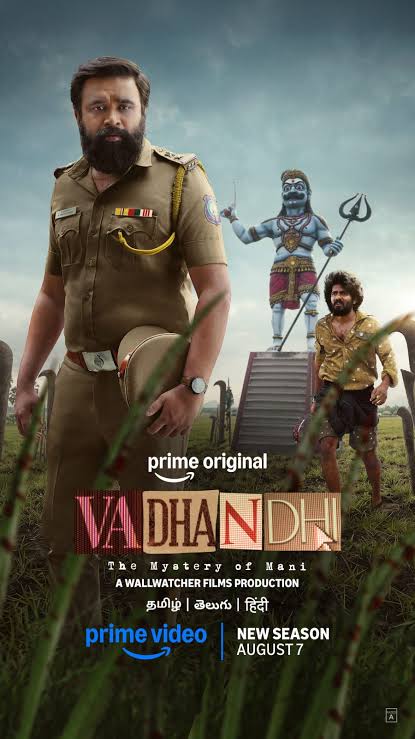
It is interesting on how the politics of the vicinity forms the fabric of the second season of Vadhandhi: The Mystery Of Mani. For instance when you are introduced to the protagonist SI Moosa (M Sasikumar), you see him in a conflict with the very system that he is a part of. He is an Investigating Officer serving a punishment posting, not because he is arrogant or disrespectful, but simply because he refuses to shave off his beard after returning from a trip in Hajj – with a hope that his wife would conceive. He is deeply religious but is also caring – and yet a part of him has a strong sense of morality that prompts him to take on his system despite his minority status, and eventually win in the eyes of the law. It tells you a very specific quality about him being righteous, a case in point that would later on have a payoff.
And yet, folks like Moosa are a part of a setting that thrives of sensationalism – another byproduct of the thriving politics in the land that forms the core premise of the show, even as a couple of sketetons are discovered from an inauguration site that pits the State and the Central Government against each other for a political conspiracy that may or may not exist. In hindsight, these minute details may seem disjointed or irrelevant without a major payoff to the main plot, but they are a vital cogs in defining the fabric of the society – one that is biased towards a minority (not necessarily based on caste or religion), and the other wanting to sensationalize the truth. Ironically, both of these traces are found in the eventual subtext of the investigation.
Written by Andrew Louis, the second season of Vadhandhi is an understated police procedural that formulates the investigative premise of the show. In a sharp contrast to some of the other shows in terms of the characterization like Brown (2026) or Search (2025), you don’t really perceive the protagonist to be grief-stricken. Instead, the only form of guilt that laces his character is with regards to the limited time that he spends with his wife Sumaya (Aparna Das), given that he is assigned the investigation following the discovery of the skeletons.
This dynamic forms another contrasting companion piece to the one with his superior SP Rathika (Anagha LK) who shares a thorny relationship with her husband Sukumaran (Arjun Nandhakumar). The contrast isn’t entirely coincidental but a definite meeting point of two similarly tempered characters – one fighting a minority discrimination while having to carry out his duty away from his family, and the other, a form of casual patriarchy carrying out her duty as a form of escapism from her husband, only to join forces in order to crack the case.
In a flashback, you are also acquainted to a Jallikattu champion Mani (Yashwanth) who is courted by a local village girl Nilavathi (Revathy Sarma), even as classism forms an interesting dynamic in their discrete relationship. Ironically, it is Mani who finds himself to be a chief suspect in the current timeline, refusing to utter a single word in the court of law, thereby reaffirming his supposed guilt-stricken status to everyone involved. His silence isn’t incidental either – almost doubling up as a social (and political) metaphor of fear with regards to the society, a small extension of the times we find ourselves in today.
The events remain immersive, often giving you a steady glimpse of the two timelines at the start, without losing focus on the police procedural that defines the pacing of the narrative. The idea is really to go from point A to point B, and that journey remains pretty intense and twisted – with every clue leading to a fresh discovery or a potential dead end. I must admit that on the flipside, the writing does get partly convoluted in the middle – almost clouding the ongoing investigation with multiple subplots and characters that had me challenging my attention span (and luckily, I sailed through it pretty ably; but I get the criticism around it). But fortunately, the pacing doesn’t suffer – even as the screenplay maintains a brisk pace, despite one diversions too many.
The twisted nature of the investigation definitely comes to life, amidst a brief and fleeting commentary on the hierarchies prevalent in the police department, along with the role of the social media in skewing the clues during the investigation. It is also impressive on how the ‘mystery’ is kept alive right until the final moments of the final episode – even as the writing teases its viewers into guessing a puzzle that amounts to infinite possibilities. I would have also liked a little more pronounced commentary on the political landscape of the land that didn’t substantially connect to the main plot (apart from the general inferences). This, along with the final revelation that was shocking (but needed a stronger call back from a characterization POV in order to connect the dots). That apart, the screenplay is a visceral investigative thriller that will keep you invested throughout the narrative.
The dialogues are brewing conversations that double up as key revelations, while keeping the needle of the investigation ticking throughout. The BGM doesn’t overpower the narrative while deftly making its presence felt at a few pivotal moments in the narrative. The cinematography comprises of frames that ably define the fabric of the drama through its dusty locations with a frequent greyish tint. In fact the latter creates a sense of atmosphere that is immersive and twisted, two key traits that define the drama. The frames are also meticulous in defining the emotional plight of the characters, something that acts as an alternate dimension to the ongoing investigation in play.
The editing pattern was an ambitious proposition on paper, given how the drama unfolds across two timelines, while frequently having to cutaway from the investigation without allowing the viewers to feel disconnected. And although the proceedings get marginally convoluted in the middle, the editing pattern still does enough to hold the narrative – keeping your interests alive in the proceedings. Director Andrew Louis offers a visceral outlook to his investigative narrative, doing enough with the characterization but thriving on measured chaos that drives the proceedings. There is a rhythmic tone to the narrative that is immersive and enough to pique your interests, although there is a brief stumble in the convoluted middle. Nevertheless, the direction still holds well and sees things to a shocking conclusion, thereby ensuring that it is a green tick in the report card of the filmmaker.
The performances are pretty solid by the members of the ensemble cast. Varshini Karmegham as Poorni, Ajith Koshy as the police commissioner and Lathika Balamurugan as Sangeetha have their moments to shine. Deepikka Anand as Venba and Revathy Sarma as Nilavathi are interesting characters that offer a strong emotional core to their proceedings with their impeccable performances. And both of them are impressive to witness here. The same applies to Geethi Sangeetha as Sundaresan’s mother, and she comes to life at pivotal moments in the narrative. Arjun Chakkaravarthy as Sundaresan and Vasanth Kannan as Praba are epitomes of youth dangled in the realms of the chaotic big bad world, and both of them offer steady moments of restrain throughout the narrative.
Arjun Nandhakumar as Sukumaran is a layered character, almost insecure of his wife’s success while also presenting a caring and righteous demeanor when asked for help. And he ably balances these two virtues of his character, while putting forth a competent act. Anagha L.K. as SP Rathika is sincere and earnest while offering an understated virtue of compassion. She uses her posture and body language to great effect while delivering a palpably understated performance.
Vivek Prasanna as Ramar is assured in the lighter moments of the narrative, without going overboard with them. He does offer restraint that doesn’t allow the tonal deflections of his character overpower the overall tone of the drama. Aparna Das as Sumaya is pretty earnest in her performance, being a quiet pillar of strength and understanding for her husband Moosa. Yashwant as Mani is yet another layered character who would appear to be in the mould of an alpha male at specific instances in the narrative on the lines of Arjun Reddy or even Pushpa, but gently transitioning into a silence of acceptance that flags the maturity of his character. The grey shades of his persona are enough to raise doubts of his purpose, while also empathizing with him – a wonderful duality that keeps the investigation ticking. He was a joy to witness here.
The show though belongs to M Sasikumar who is yet again wonderful to witness as Moosa. There is a searing conflict of identity and his rights that defines his persona, without allowing these qualities to transform into a bitter person. There are dollops of morality and righteousness that define his character, even in testing pivotal moments of investigation that require him to dig deeper into his conscience. And yet, his understated presence along with his ability to showcase a sense of unusual warmth to people around him (even when they are at fault; like never losing his head in a scene even as his subordinate breaks a specific rule), makes for an affable act that has you rooting for him throughout.
Despite a slightly convoluted middle, the second season of Vadhandhi delivers an engaging investigative drama deeply woven into the social and political fabric of society. The series masterfully maintains its dark, twisted undertones while anchoring the mystery in resonant cultural themes. Driven by solid performances, the narrative quickly overcomes its pacing missteps with intense emotional stakes that propel the drama. It may not always be groundbreaking but this gripping blend of gritty social commentary and suspense makes for a compelling thriller that is well worth your time. Available on Amazon Prime Video.


