

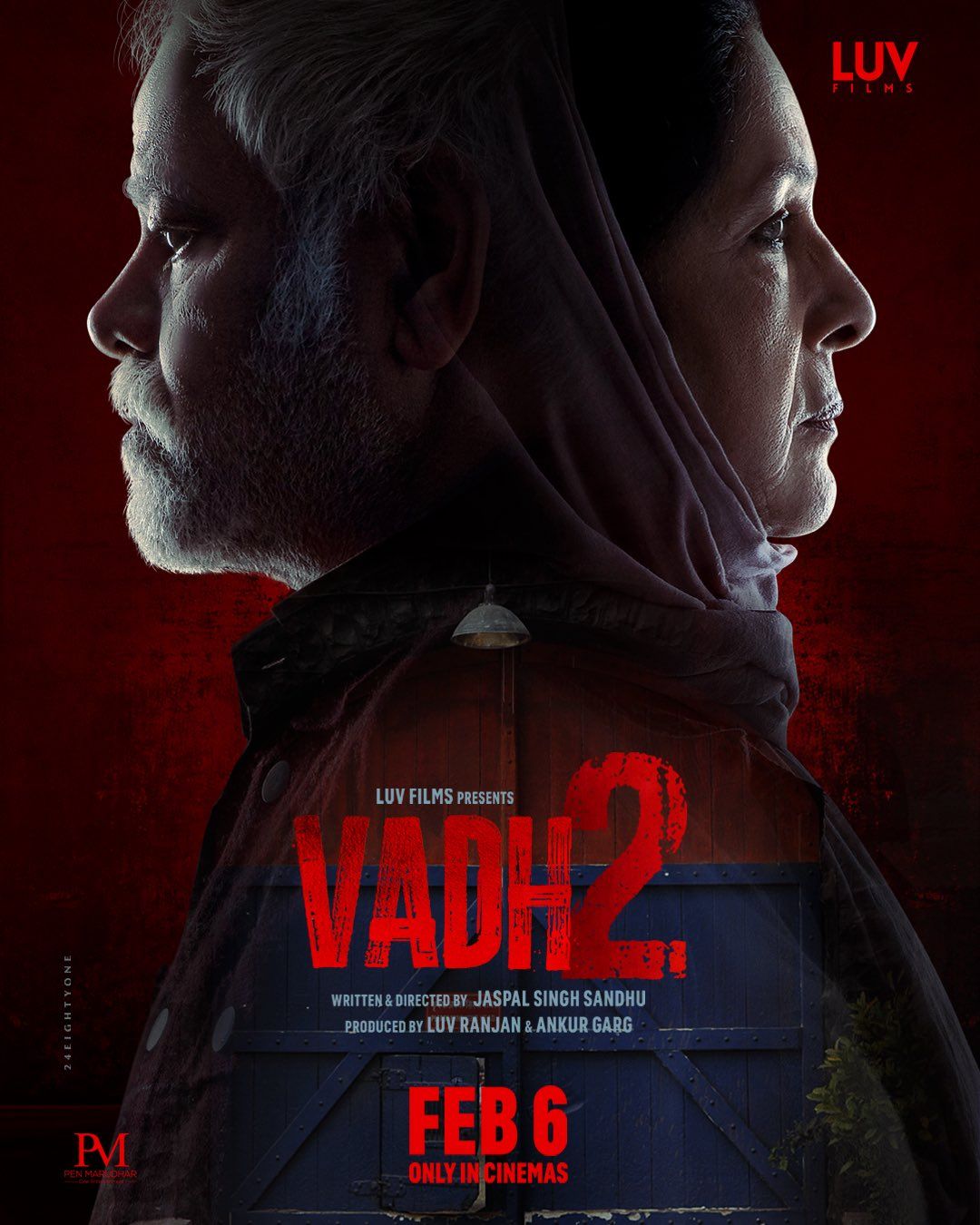
The cold open of Vadh 2, a spiritual sequel of the 2022 film Vadh has shades of the Malayalam film Mathilukal (1990) infused in the narrative. The scene features the two low-key protagonists Shambhu (Sanjay Mishra) and Manju (Neena Gupta) sharing tender moments of joy whilst being separated by a jail wall. Shambhu is a constable, Manju is an inmate – and their potential love story is woefully marred by a prison sentence that has aged like the two protagonists in question. She doesn’t want to leave owing to uncertainty in the real world, and he is content on narrating his life story involving his son who is settled in the US and doesn’t give attention to him. It is a story laced with a tragedy of fate, or even on the grounds of the rotting nature of the society – wherein the wall between the them is an integral character, both metaphorically and literally speaking. And it is interesting on how the crime that had actually occured in Vadh (2022) remained an anti-thesis of the couple separating here. The fight then was to stay together despite the crime being committed, the fight here remains to reunite after years of oppression.
Written by Jaspal Singh Sandhu, Vadh 2 ably explores the moral ambiguity of the characters that are steadily introduced in a narrative that pays a compelling homage to the neo-noir crime genre. Whilst the scene preceding the cold open presents a deliberate foreshadowing of the crime that would soon be committed – meticulously introducing the arnaments in play, it also serves as a reminder of the rotting system that ties the characters together. For instance, Shambhu is forced to make a living by selling vegetables that he smuggles from the prison. You can see that he is burdened by regret, but at the same time the alcohol that he consumes doesn’t necessarily compliment his baggage. The grey shades are for everyone to see.
Even when you are introduced to some of the characters, the moral ambiguity stays. Naina (Yogita Bihani) is a 22 year old girl falsely trapped in a fradulent case while being forced to spend time in jail; Rajni (Shilpa Shukla) remains a shady female warden who quietly ‘caters’ to the needs of a powerful criminal Keshav (Akkshay Dogra) residing in the jail premises. Keshav remains an extremely dark character with no remorse – in a scene, you see him killing puppies for fun; in another you see him demanding a lawyer character to delay the bail application of Naina just so that he could spend the night with her. The greyness in the drama also extends to SI Prakash Singh (Kumud Mishra) who has a heavy caste-bias and isn’t a very likeable figure when you are first introduced to him. But in a scene when he is pitted against Keshav, your loyalties almost switch ably towards his character. The writing remains an interesting mix of loyalties and ambiguities with respect to the characters in fray.
Given the over-exposure of the crime thrillers consumed these days, you can almost sniff the predictability of the drama after a character randomly disappears. But it is here also that the writing chooses to test your alertness, by deliberately serving you clues that would further fuel your bias. In between, the subtext remains an interesting talking point too with respect to the social commentary of the drama – the hierarchies of the rotting police department are tested even as there remains an attempt to cover-up the crime, an oblivious Muslim character becomes the first point of contact for the investigation headed by Ateet Singh (Amitt K Singh), and soon the needle of suspicion begins to point to Shambhu – a character who seemingly forms a warm bond along the way with Ateet.
The predictability of the investigation although deliberate, cannot be overseen here given how maximum time in the drama is alloted to the investigation that appears to be as clear as light and day for the most part. This is true particularly in the second hour when the picture starts to get clearer, and the narrative unfolds in a linear pattern – with every character spilling the beans only for the next subsequent character to take over. I am still holding onto the card of this being ‘deliberately’ done, but your expectations slowly begin to recede here in the garb of predictability. Having said that, the writing never loses sight of the moral ambiguity of the characters, some who are reduced in the background while treading on their familiar path of longing.
For instance, you just know where the drama is headed with respect to the suspects, even whilst being fully aware of the exit mechanism employed by a certain character. But when the beans are actually spilled, the writing hinges on a strong recall value of a crime that was committed at the start of the film in its prelude, while linking its presence in the modern setup. In the same breath, it reinforced the bond between two characters who once again had their roots at the start of the film.
The subtext of the rotting practices of the society and the system also circle back to this moment, making the finale layered and memorable in many ways. And here is where the ‘deliberate’ nature of the writing is reinforced too – to lower your guard in the wake of predictability, and gently slip in another angle. This is a rarity in Hindi films at the moment wherein the writing is designed to aim at the lowest hanging fruit. In that sense, the screenplay here is wonderfully well penned while flaunting the neo-noir techniques pretty well.
The dialogues are profound in many ways, while always sticking to the gritty tone of the drama. And through the lines, the context of the title is all the more justified – with Vadh not standing for killing but executing, a term often used in prisons for inmates. Ironically, the setting in this regard remains a paradox too. The music and BGM don’t overpower the drama at any point, while gently nurturing the noir elements in this crime drama. The same can be said about the cinematography wherein the shades of grey representing the scenes of the prison can be directly correlated to the corrupt and grey minds of most characters in the fray suffering from bouts of moral ambiguity.
The editing pattern is decent although certain moments of blackout designed to heighten the tension felt like a distraction more than anything else. Director Jaspal Singh Sandhu meticulously designs his world with broader shades of grey while intrically focusing on the moral ambiguity of his characters, which remains a consistent theme throughout. His biggest asset remains on his ability to stick to the gritty tone in the drama without deviating to some of its lighter counterparts. The grip in the narrative is maintained even when the drama wants you to hinge on its wave of predictability, before delivering a final blow at the end. This remained a masterful piece of direction, a rarity in times today.
The performances are wonderful by the members of the cast. Nadeem Khan as Nadeem has his moments to shine while being an important cog in the narrative, in a character designed to be at the receiving end of a social bias. Shilpa Shukla as Rajni explores the grey shades of her character with a lot of grit, almost masking her vulnerability and remorse with a tough exterior. Akkshay Dogra as Keshav is menacing and his antics will definitely send a shiver down your spine. In a scene, I had my mouth covered while fearing the worst, an event that will continue to haunt me for days. Yogita Bihani as Naina plays beautifully with her expressions that exude of the pain and angst of her character, whilst never losing sight of her innocence. She was a treat to witness here.
Kumud Mishra is such a fine actor that words often fall short of his brilliance. Here as SI Prakash, he had to tread on a razor sharp path of being morally upright without losing sight of his caste bias. This automatically made his character layered and complex, and it then became a game of his expertise to nail the character with a spectacular performance. Amitt K Singh as Ateet remains sincere and earnest while putting forth a compelling act. A character being at the receiving end of the treacheries of the system, Amitt holds his own here and delivers a solid act.
Both Neena Gupta as Manju and Sanjay Mishra as Shambhu are such stupendous performers who often remain unassuming yet supremely effective with their performances. In a way, the predictability of the drama was linked and deliberately designed for both these actors simply because they have the ability to switch intensities, and slip in the background. Make no mistake – they remain the protagonists of the show here, and the unfulfilled love story at the start deserves a story of its own. But this is also where the unassuming nature of their performances comes into the picture. There is a searing sense of resentment and longing lacing their respective performances, veiled in a sea of moral ambiguity that make their characters work. Both of them are brilliant to witness here while putting forth incredibly restrained and masterful performances.
Boasting of solid performances, Vadh 2 springs one of the most pleasant surprises early in 2026. It remains a drama ably exploring the moral ambiguities of the characters in a compelling neo-noir thriller that makes for a wonderful watch. Available in a theatre near you.


