

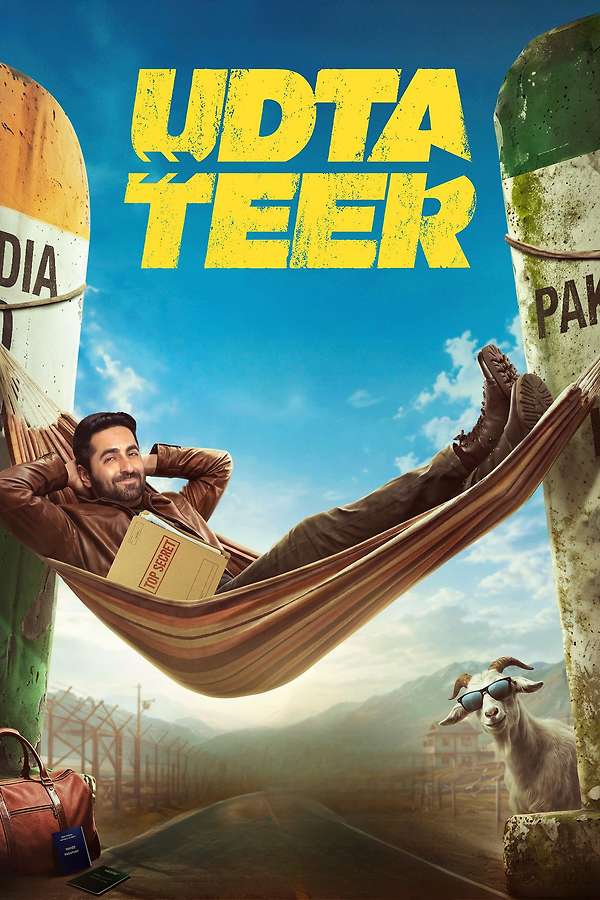
The title of the new Hindi film Udta Teer is an embedded warning sign of the film taking a stray arrow on its backside against the run of play. It is similar to falling in love with a red flag, knowing what to expect when they show their true colours – only to psyche yourself on how they remain a changed person, owing to their initial antics. It is a very specific problem that the film is a victim to – pretending to be a parody of the genre that would allow you to invest in the proceedings early on, only for it to weaponize the very aspect it is seemingly against of, in-turn flipping on its audience too.
So when you are first introduced to the protagonist Vikrant (Ayushmann Khurrana), he is plotting on nabbing the notorious yet goofy terrorist Azhar Maqsood (Late Mukul Dev), who right swipes on a dating app called ‘Hinder’, and someone who can’t even break a glass window sill during a combat. A fight sequence later and a tense chase later, it is revealed that the protagonist is in fact a double-agent Bilal – working for Pakistan, in a premise that felt like a parody-sub-plot of the Hindi film Alpha (2026).
Written by Aakash Kaushik, Madhur Sharma, Dia Walia, and Gautam Govind Sharma, Udta Teer has a very interesting premise up its sleeve, that could easily form a companion piece to Kunal Kemmu’s Vibe (2026). The idea of a spy losing his memory to amnesia, only to be confused on whose side is he playing for – is a genius concept, something that promised for a fun, frolicking ride through its marketing material. And the fun element was definitely on show during its first hour, wherein the protagonist loses his memory after a freak accident during a fight with his now-paralyzed boss Burman (Rahul Bose), even as his fellow-spy-disguised-as-an-Indian-agent Dhruv (Suhail Nayyar), and a bunch of other ‘infiltrators’ look on.
The humour is definitely staged around the misplaced identity of the protagonist, who has been plotting against India and is on the cusp of handing out the list of Indian agent present in Pakistan to his master Niyazi (Ram Kapoor), who in-turn is shown to be an ambitious character willingly taking interest in learning Chinese from his boss General Mir (Gulshan Grover); the latter being a fan of Schezwan Biryani too. If you know how geo-politics works, this gag is funny! Back home, you are also subjected to protagonist’s wife Yamini (Sara Ali Khan) who is on the cusp of a divorce, until the accident proves to be a blessing in disguise for her. With new identity, comes new responsibility – as long as the memory doesn’t return from the dead!
The writing infuses some rather hilarious moments that had be thoroughly entertained. For instance, the sequence involving the wide-eyed-and-paralyzed Burman who holds a secret about the protagonist – just that he cannot utter it at his will. It increasingly reminded me of the character of Sonu Sood from Singh Is King (2008), the one who is taken to the cleaners in the veil of being saved by the protagonist from the perpetrators. This, or even the typical Dharma trademark of some famous romantic numbers played out to some rather different sets of context – one involving the Kuch Kuch Hota Hai number planted against an ECG machine, one involving a character imitating a heartbroken Anjali from the same film, and the other involving a terrorist character coming face-to-face with the protagonist against the BGM of SRK stepping out of a helicopter in K3G (2001). Or even the mad antics of Dhruv, who hilariously watches his partner flip and arrest all his Pakistani colleagues – despite him trying his best to save them. Pretty hilarious, I must say.
Unfortunately, the writing here doesn’t wish to hinge on the refreshing parody that is sprinkled through the first half. Instead, it wishes to ride the current wave of extreme jingoism often veiled as the bare minimum form of nationalism. The steady decline also reminded me of the infamous slide from Vibe (2026), except that the latter had a genre change to action without letting jingoism creep in. Here though, you see the temptation of willing flog a title like Dhurandhar (2026), almost like wanting to enter like a parody wild card of the same. The only difference being, the writing wishes to view itself as Dhurandhar and not a parody – thereby allowing the narrative to dip to a point of no return.
It is interesting on how the comedic trait of most characters are tossed down the drain, with both Indian and Pakistani characters turning into stereotypes (from the Indian gaze) – the latter being the evil minds, and the former perennial heroes. This phase also amps up its jingoism with the national flag being a parallel lead to the protagonist amidst an unsolicited saffron wave, even as the frequent notes of ‘Khalnayak Hoon Main’ (for the Pakistani variant of the protagonist) being replaced with a more palatable and crowd-pleasing Jai Hind. This, even as a hound of terrorists are caught, and their plans are foiled against the backdrop of a few more chants of Jai Hind.
The endless twists in the final act are also symbolic of how the writers did not trust the original source material, or even worse – every writer involved here was given a different brief. Logic dies a million deaths even as the protagonist turns from a Pakistani national to an Indian spy and back to working for Pakistan, and later for India – in a loop that is one for the headache-inducing ages. It is almost as if the writers flipped the narrarive on the viewers you can’t quite remember the identity of the protagonist now, more than the protagonist himself. The green flags turn into a red herring, especially when glossed with a gaze of over-the-top nationalism. And what that does is stripping off all the worthy moments of laughter in the first hour, that literally felt a part of a different movie. In other words, the writers did take an ‘Udta Teer’ out of nowhere!
The dialogues range from frothy and hilarious, to some unsaid bouts of weaponized nationalism sandwiched between the infamous ‘Janaabs’ coined by Bollywood. The music is just so forgettable, and the song integration also makes things worse. On two occasions, you have a random love song that air-drops out of nowhere, and a song on patriotism that further highlights the jingoistic wave that the film rides on. The BGM fairs slightly better, although it increasingly suffers from bouts of confusion amidst a brain-fading second hour. The cinematography comprises of frames that capture the humour of the first hour on point, but fail to engage on an emotional level or even a forced patriotic level in the second hour – sledgehammering its way for most of the second half.
The editing pattern works in the first hour, even with its intended mode of treating each sequence in isolation. But come the second hour when convenience takes centerstage, even the editing feels increasingly choppy and incohesive – almost confused with its tonality. The twists felt like an editing masterclass in how not to edit a film – chopping and encircling from any given point towards a notorious conclusion.
Director Aakash Kaushik scores well initially by masterfully balancing a sharp premise with genuinely engaging humour during the film’s first hour. However, the narrative completely disintegrates in the second hour as it gets weighed down by an overtly excessive wave of jingoism. The late-stage twists feel highly manipulative rather than earned, sinking the film into an infuriatingly forgettable territory. Neither do the characters arcs make any sense, nor does the drama at the finishing line.
The performances are decent by the members of the cast. The likes of Supriya Pilgaonkar, Sandeep Anand as Tariq, Gulshan Grover as General Mir and Brijendra Kala as KK Srivastav have their moments to shine, while ably tickling your funny bone. Likewise, Late Mukul Dev in his final outing on celluloid as Azhar Maqsood is quite hilarious to witness, and he does a fine job in catering to the goofy synergy of his character. Ram Kapoor as Nizami never fully gets a chance to bloom with his performance, majorly due to the insipid writing that doesn’t allow him to unleash his goofy energy or completely amp up his intimidation quotient. This remained an ‘in-between’ performance if ever there was one. Even a veteran like Raghubir Yadav is woefully wasted here.
Smita Tambe and Rahul Bose are top notch here, the latter ably essaying the role of a wide-eyed paralyzed character being helpless in a critical situation. And the former delivers a dignified performance with a playful twist to her demeanor, in what felt ticklish in many ways. Sara Ali Khan delivers a decent and serviceable performance that successfully keeps the narrative moving forward. The issue remains on how her performance rarely ventures into brilliant or ground-breaking territory. She effectively handles the script’s basic comedic demands, yet she occasionally struggles to bring depth to the film’s more intense, high-stakes emotional sequences.
Ayushmann Khurrana delivers a fairly fluid performance as Bilal aka Vikrant. Tasked with playing a Pakistani secret agent who develops amnesia and believes he is a patriotic Indian, he anchors the film’s genre-bending premise with absolute ease. His solid comic timing beautifully balances the sheer absurdity of the plot’s situational humor, even though he partly struggles with the patriotic and high-energy beats in the second hour. His combat sequences aren’t very exciting either, thereby resulting in a performance that is good but not great.
Suhail Nayyar completely steals the show, emerging as the definitive standout performer of the espionage comedy. Not only does he complete a full circle with his previous ‘Indian’ act in a show like Saare Jahaan Se Achcha (2025), he completely disappears into his character, boasting an intense physical transformation, a bulked-up physique, and a distinct moustache that grants him an entirely fresh screen presence. His dedication shines brightest through his flawless command over a complex dialect, allowing him to sound deeply rooted and thoroughly authentic. Navigating a deeply layered and intriguing spy role, he balances grit and fun so perfectly that he eclipses the rest of the ensemble cast. And his comic timing is to die for!
Despite decent performances and a hilarious, promising first hour, Udta Teer snatches defeat from the jaws of victory by completely disintegrating into a sea of misplaced jingoism and fractured logic. The film initially shines as a sharp parody with an engaging, funny premise, but it entirely loses its way during a chaotic second half that abandons its core strengths. It almost felt like the film did take an ‘Udta Teer’ out of nowhere in the second hour, making this drama infuriatingly forgettable, just like the forgetful identity of the protagonist. Available in a theatre near you.


