

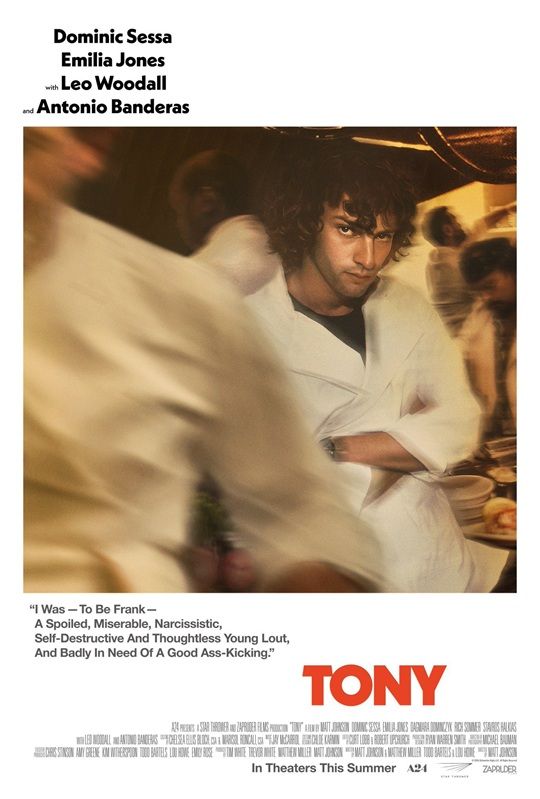
In many ways, the new English film Tony can be an immediate companion piece to Marty Supreme (2025), particularly with the traits possessed by the respective protagonists. It is interesting on how both Marty and Tony (Dominic Sessa) remain perennial narcissists – brash, rude and extremely ambitious creatures that would eventually branch out into separate individuals. In fact, there is an early scene that connects the two stories spiritually too – even as Marty initiates a make out session with his temporary lady love, whilst Tony encounters his lady love Nancy (Emilia Jones) at a local bar, only to try and woo her. Their respective ambitions also are pretty much intact, wherein Tony aspires to be a writer, much like how Marty aspires to be a ping pong player. And both of them are compulsive liars too, a trait that forms degrees of separation between the two personalities. Unlike Marty who would go to any extent in achieving his dreams, you witness a tepid drive as far as Tony is concerned – lying to his parents and his lady love about getting a fellowship in writing, instead following Nancy to Provincetown from New York in order to continue to woo her. Think of Sid from Wake Up Side (2009) minus the ambition, but with a dash of romance thrown in.
Based on the novel Kitchen Confidential by Anthony Bourdain, and written by Matt Johnson, Lou Howe, Todd Bartels, and Matthew Miller, Tony doesn’t follow the regular beats of a standard biopic, a searing complaint that I had with a film like Michael (2026). It isn’t episodic, tactfully traversing from one chapter in the life of Chef Anthony Bourdain to another. Instead, the focus remains on the events transpiring over a single summer in Provincetown – in a narrative pattern that doubles up as an edgy coming-of-age story.
Ironically, it is the setting of the drama in a dingy little restaurant named Flagship, that coincides with the muddled and confused psyche of the protagonist. For instance, the egoistic nature of the protagonist is in full display at the start – almost cooking up stories, in a nod to his creative writing skills, that keeps his secret of rejection in play. He refuses to even acknowledge this fact at multiple instances through the narrative, also ironically getting into drunken brawls while having no money to head back home. Hence, the dingy setting is a direct reflection of his psyche while also doubling up as a humble setting, a keen reminder to keep the protagonist attuned to the ground realities of his life.
It is interesting on how the narrative offers a sense of duality with regards to the aspirations of the protagonists – the one wherein he aspires to be something, and the other involving the unsaid plans of nature that want him to be something else. And this contrasting trait goes beyond the surface level aspirations of him wanting to be a writer, whilst having to work as a chef. It is more to do with shaping his personality from a brash 19-year old in the year 1975, to a well-known and most-loved chef at the turn of the century.
This sense of duality is also represented through two specific characters in the form of Sal (Leo Woodall) and the other Chef Jose Vetel (Antonio Banderas). The former remains a brash alpha male, who is known to snort drugs and continue having flings with strangers (he maintains a chip in the wall for every intimate encounter), often being callous of the goals in his life – someone towards whom, the protagonist gravitates towards initially. On the other hand, Vetel remains a disciplined figure, always expecting the staff of his restaurant Flagship to arrive 15 minutes before time. And he always wishes to keep the group together, often citing on how he is willing to carry the sins of his group. He remains a mentor who offers a specific, disciplined path ahead for the protagonist, a searing contrast to his tryst with Sal. In fact in a pivotal scene, you see Sal having a face-off with Vetel, never quite admitting his mistake of arriving late for work, instead getting in a brawl with Vetel who still didn’t intend to fire him initially. And that scene is enough to lay out the contrasting nature of their personalities.
The final act is wonderfully dedicated to the gradual transition of the protagonist, from an arrogant prick to a person with humility. You see a virtual bubble building towards a certain direction – through the attempts of the protagonist to impress both Nancy and his head-chef over a meal that soon goes awry. This is particularly true with the former, with whom he shares a pivotal moment in a beautifully curated scene that instantly reminded me of the spiritual theme tackled in Wong Kar-Wai’s In The Mood For Love (2000). In a beautiful moment just before sharing an intimate space with Nancy, you see him bearing his truth to her – almost like uttering a long withheld secret that remained buried inside the imaginary walls of his heart. The metaphor remained in him ‘bearing’ his naked thoughts before the naked deed, that eventually formulates a moment of poignancy.
At the end, the loop is completed, and feels earned by the end of things – even as the protagonist experiences a sense of belonging in his immediate close-knit community, a life lesson of having a chance to rebuild and regain the lost loves along the way, something that would go the distance in forming and defining his personality over the many years that he was alive. It remained a heartfelt, bittersweet finale that was laced with a sense of his calling – an event that would often cross individuals at different moments in their lives. And that summed up a screenplay that was deft with its emotional core, but poignant with its thoughts – something that came across beautifully in a heartfelt narrative.
The dialogues are conversational in nature, deliberately maintaining a distance with the palpable emotions in play – instead, wishing to go deeper with the themes. As a result, the emotions itself feel earned by the end of things through some fruitful and poignant lines. The BGM doesn’t overpower the drama, allowing the simmering moments of silence to do the heavy-lifting, something that doesn’t allow any sort of manipulation to creep in.
The cinematography comprises of frames that maintain a soothing aesthetic with regards to the surroundings, often maintaining a vibrant outlook to the proceedings. Even the camera angles are close enough to invest in the individual journey of the protagonist, while offering an emotional gravitas to the proceedings in a rather deft manner. No, this isn’t a tale about ‘cooking’ like the ones you would associate with shows like The Bear (2023), or Boiling Point (2021). It is more poignant and character driven, a trait that is further exercized through its frames.
The editing pattern is crisp and sharp, without incorporating any jump cuts that would steer you away from the emotional core of the proceedings. It does enough to offer space to invest in the bumpy coming-of-age ride of the protagonist, maintaining a strong emotional core through its edit.
Director Matt Johnson deftly subverts traditional biopic tropes by narrowing his lens to a singular, life-defining chapter rather than a sprawling chronological history. This hyper-focused approach strips away the typical episodic pacing of the genre, transforming the narrative into a razor-sharp, edgy coming-of-age story. By anchoring the world-building to this specific emotional crucible, the film achieves a rare depth that is simultaneously poignant, raw, and deeply resonant.
The performances are wonderful to witness by the members of the cast. The likes of Stavros Halkies as Starvos, and Michael Jibrin as Tyrone have their moments to shine. Emily Jones as Nancy is sincere and earnest, despite the writing being a tad too convenient with regards to her character sketch. And yet, she does enough to provide moments of poignancy through her impressive act. Leo Woodall as Sal is unhinged with his antics, something that doesn’t necessarily make him affable. And yet from a thematic POV, his performance offers a sharp contrast and a choice for the protagonist, that becomes pivotal in mending his character. In that capacity, the performance was superb to witness here.
Antonio Banderas as Chef Vetel is understated with his performance that is riddled with affection. You witness his gentle yet firm streak even in the most chaotic exchanges with some of the characters in the mix. His tenderness is something that I automatically gravitated towards, making his act quietly charming and wonderfully searing.
Dominic Sessa as Tony offers a searing metamorphosis in what was a bittersweet coming-of-age tale for him. There is purpose in his body language that is confused, or his expressions that are slowly finding a voice with regards to the world around him. And there is poignancy sandwiched between each of these traits that is hidden from the world. He seamless transforms from a brash and arrogant character, to the one with humility – in a performance that is exquisite and brilliant to witness.
Featuring brilliant performances, Tony is a bittersweet coming-of-age drama that masterfully cooks up an emotional storm through its poignant characterization and rich, understated depth. Instead of relying on superficial tropes, the narrative dives deep into its thematic flavors, maintaining a complex emotional gravitas that ensures every high and low feels authentically earned. This careful balance allows the overarching drama to remain wonderfully thoughtful, lingering with the audience as a profoundly heartfelt, resonant, and intellectually rewarding watch. Available in a theatre near you (from 28th August ’26 in India), and Highly Recommended!


