
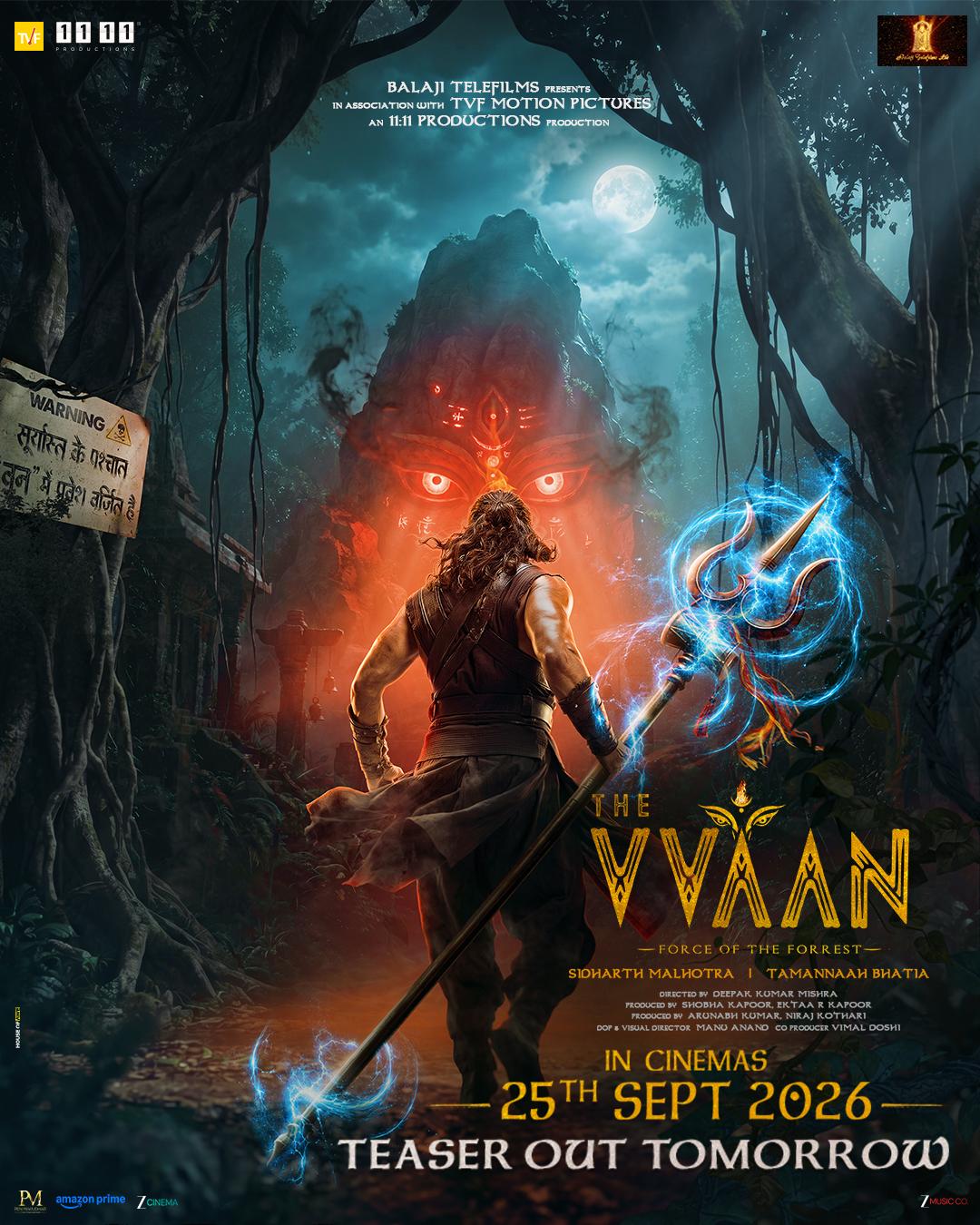
It was only recently that Mirzapur became the firat webshow to be made into a film, and released in a theatre. Unfortunately weeks after, the new Hindi film The Vvaan earns a distinction of being a discarded TV serial released as a movie on the silver screen. The film almost gave me an impression of one of those Maha-episodes on television – a mishmash of a K-Serial entering the veins of a B-grade horror show, and in turn producing content that is exclusively curated on MS Paint. It is hard to imagine a film this soulless, and featuring its protagonist Rishi (Sidharth Malhotra) who remains a modern day atheist – with much of his atheism stemming out of the fact that his wife Mamta (Tamannaah Bhatia) suffered a miscarriage while paying her regards to the forest goddess.
It is funny how the genre of a film defines the fate of a character; if this were a horror film, the character who wouldn’t believe in ghosts would be thr first to be bumped off. But because the protagonist is a pragmatic individual, the regressive arc wants him to earn the currency of devotion – often working on the template of the chosen one (an unintentional wordplay to the title of the film), and eventually having him transformed for the worse. No, I am not against devotion – I am against the idea of weaponizing it, while bidding a goodbye to all the educational degrees over the years. Faith is what I believe in, blind faith I don’t! And the writing is manipulative enough to tilt towards the latter!
Written by Arunabh Kumar and Anandeshwar Dwivedi, the tackiness of The Vvaan can be studied right at the start, when an AI prompt is used to tell the brief origin story of the sacred forest and the deity residing in it. In the same space, Kantara (2022) has used real locations to create an atmospheric that was so sacred and immersive, something that had me invested in the drama from the start. And this is what I mean by weaponizing devotion – none of the folks involved are actually interested in narrating a compelling tale, using the bear minimum effort to vouch for, and in turn use devotion as a shield for criticism.
The tackiness and silliness go hand-in-hand in its opening sequence in the current timeline – wherein the superhero powers of the protagonist save his men from a tragedy, after a malfuctioning crane goes wild. And yet, the writing uses this sequence in a standalone manner – trying hard to create a parallel between the ideologies of the protagonist and the undercurrent of devotion, unsuccessfully so. It must be noted that the protagonist is a debt-ridden character, inexplicably living in a sea-facing apartment, and trying for a loan for IVF treatment. If you can make any sense of this detail – this film is for you.
The conflict arrives in the form of a phone call from his estranged brother Shashi (Anup Soni; always being Savdhaan and Satark, a running joke in a scene) and his ‘muttering’ bhabhi Sushila (Shweta Tiwari) regarding a land acquisition deal that brings him to the land of the sacred forest from the start of the film. The forest has one rule – do not enter after dark, a sentiment that is mocked upon by the protagonist up until his pursue to be labelled as the chosen one. In between there is a journalist who is an investigative atheist like protagonist, but perhaps not as good looking – which eventually makes for a gory end. Perhaps, it is only about Good Looks, Good Looks…anddddd Good Looks.
There are a bunch of characters that act as fillers here – be it the protagonist’s friend Ved (Maniesh Paul) who finds himself in the midst of a sequence imitating the horror-special on TV, during his tryst with a wicked old woman. Or the local politician Deepak (Sunil Grover) who wants to build a road through the forest to cut-down the travel time after his father supposedly passed away, resulting in a conflict with the villagers. There is a searing social commentary sandwiched in between somewhere about capitalism – something that is buried in the garb of fear for the deity, as opposed to catering to the environment. And I can’t classify this as a noble thought – or for that matter, any thought stemming out of fear.
The writing gets into the ‘unwatchable’ category in the second hour, particularly when it chooses to cater to the transformation of the protagonist – giving it a preference over the lore of the forest. The revelations are so sketchy, that I couldn’t stop facepalming. The transformation itself lacked the soul of a person drenched in devotion, just catering to the bare-minimum criteria of realisation following a mishap in the river. I mean where is a little kid with the ability to rescue crocodiles when you need him the most. In between, the folklore itself feels lost – amidst a low-effort prompt of a shadowy tiger, or a green-screen cut-out of a bull – the latter returning the favour by forming an uncanny protector at a point in the narrative to the protagonist, who magically gets a premonition about the lore after being injured.
The template is complete during the final face-off – catering to the good-versus-bad narrative, while staying at the surface-level with the lore and the divine emotions tagged to it. The focus remains on the actual fight wherein gravity is switched off, and people flying from pole to pole – and the introduction of the trishul to guard off the evil (and the criticism around its shoddy climax). It is directly reflective of the times today, wherein terms like progress are bartered with fiery exchanges on blind faith (and I am a firm believer of faith, mind you), and the one wherein the progress of a country is inversely proporational to its ability to inherit science, particularly at a time when the facade of blind faith is directly proportional to the infinite crimes against women. You worship the Devi, but not the females around you. You talk about progress, but continue to relish on crimes against women. Bravo!
The dialogues are tonally inconsistent, trying to bring in bouts of comedy with wordplays and even brand endorsements. In a scene when a character randomly expresses his tryst with acidity, you are witness to a medicine brand out of nowhere, followed by a scene integrated to highlight an oil brand. It is the most tone-deaf and low effort integration that one can spot, even in a drama that relies on words like ‘Shakti’ and ‘Bhakti’. Even a random reference to a K-serial character in the name of a word play felt woefully out of place, in a film that focused on devotion. Imagine the kind of humour infused in a film like Laalo (2025), something that would immensely dilute the devotional dimension of the proceedings.
The music is rather forgettable, only showing a momentary glimmer in the Chhat Puja sequence that felt like a surreal moment. And why were there random item songs in the narrative? Even the BGM is blaring away to glory, overpowering and overshadowing the ongoing drama in many scenes. This, when the impact of the drama itself was non-existential. The cinematography comprises of frames that seem curated either through an AI prompt, or recreated on MS Paint – for the production quality felt like a low-budget TV serial. The scale that was required for the drama, was just timidly lowered by the frames that are both tacky and sloppy in equal measure, with shallow VFX to back it.
The editing pattern is woefully bad, often integrating cuts at the most inappropriate moment – a trait that snatches defeat from the jaws of defeat. In fact, the scattered edit in the final act may have been the single worst thing that I may have watched all year after Toxic (2026), wherein flying planes would need aversion from the flying folks in anti-gravity mode. In other words, it was ridiculously bad! And that is the best thing that I can say for the edit, particularly in the final act.
Director Deepak Kumar Mishra’s transition from Panchayat to the grand scale of The Vvaan exposes a distinct struggle with cinematic visualization and world-building. His direction fails to elevate this larger canvas, reducing an ancient forbidden forest to flat, uninspiring visuals heavily reliant on unconvincing special effects. Instead of crafting an immersive, imaginative mythos, his world-building feels convenient and transactional, utilizing local folklore merely as superficial plot devices. This lack of directorial vision is further crippled by non-existent characterization that leaves the protagonists emotionally hollow, alongside a woefully scattered tone that erratically jumps between horror, melodrama, and slapstick – thus summing up the direction that was subpar to say the least.
The performances are way underpar by the members of the cast. Talented actors like Avtar Gill, Milind Gunaji, Sulbha Arya and Durgesh Kumar are woefully wasted in the narrative. Shweta Tiwari as Sushila comes across as bickering and annoying, as opposed to being controlled with her sentiments and angst. Anup Soni delivers another one of his Savdhaan and Satark variants in a performance that is pretty dramatized.
Maniesh Paul’s brand of humour is generally not my cup of tea, but oddly, a few of his one-liners did make me chuckle here – although the humour itself was inappropriate at a few junctures. Sunil Grover as Deepak delivers a tonally inconsistent performance in a character with various shades in the narrative. I wasn’t entirely sure if he was completely committed to the ideology of his character here, never fully being intimidating along the way. Tamannaah Bhatia has a good screen presence and offers bouts of restraint, largely in a character that didn’t really contribute to the screenplay.
This brings me to the curious case of Sidharth Malhotra, who is yet again as flat as a pancake in the character of Rishi. It must be understood that beyond his good looks, the man doesn’t have the skill to pull off an emotional outlook to his characters – often stripping them off all the emotions through a flattened and stoic dialogue delivery. Yes, he fares relatively better in combat sequences (which were insipid in nature), but at no point was I invested in his act that was pretty woeful. This isn’t an anormaly but a worrying trend in his filmography, wherein his performance doesn’t elevate the written material in anyway – neither through his expressions or body language. It is time for some serious introspection now, this can’t keep going on any further.
Featuring mediocre performances, The Vvaan is a tacky, sloppy mytho-actioner driven by insipid writing that frequently resembles a low-budget TV soap opera. Its visual appeal is completely derailed by trashy, low-effort VFX that looks like pure AI slop, rendering the film a chaotic eyesore. What makes this project truly infuriating is how such blatant mediocrity is passed off under the guise of religious devotion, resulting in a deeply frustrating watch where the entire drama feels less like a cinematic effort and more like an un-godly, money-swindling act designed to exploit the audience’s faith. It is a film that deserves a ‘Vvaan’ star rating for the chosen ‘Vvaan’ template gone wrong. Available in a theatre near you.


