

At some moment after the screening of the English film The Social Reckoning, I was hinted to with my colleague (from the media fraternity) on how social media remains one of the last standing pillars of democracy; to which his reply was a chilling one – “That Is A Thing To Worry About”. In that sense, the film here can be an immediate companion piece to the documentary The Social Dilemma (2020) – something that fiercely hinted at a commentary on data leaks, and how your devices are always eavesdropping on your conversations. But here, the commentary remains much more worrisome, a case that is actively depicted in its opening act. In a scene, you witness a white woman being approached by cops on the highway for help, only for her to refuse the same – and in-turn drop an allegation of hassling a White American US citizen by racially abusing the cops in question. All of this, whilst streaming a video on her handle that would further connect her to some radical groups. The incident might appear to be fleeting in the narrative, but it represents a small faction of the larger chatter on the internet that is fuelled by hate and anger – two traits that are amplified by the algorithm in question.
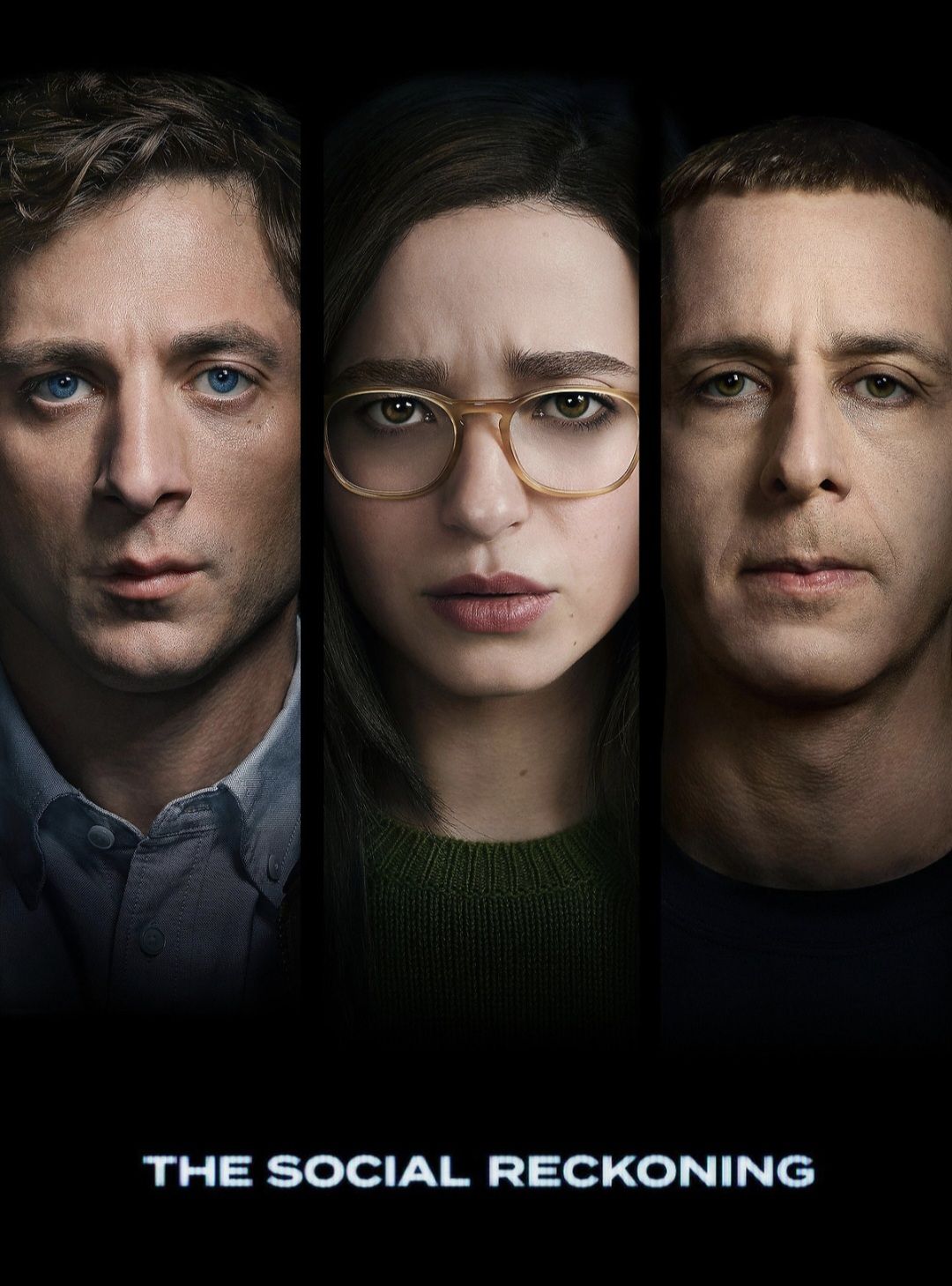
Based on the true event around the Facebook leaks controversy of 2021, and written by Aaron Sorkin, The Social Reckoning essentially adopts a David Vs Goliath narrative – a distinct departure from its spiritual street-smart successor The Social Network (2010), even as you are introduced to some of its principal characters – Jeff Horwitz (Jeremy Allen White), a fiery media personnel who mounts his investigation around the capitalism tech-company Facebook with his core focus being on the algorithm-driven programmes; Frances Haugen (Mikey Madison), a worker in the tech-company fighting her own internal battles whilst being conflicted with the ideologies of her company and her own; Mark Zuckerberg (Jeremy Strong), the owner of Facebook and the one ‘invariably’ orchestrating the algorithm tweaks.
It is interesting on how the commentary on capitalism is quite pronounced through the narrative – a searing moment of contrasts that is dictated by profits and engagement even at the cost of human lives in question. In a scene, you witness the character of Mark introducing a new metric called Meaningful Social Interactions (MSI) – a programme specifically introduced to cater to the original vision of the social media platform, to bring the community together. But in a flipside to the story when the engagements begin to decrease (even if it was 1% which on scale would mean 30M users in his words), the tweak in the algorithm was initiated, all in order to boost the engagement – even at the cost fuelling hate speeches through reshares and reactions, all in order to raise the profits of the organization. And therein was built a commentary on ethics and responsibilities vs maximizing the profit margins of the company.
The proceedings oscillate in a non-linear manner, a deliberate attempt also to analyze the wave of capitalism in hindsight. So in a steady scene when you witness Mark given legal advices with respect to his behavioral patterns in court by his team, a sort of a mock simulation to get him prepared – you do get an insight into the sea of manipulation in store. Right from the colour of his tie to his posture and his words (wherein he is told to use the word ‘users’ as opposed to ‘humans’), was a terrifying subtext to the theme of manipulation that would bypass the one involving guilt. In the same fragmented sequence when being questioned about the idea of curbing the algorithm for peace to prevail – his cold response involves his deliberate lack of interference in the free speech of the people involved.
From a characterization POV, I liked the brewing conflict of Frances, the protagonist working for the tech-giant but lacking an identity or voice of her own. It is clear on how the concept of free speech is implied elsewhere as an alibi, but not in the organization. Even from a personal POV, it is the protagonist who has witnessed her friend be radicalized, all in the view of an amplified algorithm that was to be supervised and curbed by her team. Even in a couple of fleeting moments, she encounters people who are either bullied online or randomly believe some wild theories online, much like the Whatsapp uncles who begin their day with false positive Whatsapp forwards. Guess, the term blind-faith doesn’t only apply to folks from one country on this planet, even as political parties mounted on hatred and divide, prosper!
The proceedings follow an understated investigative tone that is borrowed from films like Spotlight (2015). There is a definite political subtext in the narrative, hinting at the unregulated inflammatory messages circulated by the right-wing governments that isn’t fact-checked but instead, boosted for engagement, even whilst fuelling riots and violence across the globe. All of this, even as the narrative focuses on the platonic dynamic between the protagonists – two underdogs who haven’t always tasted success, but still continue to showcase a wave of resilience against the mighty and the powerful organization. In words of Frances, she remains the perennial underdog who would stay hidden in her classroom, without having the opportunity to even celebrate her wins.
My only minor gripe with the narrative remained its abrupt finale that relied on the captions (fiery but less impactful) in the narrative. It just felt like a step-back from the potential courtroom sequences that were a knockout like in a film like The Trial Of The Chicago 7 (2020). Yes, I understand that the narrative centered around the investigation which was the prime focal point of the drama. But a little hint into the eventual courtroom scenes would not have done much harm, summing up a screenplay that was otherwise supremely impactful and poignant, while exposing the undercurrents of capitalism in a world that is increasingly thriving on hate. And now we know why!
The dialogues are conversational and understated with the themes being tackled in the narrative, offering a visceral and intellectually stimulating outlook to the proceedings. The BGM doesn’t overpower the narrative, often seen fuelling and aiding the pivotal moments with grace and poise, even while presenting an intriguing piece of art veiled as a thriller. This quality extends to the cinematography too, presenting muted frames with hues of grey and blue to christen the screen that gels with the understated yet vile tone of the proceedings. Interestingly when both the protagonists find themselves in the same frame, the frames offer a contrasting shade of brighter hues – almost resembling a ray of hope in an othereise dark and grim world. This contrast helps to view the characters in a certain light, whilst being emotionally invested in the proceedings.
The editing pattern is crisp, intercutting multiple timelines whilst seamlessly tying them up to ably hold the narrative together. Director Aaron Sorkin trades the stipulated tense atmosphere of the drama with a high-stakes, dialogue-driven narrative that remains focused on the investigative dimension in the narrative. He structures the film as an intellectual legal drama reminiscent of classic newsroom procedurals. His directorial choices prioritize the rhythmic cadence of the script, maintaining a rapid momentum to unpack the complex data ethics of the 2021 Facebook whistleblowing scandal. The tone remains relentless, a nod to Spotlight (2015) – refusing to delve into the individual arcs of the characters outside the central plot. And barring the abrupt finale, the direction remains incredibly visceral and stimulating throughout the narrative.
The performances are wonderful to witness by the members of the cast. The likes of Tehmina Sunny, Portia Doubleday, Sierra Capri, and Gbenga Akinnagbe have their moments to shine. Billy Magnussen and Betty Gilpin round out the stellar ensemble as Teddy and Kris. The former expertly plays into the corporate compliance dynamic, while the latter brings a sharp, incisive energy to the Wall Street Journal team. Their concise yet impactful performances elevate the movie’s pacing and enrich the supporting narrative layers. Wunmi Mosaku and Bill Burr shine brilliantly in their roles as Facebook employees Raya and Charlie. Mosaku infuses her character with a poignant sense of compromised idealism, while Burr provides excellent, grounded dramatic weight. Together, they effectively humanise the internal corporate tension that defines the tech giant’s internal culture.
Jeremy Strong commands the screen with his immersive, method-driven portrayal of tech mogul Mark Zuckerberg. He adopts a rigid, calculated demeanor that underscores the character’s cold focus on corporate growth and algorithmic prioritization. His thunderous presence introduces a formidable, fascinating antagonism into the narrative.
Jeremy Allen White brings a gripping, fast-paced intensity to his role as Wall Street Journal reporter Jeff Horwitz. He infuses the character with a sharp, relentless journalistic drive that pairs beautifully with the film’s fast-talking script. He effortlessly captures the stressful, high-stakes reality of investigative reporting under intense corporate pressure.
Mikey Madison delivers a luminous and deeply grounded performance as the courageous whistleblower Frances Haugen. She perfectly captures the intense internal conflict of an engineer torn between corporate loyalty and public safety. Her expressive acting ensures that her character’s high-stakes moral dilemma forms the emotional anchor of the entire film.
Featuring stellar performances, The Social Reckoning is a visceral, relentless commentary on the predatory nature of modern capitalism, specifically exposing how social media tech giants prioritize corporate profit and societal unrest over peace and human ethics. Despite an abrupt finale, the drama successfully sparks an impactful discussion about the manipulative psychological tactics companies employ to artificially drive engagement. The film’s message leaves behind a poignant irony: to share this very review, reviewers like me must rely on the exact platforms the movie so fiercely critiques. In the end, irony has died once again—but aren’t we all hypocrites in some way, much like the collective complicity Tom Cruise’s character so powerfully highlighted in his show-stopping monologue in Alejandro G. Iñárritu’s Digger? Available in a theatre near you (from 9th October 2026 onwards).


