

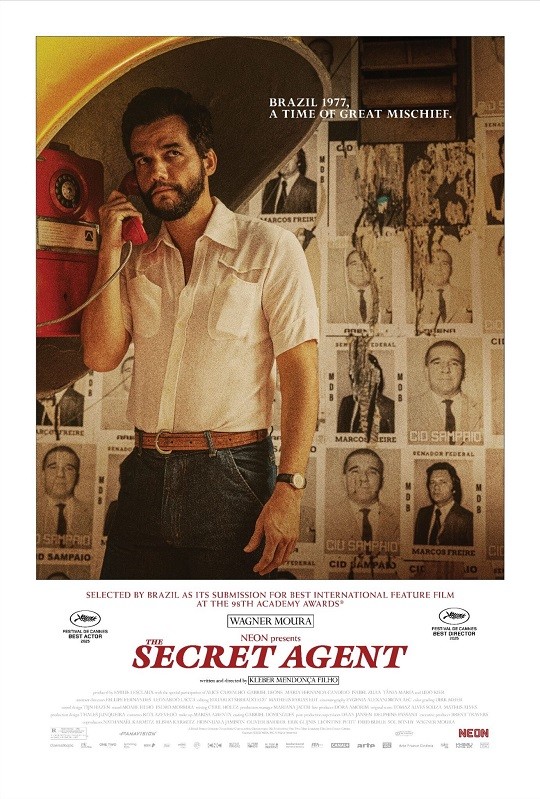
Somewhere in the film The Secret Agent, Brazil’s Official Submission to the Oscars of 2026, a little child is not allowed to watch the then global phenomena – Jaws (1975). Elsewhere, there is a human leg found in the mouth of a tiger shark that sparks a curiosity, wherein the human leg is turned into an urban legend known to hunt down people. These may seem absurd references on the surface, but the setting of Recife – a city in Brazil in 1977 makes the picture clearer. Each of these absurd references align with the political climate of the country that was then under the military rule. The metaphors of censorship act as a connective tissue between each of the instances above, even as you are introduced to the character of Armando (Wagner Moura) who freshly enters the city of Recife with a purpose. The foreshadow of a character telling him that he exudes of ‘cop vibes’ is hardly incidental, as is a dead body laying exclaimed in front of a gas station. These remain important symbolisms of the dictatorship rule – wherein fear is often met with an oppressed fate, even as a cop enters to search the car of Wagner. The impression created remains of Wagner being a spy or an undercover cop himself, even as reality remains far more simpler and complex that you can ever imagine.
Written by Kleber Mendonca Filho, The Secret Agent can best be understood when you view the film backwards. In the final act, you see a history student Flavia (Laura Lufesi) approaching a doctor Fernando (Wagner Moura again) with recordings about his father Armando. Care has been taken that Fernando and Armando look the same – given how the entire drama unfolds through the gaze of Flavia and her friend listening to the recordings of Armando, in hindsight. At this point, you witness a moderately detached Fernando telling Flavia on how he has very little memory of his father, remembering how he finally did get to watch the films Jaws at a theatre that has now been converted into a hospital where he works in.
Each of these details tells us about the fractured memory that Fernando is subjected to – wherein the then dictatorial rule had ensured that not only was he distant from his own family, but also had no ‘real’ memory of them. A spritely deviation into last year’s I’m Still Here would be a perfect companion piece – particularly with its final scene wherein the protagonist in her last leg of her life, is the only one to remember her ‘estranged’ husband.
A direct parallel could be drawn to Armando’s life too, even as we are gently acquainted with him. You soon get to know that he isn’t a spy or a cop, but a former professor and tech-expert whose only purpose remains to reunite with his family. And like Fernando, Armando wishes to traces back the roots of his family tree by wanting to know more about his mother (something that positions himself at an Identification center).
But the differentiator for Armando and Fernando remains the times that both the characters reside in – the latter is unconsciously enjoying the perks of a democracy, while the former has to literally live his life ‘undercover’ and stay away from the limelight of the authoritarians in power – one of whom is shown to send hitmen behind him, simply because he disagrees with Armando’s ideology who is being viewed as a communist sympathizer. Yes, absolute power always corrupts – so if you choose not to ask questions before it is too late, you would also find yourself on the run like Armando.
The narrative has a neo-noir outlook with the proceedings, even whilst delving into bouts of dark humour that are sprinkled in the narrative. Be it the ‘censored’ newspaper headlines that results in laughs, or a parallel involving the ‘number of deaths at a carnival’ – a phrase that remains a paradox in itself while defining the fabric of the nation, the repressed times while being kept in the background, are breeding grounds for humour. And yet there are quieter moments that remain heartfelt too. In a scene you see a young Fernando asking Armando if he will ever get to see his dead mother, to which the reply is a plain and simple no. She is implied to have succumbed to pneunomia but the reality stays hidden from Fernando and the viewers alike.
While the proceedings remain a slow-burn, the fate of Armando towards the end is smartly kept under wraps, even as the tone of the drama shifts towards violence. The shootout in itself remains a metaphor for survival for one character, whilst for Armando, it all remains about survival. It is representative of the perfect paradox that we suffer as a society, wherein frustration and suffering often transition into survival. And yet, the end result remains heartbreaking in every way followed by the outro (mentioned at the start of this segment) that remains an ode to fractured memories that would soon be lost in oblivion.
The dialogues are understated while conveying the political anguish of a country rather effectively. The lines are personal but also representative of the times, that directly makes every ‘communist sympathizer’ a ‘spy’ (yep, anti-national was a term ‘coined’ later on). The BGM showcases snappy traces of humour in a couple of sequences, representing how foolishly the country was run back in the day. The use of silence is reserved for the gaze of the protagonists, while chaos is represented with a tinge of humour. The cinematography comprises of frames that allows you to be connected with the protagonist, even as he invariably indulges in a cat and mouse game with other characters. The tinge of yellow is reminiscent of the gangster films from the same era (1970s) while almost giving a neo-noir outlook to the drama.
The editing pattern can be labelled as ‘different’, given how it will take you a while to get acquainted with the drama – particularly folks who aren’t familiar with the history of Brazil during its dictatorial rule. The choppy edits at the start look to introduce the characters by loosely connecting the drama, before settling in to form a cohesive narrative until the final act. The abrupt cutaway to the present is a deliberate creative choice of creating an illusion of oblivion, that would grace the memories of so many folks like Fernando.
Director Kleber Mendonca Filho probably borrows a dark chapter from the city that he did reside during the 70s, while masterfully weaving a drama that is presented as a neo-noir political drama. He decides to also head the ‘genre’ way by gracing certain sequences with symbols of absurdity (read: a human leg), something that imparts a different flavour to the proceedings. But overall, he wishes to make this journey personal through his characters, focusing on some ‘unfinished’ business while allowing you to get a glimpse into the memories of the past that are soon fading. The direction remains excellent here.
The performances are superb by the members of the cast. Joao Victor Silva as Haroldo, Udo Kier as Hans, Isabel Zuaa as Thezera, Licinio Januario as Antonio and Tania Maria as Dona – all of whom play the refugee characters are natural to the core while having their moments to shine. Isadora Ruppert as Daniela and Alice Carhalvo as Fatima are understated and they do a fine job here. Laura Lufesi as Flavia has a solid screen presence, and she is wonderful to witness. Italo Martins as Arlindo, Igor de Araujo as Sergio and Kaiony Venancio as Vilmar are superb with their respective performances. Gabriel Leone as Bobbi and Roney Villela as Augusto are subtly intimidating, and they manage to leave a lasting impact. Carlos Francisco as Alexandre and Roberto Diogenes as Euclides are exceptional here, while essaying characters who are polar opposites to each other, and both remain competent through and through. Geane Albuquerque as Elisangela, Hermila Guedes as Claudia and Maria Fernanda Candido as Ezra use their body postures to great effect while adding a soothing dimension of calmness to the life of the protagonist.
The film belongs to Wagner Moura who is brilliant as ever in his two roles as Armando and Fernando. As the latter, you see him being slightly more casual and detached about his past, while as Armando, he remains wonderfully restrained while subtly accounting for the pain that he has been carrying within him. It remains interesting on how he treats his character Armando – being calm and charming while never truly transitioning into bouts of intensity through his mannerisms. The word ‘undercover’ remains an ideal description for him, given how he quietly wishes to go about his job without being placed under the limelight. He is incredible as ever here in a performance that stays with you.
Brazil’s Official Submission to the Oscars of 2026 and nominated under the ‘Best International Feature’ and ‘Best Picture’ categories (a definite frontrunner in the former category), The Secret Agent is a heartbreaking ode to fractured memories in times of dictatorship presented as a neo-noir political drama that makes for a brilliant watch. Highly Recommended!


