

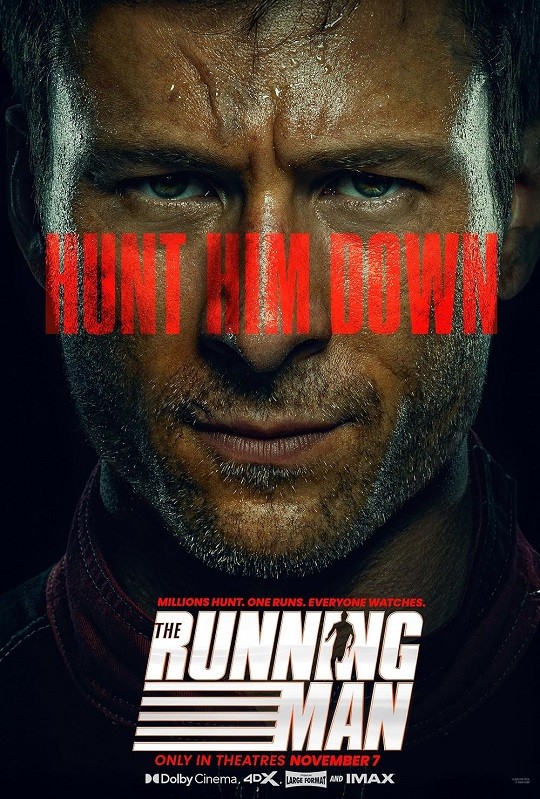
It is interesting on how the starting point of the new English film The Running Man is almost the same as the English film The Long Walk. And interestingly, both paint a dystopian picture of our future – the trick question being, are we in the end-game already? (Both books were written in the 1980s). The theme of capitalism conjoining the two narratives into blockbuster television irrespective of the fate of the contestants, does make the two films almost distant cousins of each other. It is also interesting on how both the narratives focus on movement – a smaller metaphor on struggles in our daily lives, representative of the working class who are on the hustle every single time working for their respective capitalist companies who offer them nothing really in return while earning in millions. One such member of the community is Ben (Glen Powell) who lives in a small enclosure with his wife and daughter who is shown to be ill. His wife works at a sleazy brothel for a quick buck, prompting Ben to look deep within him in order to take financial responsibility of his family. And the maze ahead for him is to participate in the game The Running Man – a 30-Day survival game show that offers him two solutions – a lump sum for his wife and daughter, or/and death!
Written by Michael Becall and Edgar Wright, The Running Man works well with the characterization of Ben – a fiery and impulsive protagonist who does stand-up against the anti-establishment elements. For instance in a scene at the start, you see him strongly fighting for an elderly person who had collapsed while standing in the queue for the auditions of The Running Man show. You are witness to the buildup of Ben’s anger – a metaphor in itself for the patience levels of the working middle class, especially when the tables begin to turn on them. His opponent isn’t a single entity but an entire organization called The Network, that hss taken over the country’s economy and infrastructure, thereby crippling the nation in the wake of fascism (hmm, sounds familiar?).
It is interesting how Dan (Josh Brolin), the head of The Network convinces Ben to be a part of his lethal gameshow. There is a hint of the power dynamics in play, so much so that it invariably makes Dan invinsible and someone who can call the shots, even while successfully having to manipulate or arm-twist people into playing the game. For Ben, it is a dead-end of sorts despite being aware that no one who has participated in the game show returns alive. And yet, the game-show is also used as a metaphor for the herd-mentality in play – wherein the gladiator-like setup of the world involves people having to report the whereabouts of the contestants, just so the authorities can hunt them down – all in the name of entertainment.
The capitalist themes have a sub-genre of manipulation, first on the part of convincing the contestants to participate, and secondly, selling lies to the people about the contestants. It is a form of witch-hunt similar to the ones we see on media channels that drives the narrative here. And yet for Ben, the important goal remains that of survival that sees him take refuge at random motels, almost being a shape-shifter of sorts like the character of John Wick in the fourth installment of the franchise. This is exactly when the drama does a balancing act of being thrilling and understated with its theme of survival. This includes an intense shootout, that further coincides with the theme of manipulation and lies, even as Ben find helpers along the way that echo his ideology.
The core criticism that I had with the writing here was more to do with the barter of indulging in thrills versus balancing it out with a strong emotional core. After a point, I did feel that while you were invested in the survival journey of Ben, his main motivation of a strong emotional core is hidden, thereby adding mildly to the hollowness of the drama. Amidst this, the themes of TRP, a term synonymous with the news channels and their anchors, makes its presence felt in the narrative too. And that does compensate for the lack of an emotional depth in the narrative.
I couldn’t help but think that the writing gets increasing convoluted in its own web, even as the writing doesn’t always land with the themes it once began with. And one reason for the same was with respecting to overstuffing the narrative with multiple themes including a kidnapping subplot, a random face-off between an assassin and the protagonist, a random reality TV actor appearing in the midst of the drama, the use of AI to further manipulate the viewers, and an extended sequence in an aircraft that threatened to challenge the absurdity of the climax in Race 2 (2013). It kind of felt forced despite me wanting to resonate with the inherent themes of the drama. It tried to be everything that The Long Walk wasn’t – focused and steady with a strong emotional core despite the presence of plenty of characters. The anti-establishment anarchy at the finishing line does salvage moments of pride making the screenplay satisfactory, but the on-your-nose treatment as opposed to a psychological one, ensured that the drama was rough around the edges.
The dialogues are corny with tonal indifferences wrapped in the narrative that boasts of bouts of black humour along with the broader strokes of urgency. The music and BGM are resounding, elevating the moments of thrill with notes that do give you that hormonal rush. The cinematography is outstanding with frames that are intriguing while being played around with the lighting really well. Even the transition shots are smooth, almost transporting you from one setup to another in a rather seamless manner. Director Edgar Wright has got to be right up there in a contemporary list of filmmakers that have a unique style of their own. And you see his style in full bloom here, wonderfully uses his frames and editing pattern to create the required amount of tension throughout the narrative. Yet, he does falter in portions in the second hour when the tone of the drama becomes increasingly corny. But having said that, the direction holds enough flair to hold the narrative together, while providing moments of entertainment along the way.
The performances are pretty solid by the members of the cast. Jayme Lawson as Sheila has her moments to shine, and she comes across as pretty sincere here. Michael Cera as Elton and Daniel Ezra as Bradley are key cogs in the screenplay and both manage to impress here. Colmon Domingo as Bobby adds zing to the narrative as the voice of the show. Lee Pace as McCone is decent here. Josh Brolin as Dan is intimidating and he uses his body language and his husky tone to convey the threat of his character, rather effectively. Glen Powell as Ben is the screen stealer here, simply given the kind of energy that he brings with his character here. Given that the majority of the drama unfolds through his gaze, it was imperative that his act would convince you to root for him through and through. And in a game of wit and synergy, Glen uses his body language and expressions to great effect while constantly carrying the weight of the narrative on his shoulders. He was a treat to witness here.
The Running Man is a relentless anti-establishment thriller that keeps you on the move despite a few rough edges in the second hour, thereby making it a fairly engaging watch. Available in a theatre near you.


