

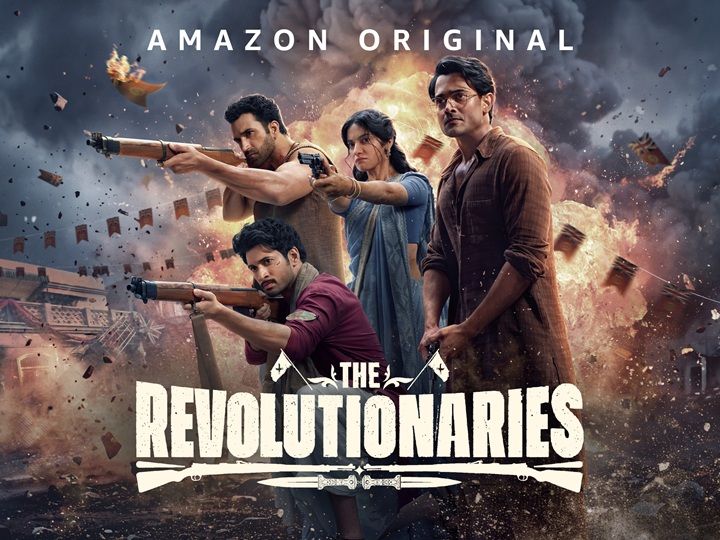
A series like The Revolutionaries can only be understood in hindsight, even as you get a fleeting glimpse of Azad, Udham Singh and Bhagat Singh towards the end of the show. In that sense, you get a fair indicator of the timeline – that is essentially a precursor to the mainstream independent struggles that have found a voice in our History textbooks. And so, the treatment also ought to have been an understated intermediary one – something that would do enough to acquaint themselves to the lesser known freedom fighters who had played their part in the collective independence of the country. Instead immediately after a prologue when you are witness to an event of an assassination attempt of the then Viceroy of the British Empire against the blaring notes of ‘Vande Mataram’, you do get a sense of isolation at the hands of the OTT algorithm that is meant for you to feel a certain way. Again, there is no hard and fast rule of presenting your national heroes as Superheroes, something that was so successfully done by SS Rajamouli in RRR (2022). The issue lies in the narrative that mustn’t use these tropes as fillers, instead returning to its bland mode of storytelling for most parts of the runtime.
Based on the novel ‘Revolutionaries: The Other Story Of How India Won Its Freedom’ by Sanjeev Sanyal, and written by Shobhit Narang, Akshita Wadhwana, Rutvi Mehta, and Sanyuktha Chawla Shaikh, The Revolutionaries can be termed as a companion piece to Nikkhil Advani’s last historical show Freedom At Midnight, simply given the context of events here. But one look at the tone of each of the two shows, and you would know a stark difference in the approach. The tone here is larger than life, something that would use slow-mos and stylized sequences to potentially elevate the action set-pieces. And my mind immediately wandered to a film like Inglorious Basterds (2009) that had used this template pretty impressively. Sadly, that isn’t the case here – wherein the writing flattens the narrative to an extent of convenience.
The focus remains on a handful of characters – Rash Behari Bose (Bhuvan Bam) who is a master of disguises while discreetly working as a chemistry professor in the vicinity of the Visceroy in order to prey on him, Sachindranath Sanyal (Rohit Saraf) who is born in a family of revolutionaries and wishes to prove his mettle as a ‘Gen Z’ revolutionary, his love interest and fellow potential revolutionary Pratibha (Pratibha Ranta) who adds to his conflict, and Bagha Jatin (Gurfateh Pirzada) who acts as their super senior in their collective quest for independence. This, even as some of the others including Sachin’s older cousin Abani (Tota Roy Chaudhary), Bose’s aide Pishima (Paoli Dam), Kartar Singh Sarabha (Kashish Saluja), and an overseas aide to the group Lala Har Dayal (Neil Bhoopalam) remain bylines in the narrative and their isolated set-pieces.
The writing decides to introduce a bit of pulp in the mannerisms of the antagonist General Dyer (Jason Shah) who stutters in a manner to make him be viewed as a caricature. And if the part of the brutality is lost in translation, then it is due to the stutter that is distracting in so many scenes. From a structural POV, the drama unfolds over a period of three years, ending in 1915 with the Ghadar Mutiny. But the portions in between feel utterly repetitive and increasingly bland. Be it the cat and mouse chase between the revolutionaries and the British that unfolds over cities like Benaras, Delhi, Lahore and Bengal, or even the interpersonal dynamics that lack the flair of youth – almost reducing every character to a moralistic sketch that wishes to exist in isolation.
There are periods of lag along with ridiculously wild slogs that mar the narrative. For instance in a scene, when the antagonist uses a piece of cloth to trace its origin to the city of Benaras which is the hiding spot of the protagonists – it felt like a far shot that was more distracting than palapably believable. This was particularly an issue given how the end result isn’t strong enough – with the protagonists fleeing at the nth hour, much like the writing of the show that doesn’t wish to go on a victory parade, often settling for a middling outlook. Another instance includes a pivotal sequence at the Calcutta port that is followed by a game of wits and a shootout, only for a messy bout of chaos to be the deciding factor on how some members of the group escape. Or even a sequence involving a plane crash that acts as a fair cliffhanger but offers nothing substantial in the subsequent episode.
The storytelling remains pretty flat and exhausting given how the themes begin to translate as a history lesson filled with preachiness. Be it the repeated words on how History will remember the characters, or even a character estimating the frustration of Indian soldiers in the British Army, or a checkpoint of feminism in the wake of the struggles of Independence – may all be relevant points, but they do come across as preachy instead of contributing to the immersive quotient of the drama.
The final act almost felt like an extended montage, even as the writing taps into crutial plot-points and later, skimming through the proceedings. This includes a mole in the vicinity who wishes to potentially rat out his peers, a planning amd preparation montage building up towards the Ghadar Mutiny, and eventually the final face-off. The emotional quotient in this period was so low and so manipulative that I didn’t feel anything for the characters – the highs of a nationalist flag being swayed in British-owned territory, or a moving moment centered around the death of a particular character. And that was enough to tell me on how the screenplay felt increasingly repetitive and exhausting, as opposed to an enticing commentary on freedom that was beautifully christened in a show like Freedom At Midnight!
The dialogues are intended to be over-the-top but the returns are diminishing, given how the core impact of the drama is missing. And when you have two English ‘stereotypical’ officers talking to each other in Hindi, you do realise that a lot of things are wrong with the writing. The BGM is blaring, often using the coined term ‘Vande Mataram’ against the backdrop of many frivolously choreographed action set-pieces (apart from the one at the Calcutta Port that was well staged).
The cinematography comprises of frames that don’t fully allow you to settle with the lines and emotions of the characters, while subverting the moments with crowded action blocks. Even the zoomed in frames, offer frustrating close up shots of a couple of characters at pivotal moments – something that had me distracted and disconnected from the drama. Even from a staging POV, the frames don’t score – wherein in an instance, you see a character trying to overpowering another character while facing the third character with a gun who shoots him down. Why couldn’t the character see right in front of him? Either he was blind, or the viewers! Additionally, even the plethora of locations feel the same, often brushed with tints of brown that just don’t add depth to the proceedings.
The editing pattern is pretty choppy, offering fleeting moments in isolation without transitioning the emotional core from one scene to another. The plane sequence is just one of the examples of the same here – something that felt like bouts of convenience, even as emotions are lost along the way. I had a good amount of hope from director Nikkhil Advani given his previous outing in the form of Freedom At Midnight earlier in the year. But here, the filmmaking felt flat and tiring, never fully realising the emotional core of the characters nor fully elevating the high-points in the drama. A couple of moments in the final act felt slightly clunky too, almost being staged in a way that had me facepalming. The soul and the tension (through grounded lines) that was pivotal in a show like Freedom At Midnight, was woefully missing here, summing up the direction that wasn’t the best.
The performances are a mixed bag here by the members of the ensemble. The likes of Riyansh Taneja as Kirpal Singh, Siddhant Raj Tripathi as Ravi Singh, Anubha Fatehpuria as Sachin’s mother, Mahabir Bhullar as Gurdit Singh, Tenzin Heshay Bodh as Marwin, KC Shankar and Pratik Laxman Motwani as Maan Singh have their moments to shine. Neil Bhoopalam as Lala Har Dayal is understated but also felt slightly half-baked from a characterization POV, given that the writing doesn’t fully allow his performance to bloom.
Athena Loanna Wyn Vlachos as Rebecca has a good screen presence, and she is pretty affable to witness here. Edward Lorimer Barnabas Robinson as DCP Charles doesn’t exactly get the sinister trait of his character right, something that is often weighed down by a tepid act. Jason Shah as Lt Col General Dyer came across as a bit of a caricature given his flimsy stuttering antic, that nullified the steady and calculative persona of his performance. As a result, the character didn’t really feel intimidating, something that was the need of the hour.
Paoli Dam as Pishima, Tota Roy Chaudhary as Abani, Avjit Dutta as Vishnu, and Kashish Saluja as Kartar Singh Sarabha often nicely grounded performances, although the writing reduces the impact of every character to a byline or a google search. Gurfateh Pirzada as Bagha Jatin is decent here, but his stoic expressions stripped his character off all the emotions. The performance needed to be slightly more immersive to have a lasting impression.
Pratibha Ranta as Pratibha Lahiri has a pleasant personality onscreen, but the arc given to her character felt convenience and preachy in the same breath, something that lowered the impact of her character. Rohit Saraf as Sachindranath Sanyal is presented as a confused and a conflicted personality, particularly the bouts featuring his love-story that felt utterly repetitive. And while his poise as a performer is on point, the performance itself doesn’t offer a range of self realisation that was pivotal for his act. This results in a mixed bag that with pretty consistent yet middling returns.
Bhuvan Bam as Rash Behari Bose is wonderful to the witness here, and the only actor (from the main cast) who is seemingly in control of his craft. His cold expressions don’t feel empty, his wiry body language has a larger purpose on offer, and the disguises that he endures is pretty well executed in an act that is steady, and largely impressive. This is definitely a step up for the performer who had started his acting stint on Youtube with BB Ki Vines, and now is heading a major show on a major OTT platform. That is an arc in itself, even as his performance here remains pretty convincing.
The Revolutionaries is a bland historical drama that frequently devolves into a repetitive, preachy slog without ever realizing its true potential. Instead of delivering an immersive experience with genuine emotional weight, the show relies on over-the-top dramatics that consistently miss the mark. Furthermore, convenient scriptwriting reduces potentially powerful moments to predictable clichés. Ultimately, these structural flaws and middling performances drain the narrative of any real tension, leaving me with a thoroughly dull and forgettable watch. Available on Amazon Prime.


