

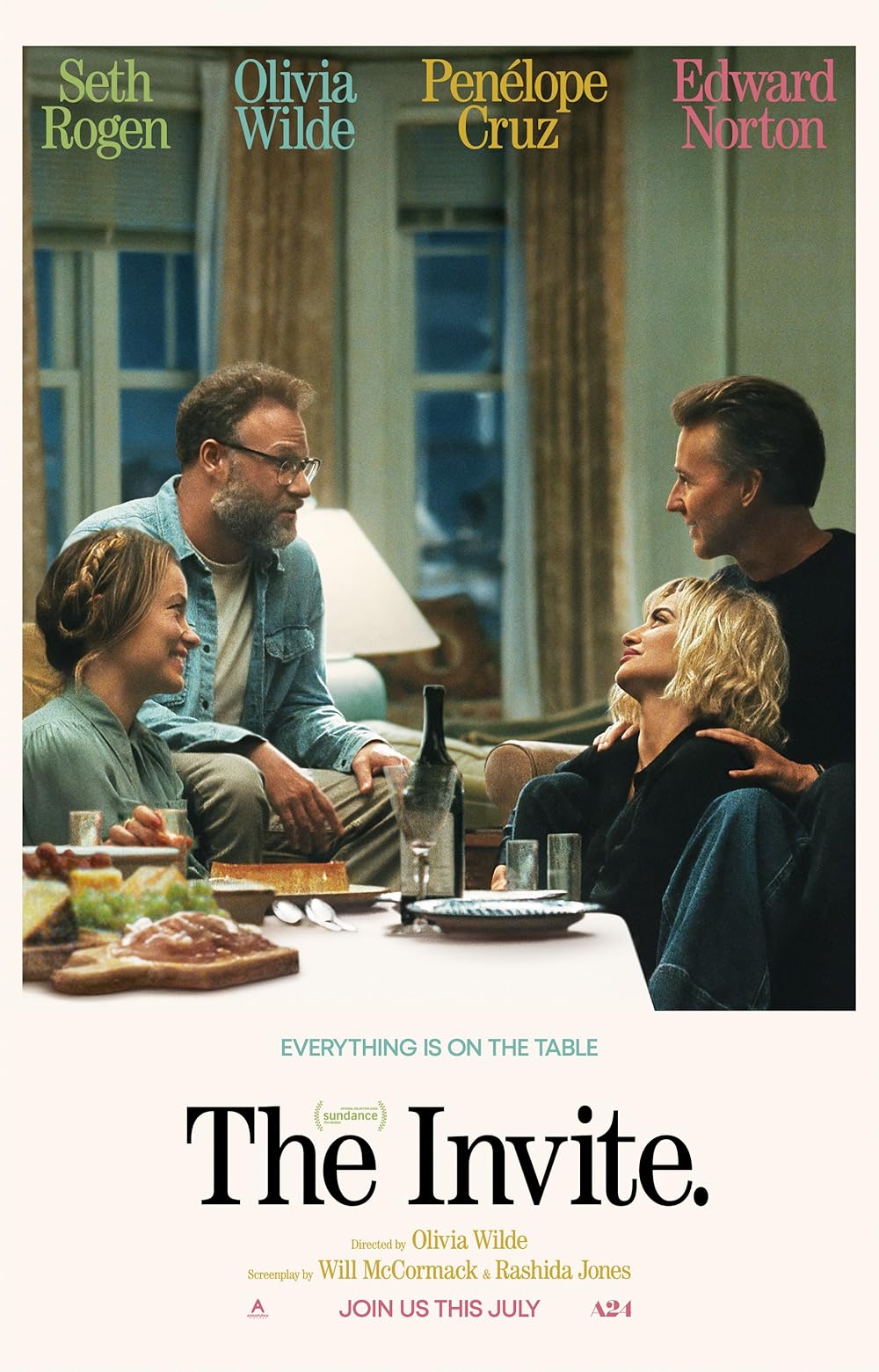
There is a pessimistic undertone greeting you at the start of the English film The Invite that greets you with the line – ‘One should always be in love. That is the reason one should never marry.’ It is almost a subtext of the characters Joe (Seth Rogen) and Angela (Olivia Wilde) who are visibly unhappy and entrapped in a sinking relationship. In fact, their relationship remains visibly off-colour – much like the pale blue attire of theirs, or the peeling shades of blue on their walls, symbolizing of the emotion of ‘feeling blue’. And the first obvious evidence of the same remains in their miscommunication – even as Angela willingly invites their neighbours for an evening of talk and wine, assuming that Joe has been paying attention to her words regarding the same, something that she has uttered just once. For the former, it remains a form of escapism – the idea of meeting and befriending new folks outside the four walls of her home. For the latter, it remains a medium of annoyance – of having to be his best (and most uncomfortable) behavior, while ignoring the issues that he has previously had with the couple.
An official adaptation of the 2020 Spanish film The People Upstairs, and written by Will McCormack and Rashida Jones, the single setting of The Invite remains a perfect recipe for a palpable disaster waiting to happen. In an alternate world, it would translate into a closed door murder mystery, or simply a night filled with secrets unravelling at regular junctures. But the tone employed here is of a searing comedy – something that could potentially extend to most married couples suffering from a communication crisis. In fact, the setting doubles up as a medium of claustrophobia too (in this case : a marriage) that instantly gives the characters a feeling of being ‘trapped’ – only for one of them to ‘invite’ an external influence as a ray of hope.
The characterization remains the key driving point of the narrative. While Joe is a failed musician, and quietly living a supposedly ‘failed’ life of a music teacher – he is quick to point a sexist flaw in his wife Angela, by asking her on what does she do the entire day at home. In another, he ridicules the condition of a menopause by plugging in a joke – something while increasingly coming off as a chauvinist. The same holds true for him cracking a joke at the most inappropriate place, when a character in his vulnerable moment is narrating the story behind his self-employed name. If you look closer, it remains his inability to comprehend the situation that he finds himself in – something that a character defines as something that many people would die for.
On the other hand, Angela remains a secluded character (you witness the lack of confidence in her frequent stutters, and the need to be politically correct without hurting anyone involved), lacking a spark in her life despite the presence of her husband and daughter. In a scene, she is quick to reminiscent of her first meeting with Joe at a nightclub – something that made her feel fresh and alive (enough to run 11 blocks to meet him), while only holding onto the same as her lone memory. Not only does she lack intimacy in her daily routine, but life has almost come to a monotonous standstill – to the point that she is now willing to befriend strangers as an escape mechanism. Ironically, she also buys into the idea of swapping partners at the first instance, almost willingly agreeing to barter her loyalty for the ‘freshness’ and ‘excitement’ in her relationship.
Both Pina (Penelope Cruz) and Hawk (Edward Norton) may appear to be ultra-liberated individuals, who would challenge the conventional norms of happiness for the society. In fact in an alternate world, the characters would appear are therapists or counsellors to couples – a trace of which you sense, during their individual interactions with Joe and Angela. But the subtext to their liberal character trait remains an after-effect of their previous lives – wherein both characters have had a dark past involving failed relationships. And therefore, their idea of happiness isn’t confined to the norms of the society, nor is it confined to loyalty – even as you witness the couple inviting the protagonists for a night filled with passion and k*nk (in the most open manner possible).
The proceedings are often laced with dollops of dry (and ‘wet’ 😉) humour, while maintaining a layer of k*nk as an underlying layer. The subtext remains on how intimacy could be the first step in bringing couples closer – with the exception that they need not be interlinked with loyalty or monogamy. It remains a specific instance of reviving the spark in life, something that would keep relationships healthy without compartmentalizing it with the baggage of love to begin with. And while this philosophy holds true for Pina and Hawk – you mildly witness the hesitance in Joe and Angela, who buy into the idea without fully committing to the philosophy.
The events offer a profound commentary on the idea of love and intimacy, particularly as viewed through the gaze of Joe and Angela. For the duo, intimacy remains the first door of navigating towards emotional infidelity – even as both of these traits have evaporated over the years in a sparkless marriage. In a scene when it is disclosed that the couple haven’t been intimate with each other in over a year – it reaffirms these traits or rather, the lack of them.
And yet, the finale involving the couple reclaiming their emotional core while playing the piano – it is a reminder that intimacy may not always be physical but also emotional, even as the couple draw inspiration from their past to create a sliver of a spark that ignites a sense of hope for their relationship. The screenplay is layered, and wonderfully penned while having profound streaks sandwiched between unfiltered moments of laughter.
The dialogues are conversational and layered with sarcasm and dry bouts of humour, that keep the conversations brewing. In fact, the lines reveal a lot of information about the characters, their traits, and the situation that they find themselves in – without ever entering the melodramatic space. The shades of dry and dark humour alternate well, while efficiently creating humourous moments along the way, even while accounting for a strong emotional core with respect to the characters involved. The BGM relies on the raw sounds engulfing the characters, something that naturally immerses you in the narrative.
The cinematography comprises of frames that oscillate between wide-angles shots and tight closeups – the former used to showcase the emotional distance between the characters, and the latter accounting for a deep dive into their psyche. This, while never losing out on the humour quotient of the narrative by allowing the lines (and situations) to take centerstage. The editing pattern allows the conversations to brew seamlessly, without employing fast cuts to trim the flow of the same. This, while crisply intercutting two parallel narratives at one-point – both hinting at a freshly brewing spark between a specific set of characters, that keeps the ball moving. And all of it, while never losing sight of the core themes of the drama.
Director Olivia Wilde does a superb job in creating an immersive ambience, laced with eerie and mysterious undertones, only to flip the tone and inject ample amounts of humour along the way. This, while also majorly scoring with the characterization – something that not only offers an emotional hinge in the drama, but also creates an alternate dimension to the humour quotient in the narrative. The direction is splendid, even as it challenges the stereotypical norms of happiness imposed by the society, while also creating profound moments of intimacy that adds weight to its characters.
The performances are splendid by the members of the cast. Edward Norton as Hawk offers a carefree presence on the surface, while effectively carrying an emotional burden that shapes up his present – a complex character that is essayed with perfection. Penelope Cruz as Pina offers a matured presence as a sharp contrast to her ‘partner’, while having a rational and unfiltered approach to the concept of happiness and love. And she pulls off her character wonderfully well, with streaks of k*nk and profoundness.
Seth Rogen as Joe almost veils himself like a modern day Chandler from Friends (1994) – with the exception of him being ‘mostly’ emotionally unavailable for his wife. There is a specific quirk tagged to his character, something that makes him appear to be a callous chauvinist. And yet, he uses his humour (including some sharp one-liners) effectively to hide his vulnerability of being a failed musician – something that he pulls off with a lot of flair.
Olivia Wilde as Angela is a layered character, partly underconfident, and partly escapist by nature – completely trapped in a loveless marriage, while aspiring for a spark to revive it. She uses her expressions and her body langauge to great effect, in communicating her vulnerability without specifically highlighting the same – making this a brilliant performance to the core. The specific arcs of Joe and her offer an emotional hinge to the drama, even as she wonderfully essays her character that is layered.
Beneath its sharp wit, The Invite serves as a deeply layered examination of human connection, physical and emotional intimacy, and the pursuit of happiness. Laced with dollops of dry humour and elevated by wonderfully k*nky, fearless performances, it evolves into a provocative and thoroughly entertaining watch that is profound and ticklish in equal measure. Available in a theatre near you and Highly Recommended!


