

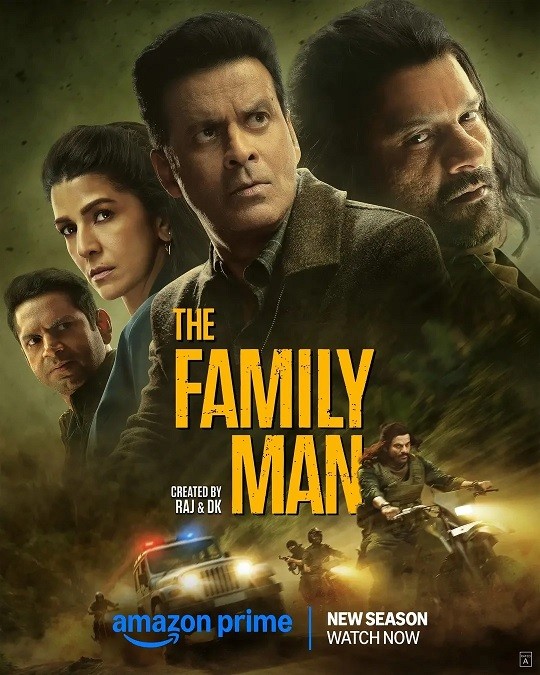
It is interesting how the third season of The Family Man marks the second show on Amazon Prime this year that is set in the North East, after the second season of Paatal Lok. And I say interesting because it tells you a thing or two about the political landscape of the country with respect to certain regions and how politics ties them together. For instance, Kashmir becomes a sensitive zone, as do Delhi and to an extent Bihar wherein you cannot set the drama in the current timeline, often having to utilize the pre-2014 period to drive home your point. But in the same breath – the territory of the North East has a little much freedom, much like the states from the South, often being viewed as mouth-pieces of anti-establishments, that offers a more refined product in terms of the politics at the end of the day.
It is what it is in 2025, and it seems like we need to accept this new normal going forward too – even as the third season of The Family Man bears an eerie resemblance to the second season of Paatal Lok: North East being at an arm’s distance from Delhi with people often exhibiting trust issues, investigative officers from outside the region entering amidst a political turmoil, a character being killed off that coincides with the integrity of the protagonist being questioned who is termed as a fugitive, even while having to deal with a broken marriage of his own. The parallels are there but so is the fetish to continue the story to the next season.
Written by Raj & DK, Sumit Arora and Suman Kumar, the third season of The Family Man scores once again with its characterization of the protagonist and the antagonist here. Both Srikant Tiwari (Manoj Bajpayee) and Rukma (Jaideep Ahlawat) are two characters who are mirror images of each other. Srikant is an intelligence officer so committed to serving his country, that he is distanced from his wife Suchitra (Priyamani). In fact, the feeling of his wife having cheated on him ‘once’ doesn’t necessarily anger Srikant who still understands her point of view – but the repercussion being that of him distancing himself from her and his family. Ironically, it is similar to the North East region that is distanced from the mainland in terms of the political disagreements and issues that co-exist specifically in that region. And it is also ironic on how the latest mission of Srikant becomes the sole reason of him coming close to his family.
Rukma on the other hand is a drug kingpin and someone who takes up odd ‘illegal’ jobs to survive. It must also be noted on how sharp Rukma is with his assignments and figures – you see him killing off a character who stealing just Rs 30 lacs from him, or in another wherein he forcibly injures a character by shooting him on his ear lobe, because for Rukma it is all about integrity. In a parallel world, this would be Srikant who is committed to any drug assignment given to him, or Rukma who would go to any extent in serving the nation. Both characters have similar traits and are interchangeable. But the conflict of Rukma is exactly the opposite of Srikant – he aspires to marry Nima (Andrea Kevichusa) and adopt her son along the way, only for Nima to get killed off in a shootout, something that he blames Srikant for given his affiliation to the law that would never provide justice to people like Rukma.
This particular event is true even for Srikant who has lost his mentor, having being killed off by Rukma, thereby making this mission personal. One is a family man, one aspires to be and the mission is personal to both due to the commonalities in the deaths of their loved ones respectively. The same parallels can extend to a couple more characters on the show – Zoya (Shreya Dhanwanthary) and Yatish (Harman Singha), both characters suffering from personal losses, while having their eyes on Srikant for different reasons. It is also a reminder on how most characters here don’t work in isolation bit instead are tied together by similar character arcs along the way.
The humour of this franchise has always been situational, and here too you notice some interesting bouts of it. Raj & DK’s dig to the YRF spy universe is now evident through the bits in the trailer even as you notice a curious Atharv (Vedant Sinha) asking his father whether he has code names in his profession like Tiger, Panther etc. It remains the first sign of a curious mind being acquainted to the professional whereabouts of his father, something that translates into the family coming together. For Suchitra, it remains a bit of a dichotomy of having to choose between being completely oblivious and falsely assured about Srikant, or now, knowing his reality that remains linked to him being alive or not. You see her being agitated in various sequences just because she doesn’t know the whereabouts of her husband – another sign of the family of Srikant coming close (interestingly set in the North East that draws parallels to Srikant too). That said, the parts involving JK (Sharib Hashmi) and his matrimonial dating encounters felt slightly forced and something that works in isolation as opposed to circling back to the main plot.
The politics in the drama also adds some weightage to the narrative even though I did get an impression that Raj & DK couldn’t go all cylinders blazing here. There are characters like Stephen (Paalin Kabak) – the grandson of a senior leader, and the leader of a rebellious group himself who is falsely framed for the attacks in the state – another parallel to Srikant who is falsely implicated as a fugitive for his own organization. You also have a capitalist businessman Dwarak (Jugal Hansraj) who wishes to push forth the arms deal with the governments of India and Pakistan, all for money without considering a clash of the nations. So when the peace treaty in the North East sabotages his deal, his pushes forth his broker Meera (Nimrat Kaur) one the ground level to fuel chaos. In the same breath, Meera and Rukma are similar characters who might have an indifferent beginning but still tend to get along well as the drama progresses. She is as much of a pawn as Rukma, an unfamiliar common ground that binds these characters.
On the other hand, the political games being implied with the characters of PM Basu (Seema Biswas, perhaps a character rewrite demand from OTT), Sambit (Vipin Sharma) and Yashwant (Aditya Srivastava) is skewed if you take the current political atmosphere into consideration. PM Basu feels like a juvenile while being surrounded by men who wish to take a decision for her, almost as the drama seems to be set in a parallel world wherein media houses prefer to question her integrity as opposed to the opposition parties. And the main Delhi-conflict from the perspective of Nagaland was the missing link, something that needed to be more pronounced. Well atleast there is a scene of a news anchor flipping the narrative of Suchitra’s (who happens to be on a panel) Chinese App by shifting focus to her personal life. Yes, it is the kind of a barter that we will have to settle with even as censorship continues to break new boundaries.
This season though is a lesser product than its previous two seasons simply because there is a tad too much emphasis on the context, almost preparing the viewers for the things to follow. For instance, the shocker of a principal character being bumped off at the start feels a tad underwhelming because the scene prior to that involves that character literally laying out the dangers of life in the state of Nagaland. Likewise, some of the sequences seem clunky from an execution point of view too, along with being far too convenient with the writing. For instance, the finale clash wherein Srikant and his convoy are captured, only to be free in a couple of scenes. The clash between Srikant and Rukma also feels largely underwhelming given that the stakes in the drama after the twin-personal losses continue to be middling, without any real fizz to bind the emotions together. And at the cost of repeating myself – what is the fetish really of filmmakers choosing to end a season on a cliffhanger without quite ending the current storyline. It happened with Search and Maharani this year, and this plague also has affected the third season of The Family Man. The end result is underwhelming and incomplete particularly when you view the potential that the show had with its above pointers.
The dialogues are accompanied by tad bits of humour that may not be as memorable as the previous two seasons, but they still remain effective with respect to the storytelling here. The BGM is gentle in scenes of dialogue exchanges and exposition, but automatically amps up the synergy in multiple chase sequences and moments of thrill. The cinematography comprises of frames that captures the landscape of Nagaland and Manipur beautifully. In fact, the incredible one-take shot offers a perfect cold open wherein a political talk at a cultural event is cut short by a bomb blast. The editing pattern here is crisp for most parts of the runtime, offering ample moments of thrill along the way.
I will always be seated for a Raj & DK show simply because the narrative style that they employ is always unique. And here too, their focus remains on playing with the characterization and character arcs even though the politics this time around can be labelled as ‘safe’. But that might be more of the OTT issue rather than the prolific director duo who manage to score here despite a lesser outing by their standards. And the little homage to actor Amit Mistry did account for a moment of melancholy too.
The performances are incredibly good here by the members of the ensemble cast and a huge shoutout once again to casting director Mukesh Chhabra for hand-picking some exciting talent here. The likes of Priti M as the airport ground staff, Ronjini Chakraborty as Prerna, Sunil Thapa as David, Aritro Rudraneil Banerjee as Punit, sundeep Kishan as Major Vikram, Dalip Tahil as Kulkarni, Riyan Mipi as Bobby (super sincere), Aditya Srivastava as Yashwant and Tenzin Dalha as Rabbit, all are supremely competent while having their moments to shine. Vijay Vikram Singh as Ajit, Ravi Varma as Varaprasad, Uday Mahesh as Chellam sir, Pawan Chopra as Sharma and Jason Tham as Colonel Zhulong are wonderful to witness here. Poonam Gurung as Ulupi and Millo Sunka as Jesmina are wonderful additions here and they manage to impress. Andrea Kevichusa as Nima has such a solid screen presence that you feel the impact of her character even after witnessing her fate.
Seema Biswas as PM Basu delivers a dignified act despite her character being underwritten from the subtext of politics. Vipin Sharma as Sambit is a layered character with a lot of understated motives that act as moments of exposition, and he manages to excel yet again here. Paalin Kabak as Stephen is sincere and understated, something that act as key contributors in wanting to emotionally invest in his character. Jugal Hansraj as Dwarak is deftly scheming while having an aura of power that he utilizes very well with respect to his character. Darshan Kumaar as Major Sameer again has a layered perspective with respect to the conflict that he beholds, and he manages to leave a mark. Gul Panag as Saloni is assertive and uses her aggressive body language effectively while putting forth a commendable act.
Harman Singha as Yatish has the personality of a savior that plays a major role with the kind of perspective you view the character from. And given the payoff, it can’t be denied that there are layers to be discovered, wherein he puts forth a solid act. Likewise, Shreya Dhanwanthary as Zoya has a more internal conflict that keeps you invested in her journey. The traits of grief and regret lace her character beautifully, even as she touches upon some emotional facets of her character rather well. Vedant Sinha as Atharva and Ashlesha Thakur as Dhriti add a different dimension to the drama with respect to the humour and deliberate wokeness as viewed from Srikant’s perspective. And both of them are a joy to witness here.
Priyamani as Suchitra has the poise and grace to carry off her character with aplomb while effectively accounting for anxiety that laces her character, this time around. Nimrat Kaur as Meera has a poise of her own here, while carrying a cold persona of intimidation even as she owns the arena here. There is something about witnessing Sharib Hashmi onscreen, someone that always reeks of sincerity and affable layers of joy that genuinely reflect in his performance. As the boisterous JK, an anti-image of an intelligence officer, Sharib is exceptional here, often tickling your funny bone with subtle bouts of humour despite most of his sequences written in isolation. He is effective as ever and has a sense of relatability to that one friend in your group who maybe boisterous but is always a loyalist.
Jaideep Ahlawat as Rukma (his second outing in the North East this year after the impeccable Paatal Lok) has such a refreshing approach to his character. He isn’t your typical antagonist with binary shades in play. He humanizes the character so much so that you understand his perspective too while empathizes with his flaws. It remains a genuine attempt of having a layered approach to a character that the world sees as ‘bad’, even while putting forth a supremely brilliant act.
Manoj Bajpayee as Srikant Tiwari is the life of the show, and he continues his act of brilliance here. He is vulnerable but still assertive while carrying off his duty as an intelligence officer and balancing his personal life too. And that makes this character grounded unlike the Tigers and Panthers of another Spy Universe, wherein the rooted traits of his character resonate really well. He is effective in combat sequences while absolutely acing his character here, and at this point Srikant Tiwari is a cult figure in the pop-culture of the internet.
The third season of The Family Man is a fairly engaging thriller with strong performances that drive the narrative. But it still marks a dip in form for a franchise that is widely loved, and much of it stems from the idea of trying to play it safe (more to do with most OTT platforms these days), while suffering from the fetish of the next season syndrome given the cliffhanger at the end. But despite that criticism, the show still remains bingeable and well worth a watch. Available on Amazon Prime.


