
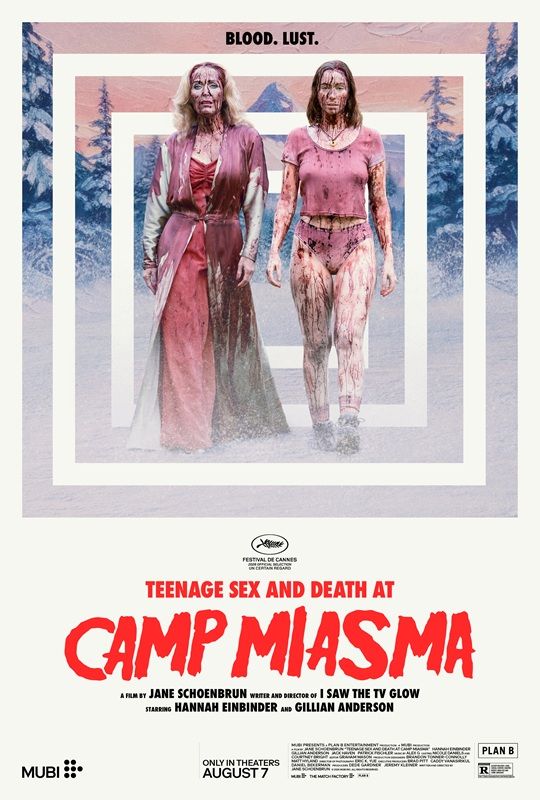
It is interesting on how the cold ‘montage-y’ open of the English film Teenage S*x And Death At Camp Miasma offers a contrasting balance between a nostalgic bait and a biting satire for horror films. The visuals of a low-budget horror franchise pop-up, ranging from the significant highs of sleaze to the ultimate lows of its cash-cow sequels – something that forms a searing arc of its own. It is almost reflective of a franchise that had once successfully tapped into the thirsty psyche of the viewers, containing their palpable excitement in the world, and later only creating iterations of it. And needless to say, it is the latter that had lead to the downfall of a franchise called Camp Miasma – the set of movies known to commodify the trans-s*xuality of the antagonist while turning him into a killing machine veiled as an air-conditioning vent; the one that could be peeked into – even whilst utilizing the familiar tropes of the genre of teenage boys and girls being slashed in a geyser of blood after having s*x. Yes, s*xuality and s*x remain pivotal forms of cardinal sin in this movie within a movie which is a nod to the ‘Friday, The 13th’ franchise!
Written by Jane Schoenburn, Teenage S*x And Death At Camp Miasma can immediately be termed as a companion piece to the director’s previous outing ‘I Saw The TV Glow’ (2024), simply given how both these films connect identity with the pop-cultural phenomena. Here, the onus remains on the protagonist Kris (Hannah Einbinder), a queer director appointed by the studios to revamp the sinking horror franchise ‘Camp Miasma’. In a way, her identity is deliberately linked to a franchise that she has grown up on, almost drawing its parallels to the executives who had previously done their bit in murdering the franchise. And it is interesting on how the writing treats each of these aspects as isolation as well – forming a searing commentary on identity, acceptance and transformation; along with a biting satire on horror films and the cash-cow sequels that are generated.
The biting satire of Hollywood sequels is associated here with dollops of token-wokeism, something that is prevalent in the first half of the drama. In a scene, you witness the protagonist sharing her angst with another character by stating on how by hiring a critically acclaimed queer director to direct a sequel, the studio executives have tried to perform a clean up an intellectual property by using the identity of the protagonist, whilst completely ignoring the raw forms of art that had made the franchise successful in the first place. It is similar to a recent meta-example of a superstar choosing to work with a successful indie-filmmaker while ultimately delivering a ‘toxic’ mess of a film, given how the latter’s identity was used to mask the ulterior identity of a film that predominantly did unfold through the male gaze. Irony keeps dying at the hands of cinema, another form of Little Death!
It is interesting on how the writing creates an intersecting Venn Diagram between s*x, death, and trauma – the triangle of pleasure. And this is implied with respect to the protagonist who had consumed the horror film as her staple diet during her impressionable years. The effect of the horror film can be substantiated from the fact that the protagonist wishes to cast the yesteryear’s actress Billy (Gillian Anderson) for a pivotal character in her new film. It is immediately a bout of nostalgia for the protagonist who has contained her identity in the most successful film of the franchise. In fact, the dynamic shared between Kris and Billy is topped with a shared crisis of trauma, death and intimacy.
In a pivotal scene, you witness Billy being slightly uncomfortable while watching her younger self in a scene from the film Camp Miasma. It is later revealed on how she was s*xually assaulted to the point wherein she chose to dissociate in the moment, only to enjoy the act from the POV of Little Death. And an interesting anecdote is that the metaphor for Little Death is a steady orgasm. For Kris, this trauma is shared – having to witness the antagonist traits of the killer who is a trans, only enjoying s*x while fantasizing herself as the victim girl who dies at the end. The mental block of intimacy is what links the two characters together, essentially being the same individual at different stages of life tied together by the common issue of abuse, desires, acceptance.
It is also imperative to know that the protagonist Kris had deliberately made a critically-acclaimed horror film by reversing the tropes of transphobia – as highlighted in films like Psycho (1960), almost rewriting a film from the victim’s POV. This is an immediate metaphor for the final girl trope that is conceived on the basis of patriarchy and the male gaze – often being the only survivor because she is ‘pure’. But this theme is also subverted through the protagonist’s interactions with Billy, who suggests her to avoid intellectuallizing a film while helping her discover her suppressed s*xuality.
As a result, their mutual obsession gives way to a new language of the horror film – wherein the male gaze is transformed into a palatable queer language governed by the male gaze. And the blurring final act is symbolic of the same – wherein both the protagonists choose to uphold their identities, leading to a surreal state of transformation through the medium of cinema; with their previous selves being killed, and the newer ‘blood-drenched’ versions being reborn. The latter being free of any prejudices of the hacked agents and Hollywood executives dictating their terms in a soft power tussle, or their previous selves being curbed with regards to their desires, and identities. The screenplay is wonderfully well penned, while superbly highlighting the meta-ness dictating the lives of people.
The dialogues range from posing as a biting satire to a deliberately ‘campy’ commentary on identity. And the lines often are christened with a streak of comedy in their aftermath. The BGM offers a parody of sorts on the million slasher movies being made previously, while subverting it with softer notes of affection and awakening. The balance is pretty effective in the context of the drama. The cinematography comprises of frames that are pulpy and vibrant, as opposed to a subdued dreary outlook that is a staple for horror slasher films. And this remained a deliberate creative choice that coincided with its themes of a satire amidst a discussion on identity. Even some of the visuals of ‘campy’ paintings is literally inspired from the alternate meaning of the word ‘camp’ in the title – offering a deliberate satire veiled as a parody of meta-ness. And the deliberate split diopter shot at the end was iconic!
The editing pattern wonderfully holds the narrative by balancing the dual themes in play, seamlessly blending a meta-commentary on identity with a biting satire on horror films. Director Jane Schoenbrun brilliantly subverts slasher tropes to explore queer desire and post-transition liberation. Moving past the dissociative dread of I Saw the TV Glow (2024), Schoenbrun’s direction uses a campy, retro horror framework to ground its characters in a deeply tactile reality. The filmmaking playfully balances stylized artifice—featuring a shifting “monster scale” of gore that jumps from neon-pink blood fountains to slick, cinematic thrills—with beautifully painted winter landscapes. By reframing the dynamic between a reclusive final character and a genderfluid killer, she treats the horror genre not as a place of punishment, but as a liberating space to confront trauma and celebrate the euphoria of self-discovery.
The performances are superb by the members of the cast. The likes of Zach Cherry as Will, Eva Victor as DJ Ella, Arthur Conti as Alex, Jasmin Savoy Brown as Mari, Patrick Fischler as Rudolph, Florence Barrett, Jordana Summer, and Ryan McEwen have their moments to shine. Jess McLeod as Tracy, Quintessa Swindell as Julie, and Sarah Sherman as Kris’ agent wonderfully contribute to the fabric of the drama. Jack Heaven as Little Death, Aren Buchholz as Thor, and Amanda Fix as Young Billy are superb while ably contributing to the meta-ness of the world.
Gillian Anderson delivers a mesmerizing performance as Billy Presley, the reclusive “final girl” of the original slasher franchise. Her portrayal blends a sultry, languid delivery with a commanding body language that radiates seasoned confidence. She expertly balances a sense of trauma with an alluring aura of sexual liberation, keeping the audience locked in her psychological grip.
Hannah Einbinder shines as Kris Williams, an ambitious and shy queer filmmaker tasked with rebooting the fading horror series. She grounds the film’s hallucinatory elements with a delicate, nervous energy that beautifully contrasts with Anderson’s commanding presence. She effectively anchors the surreal story, culminating in a powerful, emotionally raw climax.
Featuring stellar performances, Teenage S*x And Death At Camp Miasma is a brilliant, surrealist psychological romantic drama that subverts horror tropes with a biting meta-commentary on the genre itself. By deftly weaving profound themes of identity, acceptance, and s*xual awakening, this film transforms standard camp slasher conventions into a deeply layered exploration of youth and self-discovery. Though its unconventional narrative structure makes it a distinctly niche experience, its emotional resonance and razor-sharp intellect deliver a captivating drama that is brilliant to witness. Available on Mubi and Highly Recommended!


