

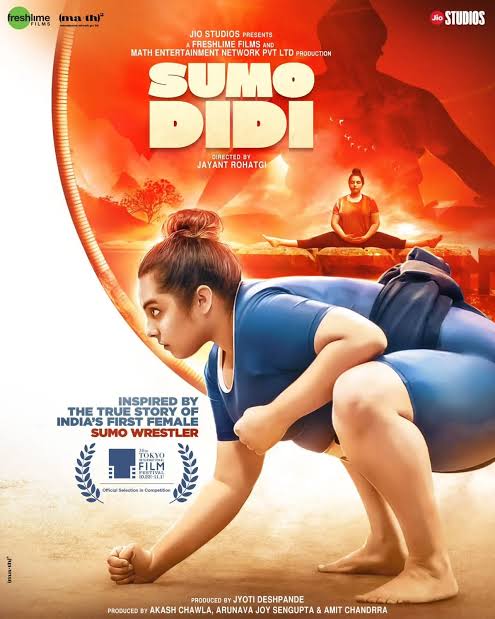
The new Hindi film Sumo Didi is a derivative sports biopic veiled as a searing humane story. If you notice this close, both these virtues often go hand-in-hand, almost forming a familiar template that eventually is designed to give you an emotional high by the end of things. But despite these familiar beats, the one thing that instantly stands out is the uniqueness of the sport – Sumo Wrestling, something that is less popular or worse, even unheard of in a cricket-loving country like ours. And this sport is formulated through the very issue of fat-shaming that it chooses to weaponize – thereby instantly forming a humane story that is capable of ringing in all the right emotions.
One scene at the start rings in this emotion rather well, wherein the protagonist Hetal (Shriyam Bhagnani) who is often shamed for her over-sized demeanor, is made to sit with her cousin during a matchmaking instance – simply because she is the ‘less-prettier’ one. Ironically, the cousin’s ‘prettier’ sister is away, while this entire incident is transpiring – a searing commentary on the society juxtaposed through the lens of the protagonist who remains a perennial underdog due to her weight.
Based on the life of Ace Sumo Wrestler Hetal Dave, and written by Nikhil Sachan and Arunava Joy Sengupta, Sumo Didi chooses to address the issue of fat-shaming as a predecessor for the sporty superpowers of the protagonist. It is interesting how the fat-shaming issue is showcased to have plagued the protagonist from her impressionable years – often surmounting a surge of angst and anger within her, a far cry from the comedic spree that this issue is passed off as, in films like Dhamaal 4 (2026). The only issue from a writing point remains on how it doesn’t wish to pause, and allow the emotions to be imbibed in the moment. The weight-issue leads to an early bout of attaining the sport of Judo for the protagonist, even while sandwiching the plethora of taunts from her mother Sudha (Anubha Fatehpuria) – who like every Indian parent wants to marry off her daughter.
It is interesting how the writing treats the perceptions of two genders here towards the protagonist. The women of the world are accustomed to taunting the protagonist, with a character also suggesting her to undergo a surgery to lose weight. In sharp contrast, the men of the world understand the protagonist a lot better. Be it the protagonist’s father Rajendra (Late Nitesh Pandey) who showcases a sensitive side by empowering his daughter, always doubling up as her silent cheer-leader or the protagonist’s friend and coach Akshat (Chaitanya Sharma), who doubles up as her caring lover too, helping her pursue her goal. Or even the protagonist’s brother Vikku (Raghav Dhir) who discreetly applies for her scholarship at one point.
One of the issues with the narrative remained how it wished to lean a lot on the montages to account for the timeline shift – in the process diluting the emotional impact of the narrative. The idea of going from point A to point B in a matter of scenes, simplified the very nature of the sport that it wished to address – a shortened sport in the ring that takes years of conditioning to win.
But having said that, the montage training sequences definitely pack in a punch. There are two montage sequences, one each in the first and second hour of the film that defines the soul of the narrative. I liked the detailing in each of the two sequences – one involving a more raw instance of the protagonist weight-training with cylinders and ropes, and the other, almost like a nod to a similar sequence in Chandni Chowk To China (2009) – minus the callous humour. It is interesting to note that each of these sequences are invariably related to the results of the protagonist inside the sumo wrestling ring – one that has her losing one game after another, and the other, wherein she lifts the bronze for the country. In between, some lesser obstacles with respect to her diet or the logistical variants required to participate, make fleeting appearances that could have been fleshed out a little better.
There is a beautiful sequence at the halfway point, wherein there are a series of revelations made about the scholarship of the protagonist, and her love-interest, amidst an argument and a chatter around her marriage. That scene was so well penned, almost having a graph of its own, that symbolized the spirit of the drama, and its characters alike. In the same breath, I liked how the human emotions of this scene circled back at the end, while steering clear from the nationalistic fervour that the genre is often guilty of.
This remains the story about an individual, flawed with its derivative template but actively superior with its emotional core and the uniqueness of a lesser known sport, packed in a screenplay that has its moments to shine. The fleeting moment of Hetal’s aunt finding courage to step away from her marriage, while drawing inspiration from her – is one of the few takeaways of how the writers chose to complete the arc of the protagonist – another indicator on how emotions take a preference over a familiar template!
The dialogues remain grounded without sensationalizing the sport or trivializing the issues of the protagonist. There is a tender outlook to the proceedings, often christened through the comforting lens of the characters that defines the fabric of the drama, subtly elevated through the lines. The music isn’t memorable here, but the songs go well with the trajectory of the narrative – infusing synergy at regular instances. The BGM encapsulates the emotional core of the drama pretty well, subtly heightening its impact at specific instances, in accordance to the journey of the protagonist.
The cinematography comprises of frames that form an arc of their own – capturing the vulnerability of the protagonist at the start, while transitioning into bouts of intensity later on. This, without losing sight of the critical emotional core on which the drama is mounted on. The editing pattern is a bit rushed, not quite allowing for the emotions to fully settle in – before moving forward. This did partially lower the impact of the narrative, but not to a point for the drama to completely drown. Some pivotal moments definitely leave you with a high, emotionally and otherwise too – through some crisp edits.
Director Jayant Rohatgi fairly elevates a conventional sports-drama template by anchoring the narrative in the raw authenticity of the protagonist. He ably taps into the female protagonist’s profound emotional graph and demanding physicality, transforming routine training montages into deeply resonant battlegrounds of the spirit. His precise focus on her internal vulnerabilities and external grit successfully papers over a derivative narrative pattern. This intimate character exploration ensures that the film’s predictable beats aren’t distracting, allowing the core drama to score fairly well.
The performances are wonderful to witness by the members of the cast. The likes of Ranjini Ghosh as Shruti, and Sucheeta Trivedi as Kusum have their moments to shine. Meenal Kapoor as Shobha delivers a subtly heartfelt performance that ably defines the inspirational legacy of the protagonist. Raghav Dhir as Vikku is natural to the core, using a chirpy and frothy mechanism to showcase the sensitive support towards his sister. Kazumasa Mato as Taoshi excels in aiding a specific montage sequence, while displaying a toughened camaraderie with the protagonist mixed with high doses of warmth. Chaitanya Sharma as Akshat has a charming presence while playing the perfect foil for the protagonist, oozing with a sense of sincerity and earnestness. He has a wonderful screen presence while putting forth a commendable act.
Anubha Fatehpuria as Sudha is wonderful to witness her as the nagging mother of the protagonist, even as the writing offers her a searing arc of realisation. She is a treat to witness here. Late Nitesh Pandey in one of his final outings as Rajendra brings such beautuful bouts of tenderness to his character. His silent sensitivity cuts through the potential vulnerability of the protagonist, while offering her soothing moments of comfort.
The star of the show is Shriyam Bhagnani who is brilliant as Hetal Dave, beautifully balancing raw athletic force with deep emotional layers. Portraying India’s first female professional sumo wrestler demanded immense physicality, requiring the actor to undergo an intense weight transformation and master gruelling, explosive movements. Yet, the true triumph of her portrayal lies in how she utilizes deliberate body language and nuanced facial expressions to anchor the character with a strong emotional corw. Through these subtle shifts, she wonderfully exposes Hetal’s profound vulnerability and quiet defiance while weathering the heavy emotional toll of societal judgment. This was a masterful act in every sense of the word.
Featuring excellent performances, Sumo Didi offers a searing wave of emotions and a humane story that cuts through the standard derivative template of a sports biopic drama. The emotions aren’t trivialized, neither is the sport sensationalized – quietly treading an intimate journey of accomplishment that makes for a good watch. It may not be ground-breaking, but it still does enough to engage you through its runtime. Available on Zee5.


