
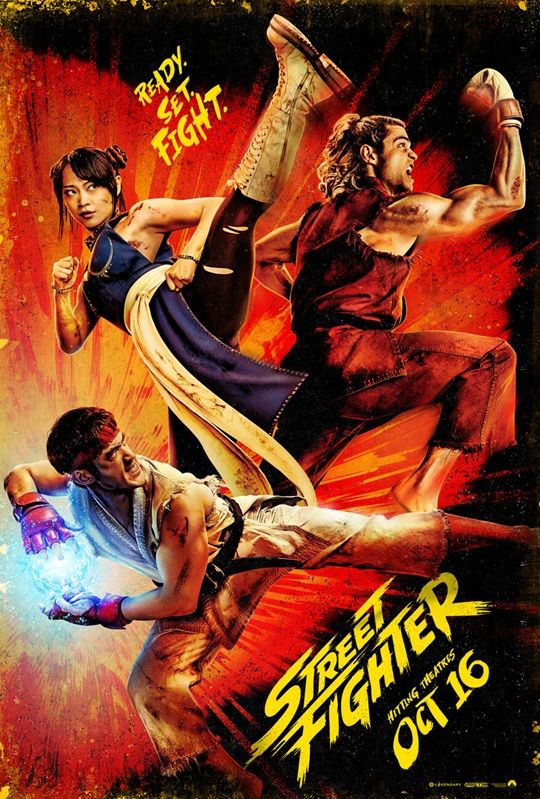
There are some films that feel like vapour – the harder to try to engage, the harder they are to grasp. Some form a positive dimension of this argument, and some make you twiddle your thumbs while witnessing brain rot of the highest order. The new English film Street Fighter falls in the latter category. Firstly, it is a straight up nostalgia-bait for the fans of the video game – even as you are introduced to the anime versions protagonists Ryu (Andrew Koji) and Ken Masters (Noah Centineo) during a 1987 prologue. The setting remains that of the World Warrior Tournament – something that immediately reminded me of Vidyut Jammwal’s Crakk: Jeetega….Toh Jeeyega (2024); and for those who have watched that travesty know exactly what I am talking about.
Instead of highlighting some beats of the tournament – all you get is a Tik-Tok cut avatar of a scene that declares Ryu as the winner, as Ken and his master Gouken (Don Lee) watch on. The issue isn’t on the manner in which the tournament is highlighted. The issue is on how the writing wishes to move from one plot point to another in a matter of minutes – never fully allowing the viewers to completely settle with the emotions in the drama. It is like one of those buffet services that keeps throwing you options of the items on the menu, without allowing you to pause, comprehend and decide an item for yourself.
Written by Dalan Musson, Gary Dauberman, Kitao Sakurai, and TJ Fixman, the characterization remains equally sketchy in the film Street Fighter. Both the protagonists Ryu and Ken remain cardboard cutout characters here – the former taking refuge in a foreign land, content with serving Ramen mixed with fermenter pigeon eggs to tourists, and the latter being a flamboyant version of the already flamboyant WWE wrestlers from the attitude era. Even their backstories are pretty generic, positioning atleast one of them to be a perennial underdog, and the other – a pulpy version of privilege, given the antics pursued by him. After years of friendship, their separation is tagged to their master Gouken who was killed off by an evil demigod Akuma (Roman Reigns). Needless to say that even the demigod feels like a sticker here, hardly coming across as terrifying outside the static display picture peeled onto the wall.
The tone applied in the narrative is pulpy, while mixing it with a dash of 80s nostalgia – layered with neon lights that are equally distracting. And here, you also notice the manipulative beats in the narrative that is designed to bring the two separated protagonists together. The occasion remains the second World Warrior Tournament hosted by a dictator M Bison (David Dastmalchian), who wishes to attain super powers for himself, by extracting them from the winner of the tournament. For the same, he hires Chun-Li (Callina Liang) to assemble the group of warriors from across the globe, without doing a background check. This is because she is secretly on an undercover mission in order to extract revenge from Bison. I was reminded of the famous words from Baburao in Phir Hera Pheri (2006) – ‘Kya Gunda Banega Re Tu’ (How will you become an antagonist with this sort of lapse).
The writing is devoid of a solid storyline, almost playing out like a TV commercial between a sports event. The latter is the warrior tournament that also brings to us other outlandisj warriors – Dhalsim (Vidyut Jammwal), Cammy (Mel Jarnson), Balrog (Curtis “50 Cent” Jackson), Zangief (Olivier Richters), and Vega (Orville Peck); each of whom are treated as sidekicks. There is a fight that transpires as a foreshadow to the main tournament, almost like a wacky character introduction of all warriors that had me facepalm in the moment. This, while intercutting its focus onto multiple subplots that start and end in a heartbeat.
It is a cardinal sin on how not one action set-piece feels remotely exciting, in a film that is centered around action. The events in the ring are laced with bouts of comedy that are increasingly flattened out with its outlandish tone, even whilst a parallel action sequence inside a jail felt like a variant of the video game from the 90s, with even worse moves to boast of. It almost felt like a pirated version of the game itself, that would rely the first copy moves of the characters to infuse life into the drama. This, even as the fights itself felt pointless and devoid of any emotions between the characters.
In fact, the flattening dynamic between the two protagonists was an absolute eye-sore; particularly given how the camaraderie was woefully missing, even in the midst of the supposed darkness that was apparently meant to be a pivotal moment in their dynamic. The recall value from the first scene was an non-existent as the trust people would have with the cops these days. It also didn’t help that there was no real face-off between the antagonist and the protagonists, with the writing opting for a sequel-bait to carry forward the already non-existent tale. As a result, even the finale felt abrupt – making the whole screenplay feel rather pointless, similar to the idea of selling hyper-nationalism to a soldier.
The dialogues are woefully campy and utterly frustrating, given how there is no depth on offer at all. Despite the tone being in the campy zone, the campiness also felt like an afterthought, much like the World Warrior Tournament itself – running the humour dry, and completely stripped off an emotional core. The music relies heavily on the 80s nostalgia by integrating numbers like ‘Who Let The Dogs Out’ (still a 2000s number?). The idea remained to serve a wacky fusion dish to the viewers, that ultimately felt tasteless even with its uninspiring score.
The cinematography comprises of frames that resemble a cookie-cutter icecream commercial, with the excessive use of neon-lights that instantly vapourize the emotions on offer. Even the fight sequences felt like an extended yawn-fest being played out like an isolated film festival of their own. The only thing that I could give a slight leeway was its scale. And what is it with the low-effort AI slop even? Why does the filmmaking have to get lazy, every time we proceed with technology? The editing pattern resembles a reel that you would spot on social media, a Tik-Tok-esque mode of inserting cuts after every minute that completely dilutes the impact of the drama. Why would a 2 second cut be incorporated in an action movie? It is brainfade in the most purest form of blasphemy!
Director Kitao Sakurai delivers a masterclass in sterile storytelling, completely draining the franchise of its signature emotional pulse and vibrant humour. By prioritizing hollow, stylized aesthetics over substance, the direction leaves its iconic roster entirely stranded with static, non-existent character arcs. Crucial narrative milestones and pivotal plot points are routinely fumbled, demonstrating a profound lack of grasp on the source material’s intrinsic lore and stakes. This feels like a pointless, disjointed exercise in direction that fundamentally misunderstands what makes the universe compelling.
The performances are poor by the members of the cast. Vidyut Jammwal is utterly wasted as Dhalsim, failing to shine in a hollow role that is severely restricted by atrocious, minuscule writing. Despite possessing top-tier real-world martial arts capabilities, he is reduced to a glorified, blink-and-miss gimmick that leaves his immense talent completely unutilized. The likes of Jason Mamoa and Don Lee also follow a similar trope.
Callina Liang struggles to inject life into Chun-Li, as her performance is thoroughly strangled by a generic, paper-thin script. While she tries to bring weight to the Interpol agent, the absolute absence of character depth leaves her completely stranded on screen. David Dastmalchian completely overcompensates as M. Bison, delivering a bizarrely cartoonish villain who feels more like a parody than a genuine, global threat. His forced villainy strips the antagonistic mastermind of any terrifying aura, turning pivotal face-offs into pure unintentional comedy.
Noah Centineo turns Ken Masters into an exasperating caricature, replacing genuine martial arts intensity with a smug, misplaced swagger that completely undermines the character’s stakes. His performance lacks the gravitas required for a seasoned tournament fighter, making his portrayal feel more like a grating sitcom audition than a legendary warrior.
Andrew Koji fails to capture the iconic heroic energy of Ryu, rendering the franchise’s central figure completely dull, flat, and entirely uninspiring. Deprived of any emotional range, his line delivery feels wooden, turning a disciplined martial arts master into a forgettable background presence.
Featuring flat, amateurish performances, Street Fighter is a woefully campy, soul-crushing actioner that arrives entirely dead on arrival. As a piece of weaponised nostalgia bait, it goes catastrophically wrong by completely gutting its own humour and emotional stakes, leaving the audience with an incoherent, two-hour social media reel that functions as a relentless yawn-fest. It sits comfortably among the absolute worst Hollywood misfires of the year, lacking any structural narrative cohesion and ultimately delivering a mind-numbing experience worth a million nightmares for any of my functioning brain cells. Available in a theatre near you.


