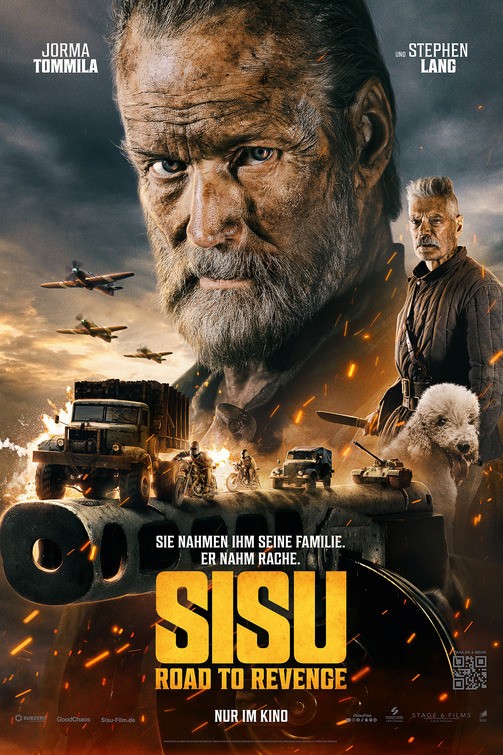

At this point, I am convinced that Aatami (Jorma Tommila) from the English film franchise Sisu is immortal, something that Munna Bhaiyya (Divyendu Sharma) claimed to be rather unsuccessfully in Mirzapur. How else would you explain a man surviving an air-crash, a bullet wound to his cheek, a bed of broken glass pieces, a crucifying attempt, an attempt to be hung out in the open, some more bullets being fired, and lots and lots of ammo that are spewed onto him. It is one of those rare luxuries of watching a silent assassin resemble an immortal mythological figure who would bump off the facists from the world. So if it was the Nazis in Sisu (2022), it is the turn of the soldiers from Soviet Union who are soon-to-be mutilated in the second instantment of Sisu, known as Sisu: Road To Revenge (or just Sisu 2). In that sense, the entire rhythm of the actioner resembles the Hindi film Kill (2024), simply wherein the filmmaker refuses to pause, while going full throttle with the action sequences that are in play throughout the film. And that works in the film’s favour simply because it doesn’t allow you time to reflect and question the inherent logic in the drama.
Written by Jalmari Helander and divided into chapters, Susu Road To Revenge can best be termed as a no-nonsense actioner wherein the only way to enjoy the drama is to have a suspension of disbelief, even as the drama follows the footsteps of Aatami the second time around – this time with the setting being after the WWII. The year is 1946 wherein you witness an understated set of emotions in play even as Aatami revisits his home after the world war is over. One little glimpse and you can sense a bit of remorse in Aatami while staring at the cracked frame featuring a photograph of his family comprising of his wife and two children.
This emotional core of his now broken home is single-handedly broken into pieces, log by log, and loaded in his lorry – a clear symbol of Aatami taking a piece of his past with him in order to rebuild. Elsewhere, you are introduced to Aatami’s nemesis, Igor (Stephen Lang), the killer of Aatami’s family, now being tasked to kill Aatami himself. It is a match made in hell, a trait that you notice through the brutal chapters that unfold.
The intensity of the action set-pieces goes on increasing with every passing minute – firstly with a familiar shootout in the middle of nowhere, before riling up the levels of tension with the inclusion of soon-to-be-massacred soldiers in the mix. What starts off as a regular action sequence, soon switches courses into something as brutal and gory, with a variety of sequences commences on land and later on transitioning in air, in water, and on a train (all elementals covered). The result is simple – mutilated bodies, with heads flying off to bodies being burst in the open, with blood splattering everywhere, and chaos ensuring on the go. The events resembled a mad-hatter T-20 match wherein the bowlers are at the mercy of a batter that absolutely goes bonkers.
In many ways, the drama here can be termed as a road movie, something that you can draw parallels with films like Mad Max: Fury Road (2015), or even a film closer to home in the form of Kaithi (2019). The basic intent is that of revenge that acts as a connecting tissue between Aatami and Igor – in what remains a game of one-upmanship. For starters, this does feel like a game of equals even as the writer infuses a few sequences with hints of dark humour that graces the narrative, at times in the most unexpected instances. The results remain eerily similar to the Final Destination franchise wherein you know what is coming your way but you continue to anticipate the deaths in the most gruesome form possible. And after a point, you begin to relish them too, even as bodies are punctured with bullet holes repeatedly, or simply slashed in two, or the multiple wounds that allow for a splash of blood at regular intervals.
Come to think of it, the slender nature of the plot could have been a major deterrent here. But credit to the writing for limiting the length of the film to just about 90 minutes, while utilizing every little minute to elevate the action set-pieces – be it Aatami coating himself in glass to escape or absolutely going bang-bang at the finishing line. Even the final face-off between Igor and Aatami reeked of a lot of fun, something that would literally blow your mind with its execution, even while being fully aware of a potential barter as far as the logic in the movie is concerned. But who is even complaining here, even as the drama circles back to its emotional quotient at the end. As is the case with films like Kill, it is this emotion that remains the driving force for the action to succeed here!
The dialogues are sparingly used here in a drama that aces the silent form of filmmaking. In that sense, the onus lies on the BGM and the cinematography to do a lot of the heavy lifting. And while the BGM sets the mood of the drama perfectly, the wide-angled shots give the film a lot of grandeur even while maintaining the gore in the narrative. The frames are bloody, gory and brutal even while treating the terrific action sequences with a hint of charm. This remains a significant improvement from the last film wherein the action was no-nonsense yes, but still felt a notch lower on innovation. The indulgent factor in the frames is evident but the self-aware filmmaking allows the gory frames to standout with aplomb.
The editing pattern is taut – not only keeping the overall runtime of the drama to under 90 minutes but also not providing any respite to pause and reflect on the logic in the proceedings. It remains a kinetically fuelled narrative that keeps coming back at you with innovations that are enhanced with its terrific editing technique – featuring fast cuts and transitions. Director Jalmari Helendar does a brilliant job in maintaining a sense of rhythm to the proceedings. Sure, the emotional quotient is significantly overpowered by the action set-pieces but the good news remains on how Jalmari uses a lot of innovation in executing these action set-pieces. In the process, he provides no respite at all, something that adds to the tension in the drama along with a sense of (happy) indulgence with the killings in store. The direction is wonderful here.
The performances compliment the style of the narrative perfectly here. Richard Blake manages to impress here, despite a limited screen time. Stephen Lang as Igor is perfect as the antagonist here – searingly chilling and supremely intimidating. He uses his body language to perfectly depict his demeanor while being a perfect nemesis to Aatami. Jorma Tommila as Aatami uses silence as a virtue for a string of emotions – from grief to aggression and he is quite brilliant to witness here, simply with the kind of rawness and energy that he brings to his character. His intensity remains unparelleled, and that itself is the single-most virtue that makes you root for him, even while being invested in his journey filled with action and dark humour.
Despite a thin storyline, Sisu: Road To Revenge is a kinetic road revenge movie packaged as a brilliant no-nonsense actioner that makes for a wonderful watch. Available in a theatre near you.