

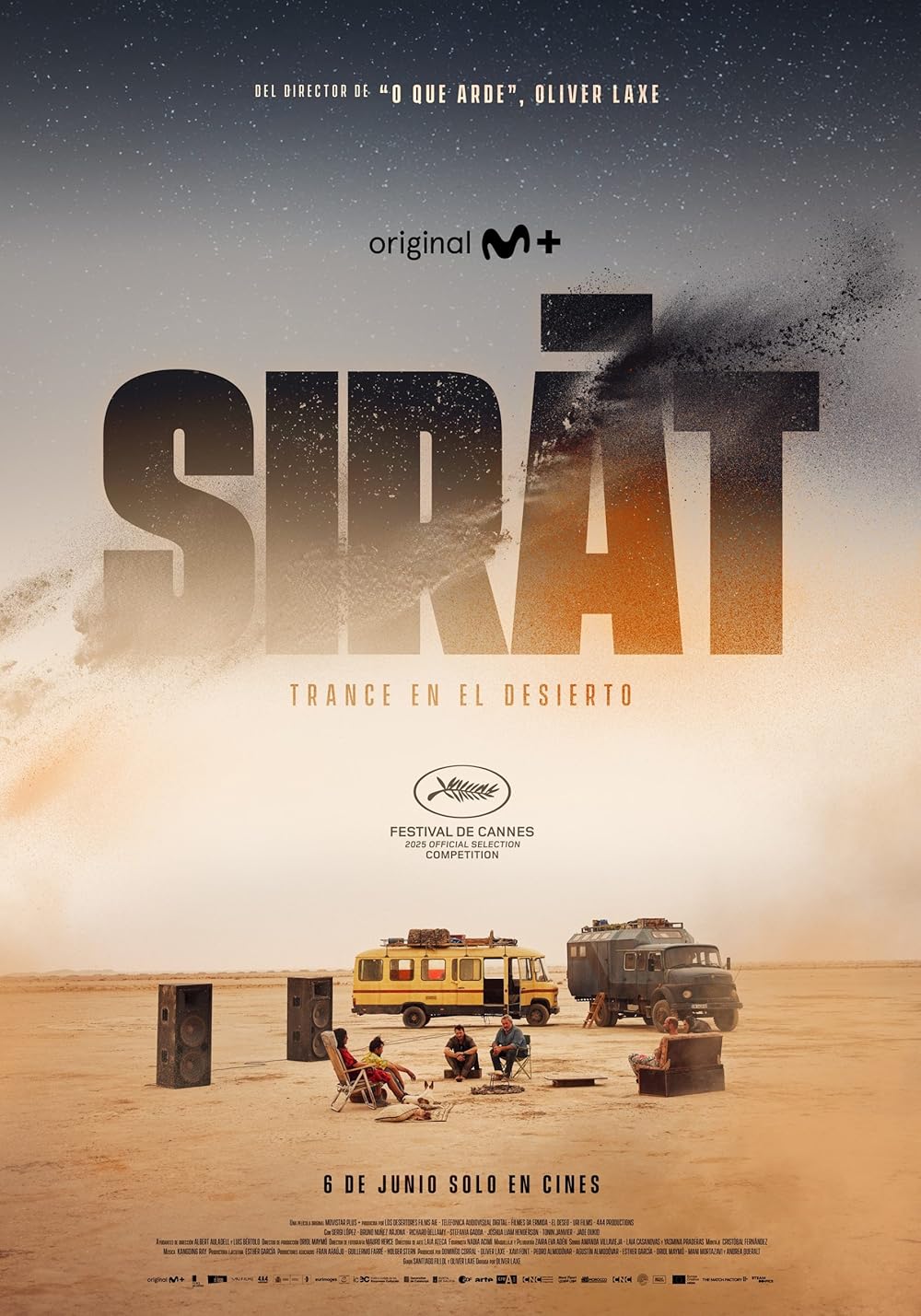
I am not going to lie – my first impression about this film remained that it was a pseudo-intellectual piece of sh*t. But oddly enough, the world presented in the Spanish film Sirat, Spain’s Official Submission to the Oscars of 2026 was so unique and enticing that it became increasingly difficult to shrug it off on face-value. It is one of those films that will be divisive – Yes, but it would also make you think and dig deeper on what the filmmaker is wishing to convey as a means of its messaging. For starters, the word Sirat is an Arabic word for a measured narrow path between paradise and hell, something as narrow and sharp as the edge of a sword that stands as a metaphor for many things in the film. In other words, it remains a spiritual passage that would be treaded on by people, something that would act as a transition bridge between the two worlds. So when you are introduced to Luis (Sergi Lopez), he is on a spree in finding his daughter Mar that has been missing at one of the many rave parties in the desert of Morocco. It must be noted on how the world of Luis is drastically different from the place he finds himself in – going from an urban setup to a trance-like place that essentially could be a metaphor for the end of the world. On a side note, Mar in Arabic stands for the sea, something that makes Luis’ journey even more deep of having to search for a sea in the desert!
Written by Oliver Laxe, the setting holds a significance of its own in Sirat. The broader barren landscapes could be interpreted as a dystopian world wherein civilization is on the brink of extinction. A passing reference of an ongoing phenomena of a potentially world war three kind of a situation does further establish this fact on how the setup might be a bridge between modern and dystopian – even with the specific rave party setup representing a form of trance, or a transcendence into a spiritual world. It is hardly surprising on how the folks at the rave have given up on the materialistic lifestyles of their past, leaving their families behind and forming their own individual connections wherein random strangers are their immediate family. It remains a metaphor of a grey space between life and death – wherein all materialistic connections are left behind while you remain in a spiritual state of trance.
One of the recurring themes of the film is that of grief, particularly with the character of Luis who is accompanied by his son Esteban (Bruno Nunez). But the writer wishes to present grief in a very different way here – almost using it as a metaphor for the past. In a scene, we do get to know that Luis’ daughter wasn’t exactly ‘missing’ but a free-consenting adult who may have escaped from the life of Luis, who in turn may have been a controlling father (this is purely a speculation from my side). Here Luis has grief tagged to him in the form of regret, yes – but the larger discussion revolves around him being stuck in the past, as opposed to moving forward. The gaze isn’t that of morality or care here, but more spiritual in nature – even as Luis finds himself on an unexpected and life-altering journey with a few ravers – Josh (Joshua Liam Henderson), Steff (Stefania Gadda), Richard Bellamy (Bigui), Tonin (Tonin Janvier), Jade (Jade Oukid). In that sense, the drama here can be viewed as a road-trip also – more specifically a journey for Luis who is ‘forced’ to move ahead in life.
There is a fleeting theme of universal brotherhood somewhere that refreshingly contradicts the backdrop of world war 3, wherein nations and people would be pitted against each other (probably). In a scene, you see the ravers helping Luis’ caravan to cross a river, even when Luis has been desperately following them from a distance with a hope that they would lead him to his daughter. In another scene, you see the ravers taking care of Luis after an unforeseen tragedy, almost wanting him to pick himself up again in life (and in the moment). In plenty of fleeting scenes, you see them bonding over lighter moments like Luis’ dog falling ill after consuming faeces laced with LSD, or when ravers offer to trim the hair of Esteben, or even when one of the ravers puts up a puppet show for Luis and Esteben while using his deformed limb as a source of entertainment. It is a reminder on how life will offer fleeting moments of joy that would only be appreciated more in hindsight.
The divisive nature of the drama is evident in the second hour wherein the drama transforms into a ‘Final Destination’ kind of a thriller out of nowhere, with tragedy striking against the run of play and the body count rising. But from a spiritual gaze, this aspect of the drama could be linked to the unpredictability of life – something that had traces of it with its world war 3 references. It is almost a signalling of fate that one cannot escape, but in the same moment, it reminds the viewers to move ahead despite the obstacles in play. For instance, the scene that kills Esteban features him seated in a van that begins to move backwards before falling off the cliff – a direct metaphor of how grief or a tragedy prompts you to take a detour backwards whereas, life offers you the only choice to move forward. The same is referenced is a separate scene wherein Jade asks Luis to test her speakers while emphasizing on how they don’t sound the same anymore. Such is life, it is ever evolving.
This sentiment remains true even with a slight change of setting to a minefield in the Sahara wherein a potential moment of trance for the group results in a tragedy of sorts. The unpredictability of life is once again evident here, even with the survivors being startled and dubiously left with no choice but to move forward. But then again, the drama wishes to talk about the subsconcious when Luis decides to walk through the minefield at the end without thinking, only to escape unscathed unlike one of the ravers who dies. The parting shot of a train in the desert can be interpreted in both physical form and spirirual form. In the physical form, it can be equated to the ongoing refugee crisis that has plagued the world. On the spirirual front, the train again forms a metaphor for transcendence – of treading on a narrow path from hell to paradise that interlinks it with the physical world. The idea is thought provoking but also niche in many ways – the latter that will divide viewers for sure.
The dialogues are minimalistic while also being profound at a few junctures. In a scene wherein a character is asked about the end of the world, he replies on how world has been ending for a while now – almost signifying a mass sense of transcendence on humanity in play. The BGM by Kangding Ray has got to be one of the best scores of the year for sure. There is a trippy ambience generated through the trance-like beats that in turns creates an immersive world that is hard to shrug off. The word transcendence holds its relevance with the beats also, almost playing out at specific junctures before a tragedy strikes. It is the perfect recipe for trance that is created here.
The cinematography extends this similar trait too, with visuals that are not only breath-taking but also dystopian in nature too – a land that could stand for a metaphor between the two worlds of paradise and hell. There is an emotional subtext defined through the situations in the second hour while purposely keeping things hollow to convey the larger meaning of detachment and moving ahead. Hence, the frames aren’t too close to any of the characters, barring in quieter moments of grief. The editing pattern is leisurely, thereby creating an immersive atmosphere representing life at the end of the world.
Director Oliver Luxe deliberately chooses to keep things vague while maintaining complexity in an even complex world. He deliberately doesn’t provide any baggage for his characters, something that corelates with the theme of living in the present and moving on in life. And the idea of establishing a conflict and then shape-shifting it was a tricky proposition and something that will still divide viewers, but given the world that Oliver creates for you, it is hard to ignore it. Either way, the director leaves his impact with a narrative style that is quite uncommon.
The performances are wonderful by the members of the cast, most of whom are non-actors and (probably) actual ravers spotted and hand-picked from rave parties. The likes of Stefania Gadda, Joshua Liam Henderson, Richard Bellamy, Tonin Janvier and Jade Oukid virtually play versions of themselves, and they bring such trippy synergy of different degrees and dimensions here. Each of them is a treat to witness here. Bruno Nunez as Esteban makes his presence felt in a well restrained performance laced with grief and innocence. Sergi Lopez as Luis delivers one of the more beautiful performances of the year laced with periods of silence, allowing his body language and mannerisms to convey his psyche. There remains nuance in his craft without quite meandering away from his core trait of grief that later transitions into acceptance. And this character arc is subtle but profound, complimented perfectly by a stellar act.
Spain’s Official Submission to the Oscars of 2026 (and in the Top 15), Sirat is a searing metaphor on spirituality, survival, and transcendence presented in one of the most trippiest films of the year that will most definitely divide viewers. And yet, I can definitely say that the film has eventually worked for me, given how I am still thinking about it days after the film has ended. Highly Recommended (with a caution to be more imbibing to its concept and themes).


