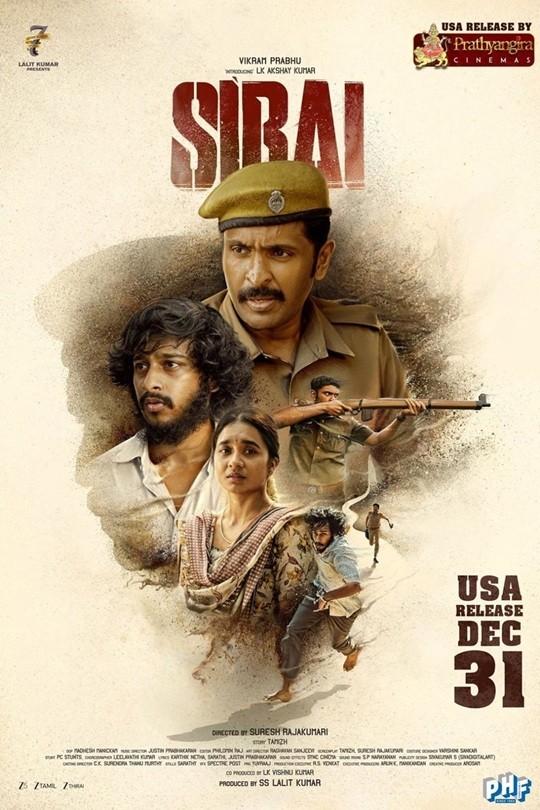

The Tamil film Sirai is keen to play on the perceptions of the characters in the drama, similar to what the Hindi film Phir Bhi Dil Hai Hindustani (2000) did years ago (yes, the Hindi film industry had some spine back in the day). When you are introduced to the cop protagonist Kathiravan (Vikram Prabhu), you see him taking law into his own hands right at the start. In a scene, you see him pointing his duty rifle at a fleeing criminal and firing a round to kill him in a crowded public place. This fleeting scene isn’t incidental – it is laced with a perception that we have about the representation of cops on celluloid. The gaze is deliberately binary, allowing Kathiravan to ‘play’ the hero without delving into an opposite perspective – that of the notorious criminal being killed, immediately making him the bad guy. This is the same argument presented by the protagonist during the human rights committe that has been setup to investigate the matter. And yet, an abrupt cutaway gives you a glimpse into the personal life of the protagonist too, wherein you see him as a family man, spending time with his daughter and his wife Constable Mariyam (Ananda Thambirajah), who incidently acts as his second layer of consciousness. The perception created is that Kathiravan is the ‘good’ guy even while pitting the system against him, initially.
Written by Tamizh and Suresh Rajakumari, Sirai is quick to create a perception for an undertrial named Abdul Rauf (Lk Akshay Kumar) too. In fact, the first encounter between Kathiravan and Abdul Rauf is filled with many questions. You are deliberately programmed to look at Abdul suspiciously even whilst being taken to court by Kathiravan and his subordinates. The whiff of some mischief awaiting to be committed is immediately on your radar, even as you notice the conversations brewing between the duo. Abdul doesn’t have money and is willing to starve during the escorting journey, something that immediately raises doubts. In a scene at a local restaurant, you almost sense Abdul wanting to escape from the clutches of the unassuming cops, an event that threatens but doesn’t take off. But all the perceptions undergo a change through the course of the film.
You slowly begin to get acquainted with Abdul in what is an extended flashback. He increasingly gives you contrasting vibes of being a simpleton, quietly going about his job of working at a local store while assisting his mother. His inter-faith love interest Kalaiyarasi (Anishma Anilkumar) also resides in his village, even as you are transported to the late 90s. The game of contrasting perceptions are wonderfully in play, often presented in segments – one dedicated to Abdul’s initial whereabouts before transitioning into the ‘crime’ that he had unwittingly committed. It is both painful and heartbreaking, while forming a deliberate social commentary on honour killings and religious perceptions (yes, Abdul is a Muslim).
One of the best scenes of the film arrive at a police station, wherein a character underlines his doubts around Abdul just because he is a Muslim, only for the commanding officer at the police station stating that he himself is a Muslim too – so would that make him a convict. It is ironic on how these events are staged in a period of the early 2000s wherein the divide is at its peak today. And yet, the pitch of the scene remains sedate – even as the mood is that of resentment more than anger. So the stereotypes in play begin to shatter post this scene, both for the viewers and Kathiravan who begin to view Abdul in a different light.
One of the strong emotional cores of the drama is the bond between Kathiravan and Abdul – with the former slowly investing in the journey of the latter. In a beautiful scene at the court, you see Kathiravan playing cupid by not only uncuffing Abdul in the court premises but also allowing the visiting Kalaiyarasi to stand beside him. In the next moment, he also nudges Abdul to confess to his crime given how the latter remains an undertrial, 5 years after the incident had taken place. The subtext is enough to expose the systematic failure of the judiciary, something that reminded me of the Netflix show Black Warrant. And yet, this passage also contributed to the growth of Kathiravan as a human being – sows seeds of empathy for the accused.
The foreshadow of joy in the lead up to the final act was enough to tell me that there was tragedy lurking in the corner towards the end. And here I must commend the brilliance in the writing, not going for the lowest hanging fruit whilst creating layers that sustain your interest throughout the finale. I did find myself completely connected to the characters, so much so that every little wrong move made my heart sink – fearing the worst. But the degrees of empathy laced in a heartfelt finale absolutely wins you over, almost leaving you with a lot of hope with your final bite of the pie. And that was enough to tell me that the screenplay was an absolute winner here.
The dialogues are thoughtful while often touching upon the social themes of the drama rather effectively. This, while maintaining the understated tone of the drama perfectly. The music and BGM nicely aide the drama through various curveballs, piquing your interests through the various shades of perception. The thrills are often dissected with empathy and emotions, wonderfully represented at pivotal moments in the drama. For instance, the halfway mark that had moments of thrills transitioned into a fabric of emotions immediately after, something that was well mapped by the lines. The cinematography comprises of frames that allow you to stay connected to the characters while being witness to their individual character arcs. For instance at the start, you see Kathiravan pointing a gun in full cinematic fashion. But towards the end, you see a more sedate approach even as he prevents another character from taking aim. The character arc was complete through the frames.
The editing pattern is mildly choppy but enough to maintain an emotional coherence in the drama. Director Suresh Rajakumari in his directorial debut laces the narrative with empathy and sensitivity, keeping the moral grounds of his characters in great light. There is a feel-good messaging served at the end, but not before the director takes you on a roller coaster of emotions. In many ways, he creates a parallel character study pertaining to his two leads, while dipping them in a sea of emotions that land beautifully. The direction remains immaculate here.
The performances are wonderful to witness here. Ismath Banu and Thavamani as Murugan have their moments to shine. PL Thenappan as the court judge, and Munnar Ramesh as Insoector Kadhar Baasha are pivotal additions in the screenplay, and both of them perfectly contribute to the fabric of the drama. Remya Suresh as Abdul’s mother delivers a heartfelt performance. Harishankar Narayanan as Pandi also has a nice little character arc to play with – going from a bit of an extremist himself to slowly nurturing a sense of empathy along the way. And he does a solid job here. Ananda Thambirajah as Constable Mariyam, Kathiravan’s wife, acts as a second layer of consciousness for her husband, and she definitely makes her presence felt. Anishma Anilkumar as Kalaiyarasi bring charm to her character with her disarming smile while accounting for a range of emotions along the way. She does a tremendous job here.
Lk Akshay Kumar as Abdul Rauf has such beautifully expressive eyes that reflect his pain buried deep inside him. This, while using her body language and mannerisms to great effect in creating a certain perception of his character. Yes, he does briefly stumble in melodramatic scene but overall he brings a flair of innocence to his character, that was wonderful to witness here.
Vikram Prabhu as Kathiravan uses his stoic demeanor to great effect here. In many ways, his character reminded me of Rajinikanth’s character from Vettaiyan (2024) except that he remained more grounded. This element helped the drama even more as he didn’t necessarily come with a superstar baggage. His character arc coincided with his shifting body language, wherein he remained brilliant to witness here.
Boasting of strong performances, Sirai is a heartfelt tale of consciousness and empathy laced with a powerful social commentary on perception that makes for a brilliant watch. Available on Zee5 and Highly Recommended!