
There is something about a male character being written by women that has nuggets of affinity as compared to males writing female characters. It felt like a facepalming moment when I witnessed the painfully absurd Hindi Film Tere Ishk Mein recently, particularly with the way the character of Mukti (Kriti Sanon) shaped up to be at the end. You could tell that Mukti remained a victim of the male gaze even from a writing standpoint, something that eventually had me rolling my eyes at all the wrong moments. But the same isn’t true for Gaurav “GG” Gehlot (Kunal Kemmu) in the new Netflix show Single Papa. GG is a typical boy being brought up in the bravado of North India – a familiar territory and a breeding ground for ‘flawed’ characters of the Hindi Film Industry (Read: Kabir Singh, Rannvijay Singh or even Shankar). But the feminine gaze for GG is evident from the writing perspective right from the start, making GG a likeable figure even when the odds would be stacked against him at a later point on the show. And quite honestly, this remains the single USP of Single Papa that makes the show warm and frothy.
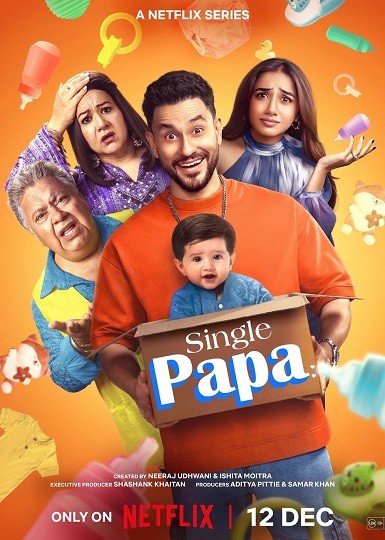
Written by Ishita Moitra and Neeraj Udhwani (and script supervisor Ankita Sarkar), Single Papa kicks off miles from the point wherein most stories would end. The setting is of a family court wherein GG is about to be divorced with his then wife Aparna (Isha Talwar), simply because the former remains a man-child who wants children but the latter cannot handle two ‘children’ together, thereby prompting a decision to separate and divorce. The tone remains callous and frivolous, although I could not quite tell if it was intentional – almost in line with the personality of the protagonist or just indifferent as a buildup for the drama to follow. Yet, it does try to build a base for the protagonist in creating bouts of ‘Baapta’ – going from a random making-out session in a car gone wrong wherein he spots a baby in an Amul box (thereby prompting the name of the baby to be ‘Amul’) to believing the baby to be his soulmate, so much so that he wishes to adopt it. In between, the template remains that of an underdog story which could also be viewed as a coming of age one!
The proceedings are genuinely funny given how the pop-cultural references form a landing base for many of the jokes in the narrative. Be it GG’s drunken dad Jatin (Manoj Pahwa) being referred to as ‘Haryanvi Devdas’ given his drinking problem while staying in Gurgaon, or in another scene wherein GG’s mother Poonam (Ayesha Raza Mishra) referring to the ‘Shubh Mangal Saavdhan’ problem (erectile dysfunction) of her son while telling her husband – ‘Aap ‘Zyaada Saavdhan’ Wale Pe Chal Gaye’, when Jatin thinks his son is a gay! Even when GG goes to the orphanage for the first time, the colourful nature of the setting makes him compare the vibe to the ‘Taare Zameen Par’ mood. It remains an interesting mixed bag of humour in play, even in scenes outside the cultural references – be it Jatin asking GG whether he is ‘important’ (read: impotent), or when asked about the ‘s*x’ of the infant, GG replying that it has been more than a year or so. The fabric of the narrative is filled with such hilarious one-liners that frequently fuel the narrative.
The drama scores the best when the focus remains on GG and his tryst with the child adoption, that sees him cross swords with Mrs Nehra (Neha Dhupia) who is a social worker. There is an underlying commentary on feminism of a different kind – something that would give men the equal rights to raise a baby, even while emphasizing on the fact that the general perception of men in general doesn’t tilt the law in their favour. In a beautifully heartfelt scene that cuts through the frivolous tone, you see GG pleading with the concerned body to give him one chance to adopt ‘Amul’. This, while previously Mrs Nehra spots GG and his family in a hilarious three-way ‘Suicidal attempt’ with guns and knives in full display! It is the kind of duality that in-turn forms as arc for GG who is reminded by his mother in a fleeting moment on how even a goldfish under his care had died, to now bringing himself to raise a child on his own – even after being forced to leave his home.
That said, some of the subplots don’t exactly land – either working just in isolation or completely missing the mark. For instance, GG’s sister Namrata’s (Prajakta Koli) to-be marriage to Goldie (Ankur Rathee) who belongs to a rather conservative family, even while GG wishes to nominate her for the role of a sole ‘female’ caretaker for his child without the knowledge of her in-laws. The subplot kind of flirted with the Priyadarshan school of filmmaking that thrived on the chaos that the characters find themselves in – something that threatened to explode but never really raised the stakes in the drama. Likewise, Poonam’s tryst with a local Godman doesn’t necessarily roundup in the narrative, even while not fully committing to the confusion of her husband suspecting her for adultry.
The proceedings remain watchable and also heartwarming when GG is back in picture – be it having to adjust his life according to the baby, or bringing his baby to work much to the annoyance of his new boss, or even managing his love-life with his ex-wife Aparna and his baby’s pediatrician Dr Shreya (Aisha Ahmed). In a hilarious scene, you see all three characters along with Mrs Nehra landing up at the same place, that fuels a gentle streak of measured chaos (it is that kind of a show). Even a lesser subplot involving GG’s tryst with Amul’s new nanny (or manny) – Parbat Singh (Dayanand Shetty), results in a heartwarming watch. In many ways, Parbat Singh remains a tall and sturdy figure that doesn’t fit into the perception of a ‘Nanny’, and there is a subtext to be consumed about equality right there too!
The area where the drama truly falters in is at the end with the whole marriage sequence being a breeding ground for revelations and solutions. The writing felt almost too convenient given how the revelations would immediately lead to a truce, thereby giving an impression of the drama barely scratching the surface as opposed to going deep inside the rabbit hole. I really wished for a little more complexity in the mix as opposed to straight up binary answers that deviate the drama towards an emotional but predictable conclusion. That said, I couldn’t overlook the humour along with the transformative character arc of GG that remained the basis of the screenplay, something that was decently well written.
The dialogues are witty and quite honestly the basis of a clean family drama on display here, something that consistently keep the drama ticking. It is an odd creative choice to lace a webseries with songs, which I admit were a distraction here but even from the point of view of the music, the songs are just about decent. In a sharp contrast, the BGM scores while elevating the impact of scenes from the point of view of emotions and humour in equal measures. The cinematography is adequate but the frames definitely contribute to the humour in the narrative, while helping you stay connected with the characters. For instance in a scene, you see a character receiving a head massage – shaking his head on every impact of the masseur while reading a letter that has a hilarious outcome.
The editing pattern is quite choppy wherein the drama just feels like an amalgamation of incidents without accounting for a connective tissue coupled as transition shots. This did bring down the technical impact of the drama to some extent, although the hilarious written material more than made up for it. Directors Shashank Khaitan, Hitesh Kewalya and Neeraj Udhwani keep things simple with bits of characterization and negligible world building, while focusing on the string of incidents in the life of GG and the characters around him. Clearly, the idea remained to add purpose to the life of a man-child by providing him with an arc of sorts while infusing the proceedings with humour, and keeping that in mind, the directors manage to do a decent job here.
The performances are wonderful by the members of the cast. Firstly, Hami Ali as Amul is the cutest and has my heart. Kamya Ahlawat as Jasmine, Nidhi Dudhraj, Kriti Garg, Sahil Shroff and Eshita Dey have their moments to shine. Priyam Galav as Sharanya is a delight to watch while infusing the proceedings with a lot of positivity. Tuhina Daa as Sayonee is understated and I liked how the writing didn’t wish to vilify her while driving home their point. As a result, her performance comes through as measured and restrained. Luke Kenny as Vishwas is decent but I couldn’t help but think that his character was a touch underwritten, or alternately not needed at all. Azinkya Mishra as Shlok (aka Woke Shlok) is sincere and earnest in what was a pretty good performance. Ishitta Arun as Meenu Minocha has her moments to shine, and she does a swell job.
Dayanand Shetty as Parbat Singh delivers such a heartfelt performance in what felt like a winner of a character from the writing perspective. Ankur Rathee as Goldie is pretty good although the writing confuses his character arc at the end, something that wasn’t ideal. Suhail Nayyar as Pawan is brilliant with his comic timing and he really excels here despite a limited screentime. Aisha Ahmed as Dr Shreya has a charming presence onscreen, and she puts forth a commendable act. Isha Talwar as Aparna is wonderfully restrained while often representing the million women having to nurture a man-child in their vicinity. Neha Dhupia as Mrs Nehra is excellent to witness here while bringing grace and dignity to her performance.
Prajakta Koli as Namrata is quite impressive here while leaving a solid impact with her performance. Ayesha Raza Mishra as Poonam is such a fine actor who has the ability to find humour and emotions at the most unexpected instances. And she remains excellent here once again while flaunting her seamless comic timing. Manoj Pahwa as Jatin is outstanding to witness as well, once again excelling with his act through his impeccable comic timing that transforms even the most unfunny lines into hilarious catch-phrases. The ‘important’ joke may not have been half as funny on paper than when Manoj sir decided to utter it. Impeccable!
Kunal Kemmu has always been that one guy that all of us have (silently) rooted for. Through his directorial debut Madgaon Express, you could sense that the man has a natural flair for comedy that remains rather effortless. And while he is excellent with his humour quotient here, the true identity of his performance can be gauged in emotional scenes that he is a part of. Kunal uses his body language and expressions to such good effect, that he invariably touches your heart and wins you with his performance at the end of the day.
Single Papa is a breezy tale of parenthood told through the gaze of a flawed man-child that results in a fairly hilarious watch. Yes, the drama is far from perfect, mostly just scratching the surface with its simplistic writing – but it still accounts for a clean entertainer that can be watched with your family. Available on Netflix.