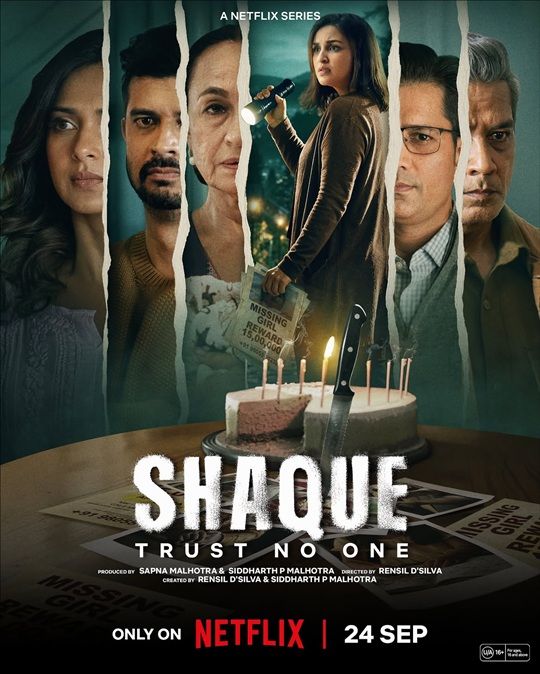

It is interesting on how the new Hindi show Shaque: Trust No One offers an uncanny and unintentional metaphor in its title. It is the kind of a show that would cackle at you after a reveal, with its standard reply being – ‘I Told You Not To Trust Anyone’. Ironically, this is also a series that could easily double up as a television show – the one that could be scoffed upon over a drinking session with friends. How else would you expect to overlook its central character Anvita (Parineeti Chopra) decked up in makeup in a maternity ward, after having delivered a baby. The cold open offers no subtlety at all – with all characters donning their worst expressions of beholding a secret, that is caught by the camera but not by the distracted eyes of the protagonist. It is again an algorithm-coded moment that would later go on to say – ‘I Told You Not To Trust Anyone’. By this time, I decided to take the warning of the show seriously – Nope, I Wasn’t Going To Trust Anyone; Not The Show, Not The Writing, Not The Performances, Not My Sanity! And we were only getting started, much to my dismay.
Written by Siddharth P Malhotra, Rensil D’Silva, Riva Razdan Kapoor, Kausar Munir, Abbas Dalal, and Hussain Dalal, the issue with Shaque remains that it tries to be smarter than it actually is, a case that is worth noting through its meandering cold open. A character disguised as a nurse enters and kidnaps the baby of the protagonist even as she looks on – an event occurring twice in a single month after the woeful Gandhari (2026); Anvita’s husband Alok (Tahir Raj Bhasin) isn’t at the scene of the crime. Instead, he gets a mysterious phone call and steps out, only to return to this disturbing news. Anvita’s bestie Shreya (Harleen Sethi) follows a similar trope and disappears for a moment; making this ‘mathematical’ equation of a potential affair between the two characters even more obvious to calculate. Then you have Shreya’s husband Bhaskar (Sumeet Vyas), a doctor who has an impression that he may have killed someone himself; almost instructing the CCTV to be wiped out before the cops arrive. And Alok’s mother (Soni Razdan) who remains a nod to Maya Sarabhai from Sarabhai Vs Sarabhai (2004), with a twist of harming her daughter-in-law through black magic.
It is also laughable on how the investigation unfolds through the night – checking CCTV cameras, threatening a guard, and calling it a day. Or more like a year – given its timejump! Oh, wait…more like 9 years now – wherein Anvita and Alok have been getting faceless photographs of their daughter on her birthday, a day that is celebrated like a party with cakes and candles. Weirdly, the investigation continues to be consistently incompetent – only looking at the fingerprints on the photographs, instead of setting up a CCTV camera at the entrance to pierce the pattern.
It is laughable on how the writing still ‘trusts’ its abilities, even when things are headed south. At this point, the protagonist is shown to have lost it – mistaking every kid that she meets, to be her ‘Apeksha’. Yes, grief might be a trait but so is insanity – the latter being the face of a stalking syndrome possessed by the protagonist, as opposed to showcase bouts of empathy along the way. If this is the representation of mental health in the year 2026, then I would definitely trust no one with it. And while most characters don’t trust the said ‘madness’ of the protagonist, the chief investigating officer Khurana (Anup Soni; Crime Patrol anyone?) does. You know why? Because he is also a part time tarot reader, besides suffering from cancer – a disease that would later be bastardized by the writing.
The proceedings are lacklustre, almost unfolding like a headless chicken – wanting to provide the thrills through multiple modes of desperation. And the latter includes multiple subplots that in hindsight, have no real semblance to the ‘mystery’. Be it an illegal surrogacy angle, a blackmail, a murder, a black magic angle involving the discovery of baby skeletons, all of these scattered between the relentless pursuit of the protagonist’s missing daughter. And when the writing circles back to the central plot – the key accused remain a young couple who have shifted to the hills with their daughter.
The insanity of the writing is laughable element in the narrative – be it in a scene involving a character who appears to be normal at a party even after her husband is arrested (and taken off the script midway) a day prior. Or a scene involving a character about to be operated, only to be stopped by a random incoming character inside an operation theatre because the suspect is the one operating him. Or a scene involving a DNA expert who discreetly shares his idea of taking a sample in broad daylight at a public place. Or a scene involving a character about to solve a case, only to hilariously die on the cusp of a revelation. I literally had to pause, laugh for a bit, and then carry on with the episode!
The revelation at the end is also so obvious, something that it could be seen coming from a mile away. And I couldn’t help but wonder on how the setting immediately switched to a melodrama out of nowhere – a sequence woefully stripped off any genuine emotions, while coming across as immensely dramatized in its execution. It felt a second screen content at its worst, spoon-feeding every detail that was already clear and invariably recreating a past event with atrocious uncertainty, only to add to the woes of the show. And that summed up the screenplay here that felt pretty tiring with the writing, only with momentary bits of laughter that was strictly unintended!
The dialogues have a unique distinction of being repetitive in form – a clear brief catered to ambient viewing. So when a caption already reads ‘8 years later’, you still have this detail inculcated in a line mouthed by a character, something that felt rather unnecessary. Also, the emotional core of the drama is stripped away through the lines that highlight the aura of the protagonist, even as she utters ‘Do You Want Me There?’. At no point did I feel emotionally invested in the lines, a deliberate brief at trading emotions with intrigue and uncertainty. The BGM is pretty forgettable, doing nothing really to elevate the levels of intrigue in the narrative. The idea was never to be nuanced, but literally in your face with the conflict – a case that ia reflective with the background score that is used as a bait in every scene to raise the levels of intensity in the drama, unsuccessfully so.
The cinematography offers a frivolous outlook to the characters, stripping away any remote possibility of emotions along the way – thereby treating them as cardboard versions of their own selves. Even from a staging POV, the frames end up being unintentionally funny – creating humour at the most serious instances in the narrative. The editing pattern remained too sharp for my liking, never allowing the drama to brew before wanting to jump onto the next event. As a result, the drama itself felt hollow and pretty inferior even with the ongoing investigations unfolding – something that had me distracted throughout.
Director Rensil D’Silva presents a thriller that reeks of staleness on arrival, even while trying to draw its inspiration from Alfred Hitchcock. In othrr words, the world building and the characterization lack the layers even while the execution pretends to be way smarter than it actually is. In fact, the unforced bouts of humour remain disastrous, given how the mood was always meant to be serious. So in other words, of the direction flattens out an already insipid piece of writing, then you know that the execution is poor.
The performances are a mixed bag by the members of the cast. Nasirr Khan as the Dean and Veer Rajwant Singh as Baldev are alright, but neither of them are allowed to fully blossom – one taken off the map, and the other restricted to a sidekick. Tarana Raja as Lajwanti is pretty impressive, while doing a solid job here. Dhruv Chaudhary has a good screen presence, but has little to do here. Sumeet Vyas as Bhaskar does a fair job, but his character is oddly written off after the half way mark. Soni Razdan is a solid performer, and despite the writing making her character sketchy – her performance remained dignified through and through.
Harleen Sethi is generally a fine actor, but the issue remained in her briefing – given how she looked a little confused as Shreya. Her reactions in a handful of scenes reek of her burying a body, which in hindsight didn’t match the magnanimity of the event that had transpired. Anup Soni as Khurana is a character reduced to a caricature in many ways. While his antics are sincere, there are brain-fade moments pertaining to his character that had me facepalming and laughing in equal measure – wherein the sentiments of the scene weren’t that at all. Yes, the writing did him dirty.
Tahir Raj Bhasin as Alok is alright, but the impact of his performance with regards to a searing emotional core was woefully missing. This remained strictly a decent outing that would be forgotten in months. Jennifer Winget is perhaps the only actor who completely stands out, holding a poise of dignity while being sincerely earnest with her act that offered multiple shades along the way.
Parineeti Chopra as Anvita Dutt delivers a largely inconsistent and mediocre performance. Her performance is frequently bogged down by a one-dimensional delivery and expressions. For the majority of the seven episodes, she relies on a permanently furrowed brow and heightened, aggressive expressions that blur the line between heartbreaking anguish and mere irritation, so much so that I could empathize with her character’s pain and grief at all in the midst of the madness. Her acting felt trapped in familiar territory, matching the underwhelming, predictable pace of the narrative rather than elevating it.
Marred by mixed performances and insipid, silly writing, the first season of Shaque is a sketchy, painfully mediocre misfire that routinely induces woeful laughter in all the wrong places. The show’s execution feels incredibly stale on arrival, frustrating viewers by completely distrusting their intelligence. Rather than offering anything compelling, this deeply disappointing show remains a poorly executed, tedious watch from start to finish – one that is far too outdated even for ambient viewing. I mean, what the ‘Shaque’ was that even? Available on Netflix.