

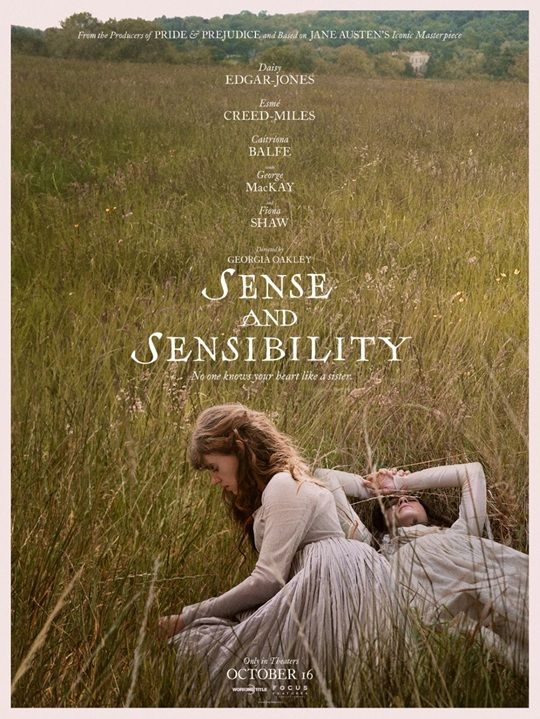
There is an immediate commentary on a class divide in the newest English adaptation of the Jane Austen classic, Sense And Sensibility. You notice on how the Dashwood sisters namely – Elinor (Daisy Edgar-Jones), Marianne (Esme Creed-Miles), Margaret (Bodhi Rae Breathnach), along with their mother Mrs Dashwood (Caitriona Balfe) are left penniless, following the death of the patriarch. The inherent nature of patriarchy subverts the difference in class, even as a large chunk of the estate ia handed over to their brother, leaving the Dashwood family to fend for themselves. It is a pivotal moment in terms of world building, particularly when the broader theme of womanhood is initiated – a theme that coincides with the harsher era of socio-politics mixed with classism, wherein women are just meant to look petite, and romance-worthy. It is interesting on how the basic premise of romance that ensues, also highlights the fact that women have to tread on the path of courtship just to escape a form of poverty – having to sacrifice their ambitions and love-interests, all in order to secure a potent future.
Written by Diana Reid, there is a clear difference in the visual tone employed in the 2026 adaptation of Sense and Sensibility, that increasingly differs from the much-celebrated 1995 version. As opposed to the warm and inviting visual tone that slices through some of the more intense moments in the 1995 version, the tone here remains grounded and christens with grey hues – almost an extension of the bleak lives of the Dashwood family. There isn’t a ray of hope to begin with, and even when the protagonist Elinor falls for a righteous Edward Ferrars (George Mackay), their dynamic is still bound by the social stigmas. In fact it is interesting to note on how it is the character of the mother who chooses to move elsewhere with her family to the countryside, in order to protect the image of her daughter who is labelled as a ‘gold-digger’, owing to the class differences slicing through a potential romance. This, whilst the protagonist is left pondering on a potential response from her potential partner.
The writing also emphasizes on the character of Marianne, a potent romantic and an idealist, something that is further accentuated through her love for poetry. She is a free bird, epitomizing the exuberance of youth while spending her time whiling away at the beach – a profound setting wherein she meets her potential prince-charming Willoughby (Frank Dillane). Her romantic inkling is referenced through a fairy tale start, wherein Willoughby ably lifts her and carries her home, when she suffers an ankle injury. Elsewhere, she detests the presence of a brooding personality, Colonel Brandon (Herbert Nordrum) – and deftly reminds him to have a ‘hobby’. The idealist nature of her personality is often marred by the lack of sensibility, the one virtue in identifying traits and patterns in men – eventually learning it the hard way through a heartbreak.
The relevance of the title is clear through the dominating virtues of both the protagonists in question. Elinor is self-restraint and cautious – using her intellect and decorum to protect herself and the family. Being the eldest daughter, the responsibility is immense even as her own ambitions and love-life remain suppressed. Ironically, it is her ‘sense’ that leads her suppression – of having to suffer in silence, even when she gets to know of Edward’s engagement with another woman.
On the other hand, the passionate nature of Marianne is immensely resonant of her deeply emotional side – the one that hasn’t yet experienced the traumas of the real world. She is known to be vocal, prominently believing in voicing her opinion and her emotions – celebrating life through a carefree scream, or completely sinking in bouts of grief during a heartbreak. It is her ‘sensibility’ that nearly gets her attached to the wrong person, almost having to endure a downward spiral in the form of her ill-health in order to trigger a wave of transformation.
Through both the protagonists, the prominent arcs of sense and sensibility give way to the other – in order to complete the circle. There is a searing theme of sisterhood that acts as a connective tissue in the narrative – even when the individual qualities of the two protagonists, are seamlessly transferred between the two characters over the course of the drama. In a pivotal scene, you see Elinor taking a stand for her sister against a man who had betrayed her trust, even as the writing refuses to lace his character with sympathies. Elsewhere, the nudge of confessing her love for Edward is initiated by Marianne – despite Elinor conveying on how it is Edward’s righteous nature that she respects; of him not backing out of an engagement while giving his partner his word.
One of the instances where the 1995 version slightly edges past this adaptation, remains its quotient on charm. There was unhinged moments of heartfelt exchanges, as opposed to comparitively lesser moments in this adaptation. That said, the humour quotient is pretty prominent here through the character of Mrs Jennings (Fiona Shaw), who is the center of playfulness and spriteliness that is pivotal in adding a refreshingly alternate dimension in the narrative.
I felt that the final act felt more playful and layered in so many ways – the one that is designed to give you an emotional high when two characters meet, after an extended period of separation. The emotional subtext is definitely prominent in a gleefully, delightful finale that hits all the right notes. When people in the audi hoot and cheer for a reunion, you just know that the emotions have landed. Overall, the screenplay is wonderfully adapted, while incorporating several heartfelt moments along the way, at times ably mixed with humour – although the 1995 version continues to remain an adaptation of a gold standard!
The dialogues are witty and wistful, while incoporating some razor sharp and punchy one-liners, without losing out on its emotional core. The BGM is perfectly reminiscent of the yesteryear’s era, using some soothing yet playful symphonies to emulate the emotional core and turmoil of its characters. The cinematography comprises of frames that significantly depart from the ‘heritage’ outlook of the 1995 film, instead creating a contrast of the two inherent worlds with the use of nature. For instance, the setting of London is showcased to be grim and bleak, as opposed to the refreshing setting of the countryside that is covered with trees and beaches. The colour grading remains muted and moody unlike the vibrant, warm colours use in the 1995 version – that automatically act as an immediately different approach to the world. This, while forming an alliance with the 1995 version in depicting the emotional core of its characters ably, something that goes a long way in resonating with the world and its characters really well.
The editing pattern is non-hurried, while seamlessly allowing the transfer of emotions from one scene to another. This, without losing sight of the prominent theme of ‘Sense And Sensibility’ in the narrative. Director Georgia Oakley swaps standard period-drama polish for a raw, muddy, and candlelit world. This realistic setting breathes fresh life into the characters, stripping away old-fashioned stuffiness to reveal the true emotions of the Dashwood sisters. By focusing closely on the sisters’ point of view, the film connects their social struggles directly to the wild nature around them. The result is a grounded story where the rough landscape perfectly mirrors the characters’ inner feelings. There are some genuine emotions tapped in the narrative that is laced with humour, highlighting that the direction remains exemplary!
The performances are wonderful by the members of the cast. Bodhi Rae Breathnach offers a charmingly natural youthful innocence as young Margaret. Tom Brooke and Stacy Martin play the tightly-wound, financially calculating John and Fanny Dashwood with a delightfully sharp edge. Ceara Coveney as Lucy is wonderfully restrained in a character that is scheming and a wholesome opportunist, showcasing her acting chops with a hint of panache. Turlough Convery has his moments to shine.
Fiona Shaw as Mrs. Jennings brings a highly energetic and welcome spark of comedic life to the narrative as the ultimate, well-meaning matchmaker. Her robust, lively performance keeps the story from sinking too deeply into its austere, moody atmosphere. Herbert Nordrum as Colonel Brandon plays the reserved colonel with an honorable, deeply gentle nature that gradually warms the screen. His understated delivery effectively communicates a lifetime of unspoken longing and quiet dedication without being overbearing.
Frank Dillane as John Willoughby breathes fresh life into the notorious rake by leaning heavily into a poetic, and charm. He portrays the same with a cold, calculated vanity, ensuring his romantic charm feels entirely manufactured to manipulate those around him. And these repulsive emotins land seamlessly through his character. Caitríona Balfe as Mrs. Dashwood portrays the grieving matriarch as a radiant, unyielding source of maternal warmth and love for her displaced daughters. Her presence brings a profound tenderness to the family’s financial struggles, anchoring their shared domestic life.
George MacKay as Edward Ferrars captures a deeply endearing, plain-spoken gentleness that makes his connection with Elinor feel completely sincere. He perfectly handles the awkward constraints of his secret obligations with a quiet, honorable dignity. This, although I missed the stammering charm and warmth of Hugh Grant from the 1995 version.
Esmé Creed-Miles as Marianne Dashwood brings a fierce, rebellious energy to the screen, painting Marianne as a wild and unapologetic force of pure emotion. Her passionate approach perfectly embodies the intense spirit of romantic sensibility without falling into caricature.
Daisy Edgar-Jones as Elinor Dashwood delivers a beautifully grounded and understated performance, expertly conveying the heavy emotional weight of a sister who constantly governs her deep feelings. Her quiet composure gives the film its moral anchor while subtly capturing the painful vulnerability of hidden heartbreak.
Featuring strong performances and a palpable central romance, Sense And Sensibility is a pleasant, charming celebration of womanhood that delivers steady emotional beats and welcome hints of humour. The film capably tackles themes of heartbreak within a patriarchal, rigid class system to offer a thoroughly engaging watch. While it falls a little short of the wistful 1995 film adaptation, which continues to stand as the gold standard, it continues to be a highly enjoyable, and a welcome addition to the Jane Austen catalog. Available in a theatre near you, and Highly Recommended!


