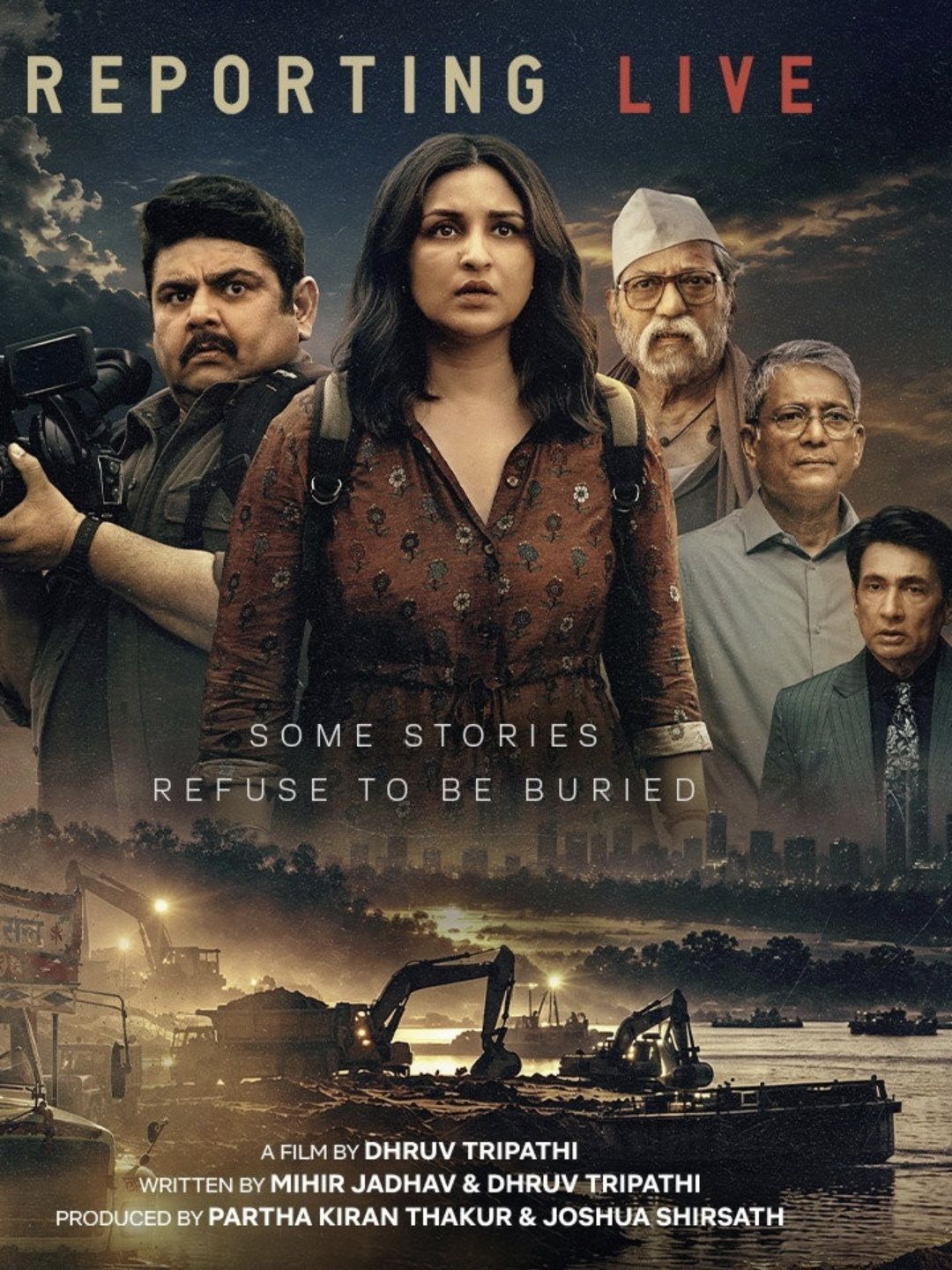

If the new Hindi film Reporting Live were a biopic, I would be quick to label it as a ‘Wikipedia Page’. The reason remains its simplistic staging, with even simpler resolutions in an era where reporting and politics go hand-in-hand. The subtext is definitely topical but the staging remains a huge point of contention for the drama that steadily sinks with its narrative. It is ironic on how the palpable metaphor would be the bridge in the film that collapses, opening a can of worms that point to illegal sand-mining. The drama resembles the bridge here, and the sand-mining is the staging and the execution – and if the metaphor isn’t self explanatory, then this film is for you. And this is particularly heartbreaking given how such films that challenge the authorities are the need of the hour in a setup that is increasingly shifting the cultural fabric of cinema. But when the portrayal of journalism itself remains so basic onscreen, it oddly is also reflective of the state of the media in reality. Perhaps, mediocrity is the new form of brilliance. Perhaps, this film ought to have been an email, or a classroom lecture, or a Netflix original. Oh wait…
Written by Dhruv Tripathi and Mihir Jadhav, the basic skeleton of Reporting Live is also reflective of the times that we are living in. There is a fleeting sub-plot of an illegal land acquisition deal by an evil capitalist company ‘Golden Sky’, a bridge collapse killing a bunch of children; a phenomena that is attributed to planetary acts by the villagers, a corrupt politician (no, not the ones in mainstream; else the film wouldn’t be out) promising a sum of 1 lac each to the families of the deceased, an illegal sand-mining scam, and an evil entrepreneur who would stop at nothing. If you look closely, each of these subplots would ideally make it to the headlines of a newspaper. The problem though is the drama in between that connects these subplots together.
When you are introduced to the protagonist Sandhya (Parineeti Chopra) and her cameraperson Parth…no, Vinod (Deven Bhojani), they form a formidable team, looking out for each other during their on-field quests. And ironically, both of them are driven with a common goal of garnering TRPs – a generic goalpost for all media outlets currently. You are also introduced to Vidur (Adil Hussain) and Shyam (Shekhar Suman) – the former being the ex-owner of the news outlet Azaad Bharati which is later sold to the latter, a familiar tale of how freedom of speech is consumed by corporates. As a result, both the protagonists Sandhya and Vinod have their hands essentially tied, often being instructed to pursue news which is neutral and ‘deemed to be fit’ for the higher masters in command. A fleeting dynamic also remains that of Vidur reminiscing of his own principles and ambitions through the protagonists, whilst also having his hands tied.
The issue arises when the two protagonists begin their set of investigation following the collapse of the bridge, later being acquainted with folks like Shiva Kaka (Amol Palekar). And this is where the issue of characterization comes to the fore – even as Sandhya patiently hears the issues about illegal sand-mining in a state of awe! It almost felt like a college lecture narrating by a teacher, while skimming through the chapter of illegal sand mining from a stipulated textbook of the syllabus. It was surprising on how neither of the protagonists had even heard about this phenomena even while veiling themselves as journalists. Or was it a reflection of today’s times when journalism has become an ignorant joke? I couldn’t tell!
The bits of the investigative tropes ought to have had the balance of a film like Spotlight (2015), but the proceedings invariably come across as juvenile – even as the protagonists film the sandmining bits by posing as documentary filmmakers. Why would anyone be okay with filming their illegal activities even if it were a part of a documentary? The sequences also feel pretty juvenile with its staging – with the protagonists filming the activities in low-key mounts, being attacked by goons; one of whom would dance to the beats of a few musical numbers, celebrate their win when the news plays out onscreen, only to later realise that their source has been bumped off (by dancing goons, remember?).
The threats that follow also feel pretty 80s and 90s coded – including a kidnapping threat to the families of the protagonists, or the random ‘suicidal’ hanging of a pet dog; none of which truly elevate the intimidation quotient in the narrative. The subtext of the investigation also unfolds like a montage – pinning its blame on just an industrialist, whereas there was an actual hint in the narrative on how the rot is spread right to the top. But when politicians are hardly referenced here, you just know that it is a cop out.
At one point, you also are reintroduced to the character of an honest reporter who was previously asked to leave the media outlet for being too honest, only to circle back and help the fluttering protagonists with their investigation. But again, the staging is a problem simply because the setting remains that of a theatre – no, not an abandoned one but with an actual film playing in it. The idea to maintain a low-key in a public place while chatting away in a theatre which is playing a movie, will have to be the most face-palming moment in the film.
The predictable tropes in the narrative play around its final act, a part of which also connects to the cold open of the film. In between, there is another staging issue involving the protagonist been asked to break a news, even as a character fires the stipulated news anchor who refuses to budge. The missing link in the narrative remained the power dynamic of a handful of characters who are about to be exposed – each of whom are assumed to have the backing of top authorities, with ‘influence’ being their middle name. And when that is left to the audience’s imagination, the impact isn’t felt as well. The bottom line being that one piece of news isn’t enough to tarnish the image of influencial folks, especially in an age wherein the world moves from one news item to another. The screenplay felt too simplistic to have any sort of impact here, although the skeleton was definitely topical. Yes, my blood was boiling – but I wasn’t entirely sure if it was all for the right reasons.
The dialogues are pretty juvenile here, explaining a host of issues to the viewers who are assumed to be toddlers. The lines lack an edginess to the proceedings, or even a fully realised emotional depth that was much needed for the trait of intimidation to kick in. The music is decent, but I did feel that the BGM was overshadowing the drama at a few places. It almost gave an impression on how the score was required to do much of the heavy lifting in a drama that just wasn’t staged too well.
The cinematography comprises of frames that falter with the staging of multiple scenes, thereby diluting the idea of adding any emotional depth to the characters. The latter thoroughly appear to be cardboard cutout rookies that didn’t really engage me at any point, barring that one moment involving a character handing out a small sum of money to establish a personal connection. Compounding this issue is the heavy-handed color grading, which relies on formulaic location filters. The film swaps creative lighting for a clinical blue in the newsroom and a dusty brown hues at the sand mines, something that gives the film a typical outlook – with each location designed to work in isolation.
There are a few easter eggs to be discovered here though – like a Guru Dutt reference with the school, or a character donning a t-shirt with the caption ‘Aalas Se Majboor’; a wordplay from a famous song from Parineeti Chopra’s debut film Ladies Vs Ricky Bahl (2011).
The editing pattern follows a similar trope of trading a nuanced drama for a quicker narrative. As a result, the idea always remains to present a conflict and push towards a simplistic solution, something that is ‘hara-kiri’ in a drama about investigative journalism.
Director Dhruv Tripathi struggles with narrative staging – faltering with the construction of a scene, whilst failing to fully realise the story’s emotional beats or inject a necessary layer of intimidation for the characters. His static visual composition and flat blocking leave performers adrift in underutilized frames, never fully creating an atmosphere of tension onscreen. Instead of using the camera to construct a palpable sense of dread, Tripathi’s mechanical approach creates a distinct emotional disconnect. Consequently, the film’s most pivotal turning points land with a hollow resonance, completely lacking the atmospheric menace and authentic psychological weight required to engage the audience.
The performances are a mixed bag here by the members of the ensemble cast. Nikie Bareja and Priti Manyal have their moments to shine. The likes of Saswata Chatterjee, Nasser, Geeta Agrawal Sharma, and Samir Kochhar aren’t allowed complete room for their performances to fully land with desired arcs. Prachee Shah Pandya, Pitobash and Amol Palekar remain sincere and earnest with their performances, even though the lines handed to the latter feel like excerpts from a Wikipedia page. Bhaskar Alekh brings a faint sense of intimidation to his character, something that makes for a fairly impressive watch.
Shekhar Suman as Shyam masterfully crafts a multi-layered antagonist, seamlessly switching between a progressive corporate facade and a ruthless nature. His performance thrives on a cold charisma while infusing it with sharp sophistication and subtle malice, thereby avoiding cartoonish tropes to present a genuinely formidable threat.
Adil Hussain as Vidur delivers a powerhouse performance as the editor-in-chief, serving as the moral anchor of the newsroom narrative. Portraying his character with quiet dignity, he commands the screen with a gravitas that captures the struggle against corporate greed. Hussain avoids over-the-top dramatics, relying instead on nuanced facial expressions and a masterful command of silence to convey his heavy burden.
Deven Bhojani as Vinod showcases his exceptional range by stepping away from comedy to deliver a brilliantly understated dramatic performance. Operating as the grounded, practical heart of the story, he brings remarkable authenticity to an otherwise flawed script. He utilizes subtle body language and an empathetic gaze to portray a companion caught in high-stakes danger.
Parineeti Chopra as Sandhya delivers a highly disappointing performance that severely drags the narrative down. Tasked with portraying a seasoned investigative reporter, she fails to project grit and instead comes across as an unconvincing rookie. Her limitations become glaringly obvious during emotional scenes, where her forced expressions feel entirely superficial. Because she cannot effectively anchor the core human drama, her weak portrayal ultimately compromises the stakes of the entire movie.
The biggest compliment Reporting Live deserves is its highly topical subject matter, but the film is ultimately undone by juvenile writing, flawed staging, and a weak performance by Parineeti Chopra. While the narrative’s skeleton held genuine potential to deliver a deeply impactful message – shoddy scriptwriting and uninspired execution rapidly sink this drama into a forgettable watch. The film squanders its timely themes through poor craftsmanship, leaving me with a frustratingly hollow experience that was uninspiring in many ways, despite me wanting to love the subject matter. Available on Netflix.