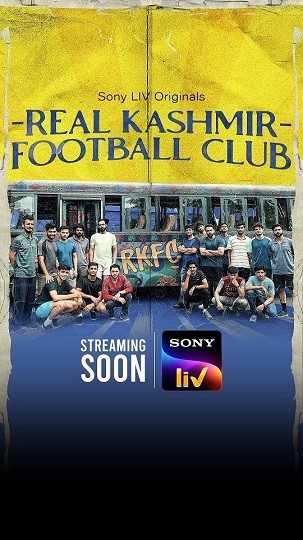

The cold open of the new Hindi show Real Kashmir Football Club is enough to briefly acquaint you with the politics of the land. The setting remains that of Kashmir in 2016 wherein a mob is gathered at a wine shop. The conflict imposed is of alcohol being ‘Haraam’ (read: forbidden), something that prompts for the gathering to get volatile. The detailing lies in the fact that much of the mob comprises of the youth of Kashmir – with an age demographic ranging from late teens to early twenties – essentially the impressionable age of youth who would easily be lured into believing religious beliefs that would at some point convert from a political stand-point too. You notice the exuberance of youth wherein a character plants a fake hand-grenade at the venue without fully realising the implications of it. This tells you everything about the mindset that is garnered on the individuals, something that prompts Sohail (Mohd Zeeshan Ayyub) to contemplate the situation, and provide a means of purpose to the youth of the state, who for generations have been manipulated and pushed into the dark.
Based on an incredible true story and written by Adhir Bhat, Chintan Gandhi, Simaab Hashmi, Mahesh Mathai, Dhruv Narang, Danish Renzu and Umang Vyas, the template of the show Real Kashmir Football Club is that of an underdog story or more specifically a moneyball team that would eventually start competing in the big league. But in the same breath, the sport of football is used as a metaphor for teamwork and discipline, something that would act as a means of purpose for the youth of the state. And given that the setting remains that of Kashmir, the story automatically goes beyond the realms of a regular underdog story, even as you are acquainted with the characters in play.
There is a streak of commentary on the Indian media even as you witness Sohail leaving his well-paid job of a journalist, given how his editor asked him to pursue a lead that has spice in it. The motivation for Sohail is as much as the ones that you would later on go to see in the members of the team – almost acting as a dual reminder on how it is never too late to start, and that challenges are a part a daily routine in the state. The same remains true for an entrepreneur Shirish Kemmu (Manav Kaul) whose connection with the state is riddled with past memories of trauma. You can see that Kemmu wishes to bring about a change in the state – first with the wine shop fiasco at the start of the show that met with severe opposition, to later being convinced in funding a brand new football club that would be assembled from the start. It is fitting how the club is named ‘Real Kashmir’ that tells you a thing or two about recalibrating its focus towards the sport, rather than participating in petty politics. In the words of Sohail who goes on to register his club – can there ever be Indian Football without Kashmir?
The familiar tropes of the genre are essentially cut through by some of the other characters who formulate the team – Rudra (Khusshal Maggo), an academy topper but minor who is frequently realigned with his academic goal by his parents, Dilshad (Afnan Fazli) who has to decide between taking up the contract at the football club or continue with his corporate job given the cash-crunch that he has at home in the wake of the finances of his home and his sister’s marriage. Azlan Shah (Anmol Dhillon Thakeria) remains a star footballer who suffers from the ‘Bindiya-Naik’ syndrome of Chak De India (2007) – often shown to be clashing with the sincere but vulnerable coach Mustafa (Mu’azzam Bhat). Farooq (Shaheem Bhat) remains the hot-headed son of a butcher who also exhibits the aggressive streak of the youth, which if not controlled can lead to violence later on. And in the mix is Amaan (Abhishaant Rana), a youth on the path of radicalisation who is given a chance to take care of the logistics of the team. The subtext lies in providing him responsibility to give his life a purpose and a direction.
The logistical challenges for a real club lay from the poor infrastructure to egos clashes to not many tournament takers for the amateur football club (in a scene even the jersey initials were incorrectly printed) , but even then the driving force remains the attitude of Sohail who is a wolf that lives for his pack. From finding ways to arrange matches for his team to doubling up as a calming mediator between the players and the coach, without quite trying to impose his own thoughts, does make Sohail a leader more than a manager. It must also be noted on how the entire setup acts as a parallel power center that is drastically different from the political one, wherein you see a character trying to impose thoughts of radicalization to the youth. The politics in play remains subtle but important in the context of the drama.
I couldn’t help but think that some of the subplots don’t really get a chance to fully bloom – be it Sohail’s balancing act with his wife and son at home, or Kemmu’s wife having the purpose of helping out widows in the valley. Or even simplistic subplots of a few players being arrested while later being released after intervention – these minor subplots feel half-baked while simply adding crucial minutes to the overall runtime. It must be said that each of these work fairly in isolation but the impact of the same to the main plot is slightly lower. But thankfully, the drama scores when the focus remains on the team as a whole.
<span;>The collective arc of the story can be judged from the fact on how the team faired for the first time on the football field versus how they aced it at the end. In between, the trajectory of the drama ranges from uncertainty – much like the foggy setup of the valley – to something that remains utterly heartfelt. Be it Sohail convincing a foreign coach Douglas (an incredible Mark Bennington) to take up the job, or the team initially being rebellious to slowly warming up to his style of coaching. Or even Murtaza joining forces at a lower position for the betterment of the team.
It was heartening for every individual to put aside their ego and come together, something that resulted in heartwarming moments. In a scene, you see the entire team arranging a wedding setup on the makeshift football ground, a sight that went beyond sports in the direction of team spirit. Even for Douglas to reluctantly take up a two-week assignment to eventually extending his stay for HIS team, was an arc in itself. It collectively felt like an uplifting passage of play that not only went beyond the football field and the predictability of the drama, but also deftly tugged the strings of my heart. It marked a symbol of hope and stability backed by a vision that says a lot about the undying spirit of our folks in the state of Kashmir. We look upto you always for such inspiring stories of unity!
The dialogues are grounded with bouts of poignancy that allow you to invest in the emotional arcs of the characters. The BGM is adequate but I wished for it to be a little better to elevate the crucial junctures and emotions in the drama. For instance, the thrilling moments of the finale match could have had an even bigger impact if the BGM was a little more resounding. The cinematography has a deliberate dull look to the narrative that can be interpreted as a metaphor for uncertainty. The frames also account for the emotional quotient of the drama by willing to focus on the humane angle of its characters, that does help in keeping you abreast with the emotional core of every character. The editing pattern does account for the highs and lows of a regular sports drama pretty well, although I couldn’t discount the brief moments of lag at a few instances. Perhaps, a crisper edit could have elevated the drama even more although the skills on display weren’t bad – particularly during the scenes involving football.
Directors Rajesh Mapuskar and Mahesh Mathai focus on the humane angle of the story rather than the standard tropes of the sports genre (or even for that matter the politics in the state), and that is what eventually makes an impact with the emotions in play. And when the drama is mounted on hope while soaking its characters in the same mould, the results will always be promising. Yes, the brief falter here was somewhere in the middle wherein the impression that I got was of stringing together a series of subplots before an upward trend began. But still, the grip in the drama was definitely there given how connected I felt to all the characters. And for that, the direction deserves a round of applause.
The performances are pretty good by the members of the cast. Garima Singh Raathore as Azra, Meher Dar, Jiya Amin as Tahira and Sarah Gesawat as Roohi have their moments to shine. Nikhaar Khullar as Nighat has a good screen presence while she deftly touches upon the conflicted role of a media personnel with ease. Kangan Baruah Nangia as Samina is understated while putting forth a restrained act. Priya Chauhan as Ghazal represents the spirit of support for her husband despite the differences that she has with him, while exhibiting a silent yet assuring demeanor that allows you to connect with her conflict and empathize with her. Vishakha Singh as Kaveri is nearly in the same mould as Ghazal, and she accounts for a sincere act. Adhir Bhat as Nazir is subtly intimidating and puts forth a stoic act.
Amandeep Thakur as Naved, Saud Al Rashid Para as Haafiz and Imran Javed have their moments to shine. Mukul Chadda perfectly exhibits the aura of the member of the football authority by using his body language and mannerisms rather effectively. Khusshal Maggo as Rudra reeks of earnestness and puts forth an endearing act. Mark Bennington as Douglas is brilliant to the core given how his character has streaks of dark humour infused in it. Mark doesn’t get carried away with it while grounding his performance in reality such that he comes across as affable in equal measures too.
Shaheem Bhat as Farooq exhibits the aggressive and callous streak of the youth of Kashmir rather accurately, while also underlying his act with traces of hope if given the right direction. Anmol Dhillon Thakeria as Azlan Shah has a towering presence and a stoic demeanor while putting forth a commendable act that is assured in many ways. Afnan Fazli as Dilshad is such a sincere performer given how he internalizes the conflict of his character rather beautifully, while coming across as well restrained and dignified. He was a treat to witness here.
Abhishaant Rana as Amaan had a stellar character arc to play with in a character that strays away from radicalisation after being given a definite purpose in life. And he is wonderful to witness here, often being the go-to guy for Sohail while also delivering a stellar speech towards the end. Mu’azzam Bhat as Mustaza is just so affable and earnest here – a character having to deal with his own financial issues in a work-sport balancing act, while staying true to the larger goal of the team. There is a genuine sense of warmth with respect to his presence onscreen.
Manav Kaul as Shirish Kemmu is once again understated here with his trauma-riddled endearing act that defines his character. There is a sense of sincerity in him wanting to stick to the team even in testing times, a streak that in a way helps him stay connected with the state of Kashmir wherein he returns after many years. He remained wonderful to witness here, once again. Mohammed Zeeshan Ayyub as Sohail remains the glue of the team and the show. The driving force of his character remains a purpose for the youth – something that he may have faced as a child while growing up in Kashmir, while ensuring that other kids don’t have ro follow a similar fate. This doubles up as his vision in setting up a club that goes beyond the realms of hate and manipulation, even while going out of his way to support it. Zeeshan accurately exhibits this never-say-die spirit while putting forth an act that is excellent in many ways. And given that most of the drama unfolds through his gaze, you witness the vulnerabilities of his character that later transforms into joy – a character arc superbly essayed by Zeeshan.
Real Kashmir Football Club is a gritty and an uplifting sports drama backed by solid performances that makes for an endearing watch. Available on SonyLiv.