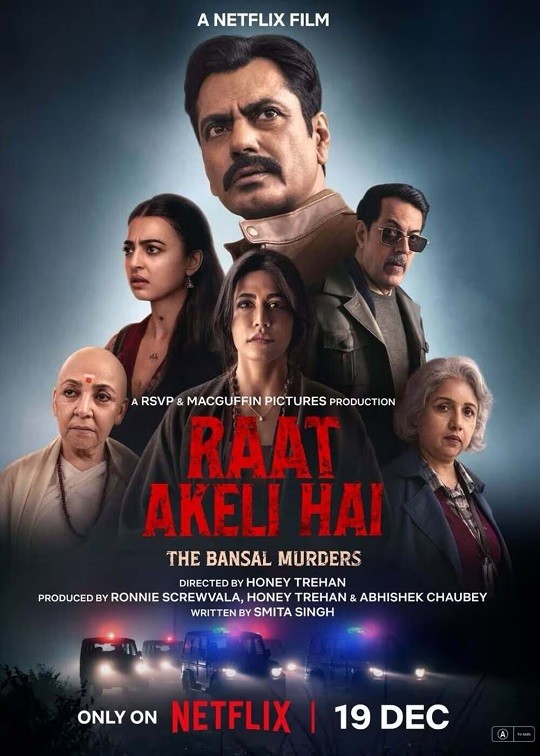

There is a clear barter of atmospherics for a far more topical subtext in the new Netflix film Raat Akeli Hai: The Bansal Murders. Like Wake Up Dead Man, it is a clear reflection of the times we live in. Hence it is ironic that the hub of the murders this time around is the Bansal household, a family synonymous with their ties with journalism – a clear subtext right there on how mainstream media has successfully been in ICU for a long time while lying ‘dead’ as the fourth pillar of the democracy. It is the kind of subtext that is capable of waking you up from your slumber and noticing the finer details that play out in Raat Akeli Hai 2 – a TV reporter blabbering in the background about a poisonous bottle gourd when a nearby slum remains the hub of a poisonous gas leakage that puts many children’s life in jeopardy.
It is the kind of dual-faced topical subtext that exists between Jatil Yadav (Nawazuddin Siddiqui) and his senior DGP Sameer Verma (Rajat Kapoor) who positions himself in an ongoing investigation, just so that he can control the narrative while fulfilling his closeness to an industrialist who happens to be connected to the family of the deceased. If you are looking to dig in deeper, it can also be viewed as a commentary on the director Honey Trehan’s long battle with the censor board that has been sitting on a film like Punjab’95 for far too long, just so that they can ‘control’ the narrative for the ones who must not be named. Freedom of speech be damned!
Written by Smita Singh (of Khauf fame), there is a deftness with which the subtext unfolds in Raat Akeli Hai 2. Come to think of it, the title of the film holds a relevance for a long and lonely night that refuses to end. The key word is also lonely here, even as inspector Jatil Yadav is the only one who feels that there is something more that meets the eye. Every other character around him is possible a product of privilege, that prompts them to keep their ‘murder’ theories on the surface, while coaxing Jatil to investigate based on the public perceptions. It is a searing subtext of the state of journalism that seeks for sensationalism on the surface as opposed to digging deeper to get to the truth.
The themes of marginalism are subtle here almost mixing them with broad strokes of religion. In a scene that doubles up as a cold open, you see a sliced pighead being placed on a newspaper cutting. It is as far as you can go today to depict the state of the society today. Even on the flip side, there is a reference to the ‘prasad’ sweet being poisoned, another reference to the minds of the people being corrupted. In the same breath, you are acquainted with two people – a godwoman (Deepti Naval) who has a reputation of ‘guiding’ people based on superstition, often calling out Jatil to change his name to Jatin for better prospects. And the other being Dr Panicker (a terrific Revathy) who tends to rely on facts and science to prove her point. Jatil is on crossroads here, almost a representation of the middle-class who are sandwiched in most cases, left to overlook bouts of superstition out of a state of compulsion more than a choice, while never having the same stature or voice as Dr Panicker.
In an extension of this marginalized theme, you are acquainted with Meera (Chitrangda Singh), a privileged but one of the lone survivors of the massacre who would later go onto to become a suspect. Then there is also an advocate Nisha Pal (Priyanka Setia) who is known to take a stand for the folks from the slum, an illegal inhabitation that remains a hub of the debris being dumped from near-by factories. It is the perfect demarcation of the society that is tied up by a common tragedy as a result of the pollution (a ‘temperature’ metric measured by a thermometer??? Yes, as per the leader of some state). This, even as some news channels peddle over lies overlooking the dead bodies that are buried in a nearby graveyard – a nod to the drone shot capturing the Covid-stricken bodies by a river that was peddled as the P-word by the media personnel. Yep, the night is indeed long but hey atleast we discussed the “subtext” of clean air and clean water through its (deleted) verses from Vande Mataram. That is a win for sure!
What didn’t always work in favour of the drama was the personal life of Jatil, featuring his nagging mother Sarita (Ila Arun) and the love of his life Radha (Radhika Apte). Yes, I could sense undercurrents of customs in the form of discussions on ‘Kundli’ that would tie itself up to the superstitions theme in the main plot, but what these sequences did was briefly put breaks on the investigation that remained the center of attraction here. Nevertheless, the damage wasn’t too deep but rather fleeting, even as the subtext of the poor-eating-the-rich (a nod to the French Revolution) was played out as a vantage point drama along with other intercutting themes. My only other issue remained the revelation that felt a tad too convenient with the way things just fell in place at the end. And yet the more I think about it, the more I have begun to feel on how close it felt to reality – with the major discussions being around the rich even as the poor are left to defend themselves with whatever little is left thereafter. Just like the screenplay here that can be reimagined as a investigative representation of the Spanish film The Platform (2019).
The dialogues are deliberately subdued while often raising topical issues through its subtext while continuing to cater to the investigation in its top layer. The BGM is searing while doing its bit to aide the subtext in the most subtle manner possible. The cinematography oozes of frames with a dash of neo-noir traits inflicted in the narrative with its yellow hues projecting a sombre mood that aides the mysterious ambience of the narrative. Even the opening shot of crows (dying) is a frame that doubles up on the ominous signs ahead in the drama – again a subtext that remains eerily closer to reality. Oh, and the frames don’t shy away from the gore either.
The editing pattern by Tanya Chhabria is crisp and sharp, dissecting the whole drama into smaller impactful nuggets that will keep you engaged through and through. She is even successful in blurring the lines between the investigation and the intended subtext, almost creating a parallel of sorts in line with the title of the film. This remains impactful given how the whodunnit itself goes beyond the usual tropes of the genre, something that is backed by an unhurried editing pattern.
Director Honey Trehan tactfully weaves a layered drama while wishing to stretch the boundaries of the subtext he wishes to convey. There is a layer of angst somewhere of all the topical issues of our current times, but the narrative remains gentle while allowing the investigation to take center stage and veil a lot of its context. This remained a clever style of execution, something that I also did witness with last week’s Wake Up Dead Man – another whodunnit that raised the bar of the genre. In other words, the direction remained impeccable while I sincereky hope that Honey’s other film Punjab’95 sees the light of the day soon!
The performances are superb by the members of the cast although I did wish that some characters had a little more meat to them. The likes of Ujjwal Raj, Aditi Gupta, Leena Sharma, Nehpal Gautam, Harssh Singh, Mohit Chauhan, Suhas Ahuja and Shivani Rai manage to leave a mark despite having a lesser screen time. Aarushi Bajaj as Aastha is first rate while making her presence felt. Delzad Hiwale as Aarav uses his physicality and body language to great effect while putting forth a commendable act. Rahaao as Om Prakash is well restrained and definitely makes for a fine act here. Sanjay Kapoor as Rajesh is good despite mostly being reduced in the background (deliberately so), almost a representation of journalism that doesn’t really believe in doing ground reporting while wishing to convey bouts of sensationism ‘from the background’. Shriidhar Dubey as Nandu is wonderfully well restrained here while delivering a commendable act. Akhilendra Mishra as SP Chauhan has shades of manipulation in his character which he is able to exploit rather well.
Ila Arun as Sarita and Radhika Apte as Radha add variations of movie to the drama with their subtle and affable bouts of humour that works in isolation mostly. Priyanka Setia as Nisha is absolutely brilliant here as the voice of the lower class, even while using her expressive eyes and her posture to convey her helplessness and despair. This, while putting up an assertive attitude against all odds. Deepti Naval as Guru Ma has a chillingly calm demeanor while coming across as subtly intimidating.
Rajat Kapoor as DGP Sameer is understated but purposeful with his performance, deliberately veiling his sincerity for vile in the most subtle manner possible. In the same breath, Chitrangda Singh as Meera also remains a layered character given the harsh truth of the society that she chooses to overlook despite a personal tragedy (something that the poor didn’t have a similar luxury for). And at various instances, you tend to question the intentions of her performance that remained beautifully calibrated and marginally remorse. The balance that Chitrangda manages to maintain was a sight to behold here.
Revathy as Dr Panicker remains one of my favourite characters here, and I hope she becomes a permanent member of this franchise from this point. There is a bout of dismissiveness tagged to her character that slowly transitions into a relentless journey of seeking the truth by facts, even while holding a position of entitlement. And Revathy is absolutely brilliant in projecting a calm demeanor with her dead-pan expressions and superb voice modulation, while leaving a lasting impact.
Nawazuddin Siddiqui as Jatil Yadav proves yet again on why he remains one of the finest actors of our times today. When in form, you witness a Nawaz who is switched on and hungry, using his subtle mannerisms (for instance chewing here) to convey the nuances of his character here. The representation of his character being from a middle-class also reflects in his performance – he doesn’t counter his seniors but is still willing to dig deeper even at the cost of shooting in the dark. This was a complex character with a variety of emotions that was performed with a lot of conviction by Nawaz.
Raat Akeli Hai: The Bansal Murders is an observant whodunnit elevated by socially relevant and topical themes that makes it a pondering and impactful watch. Available on Netflix.