

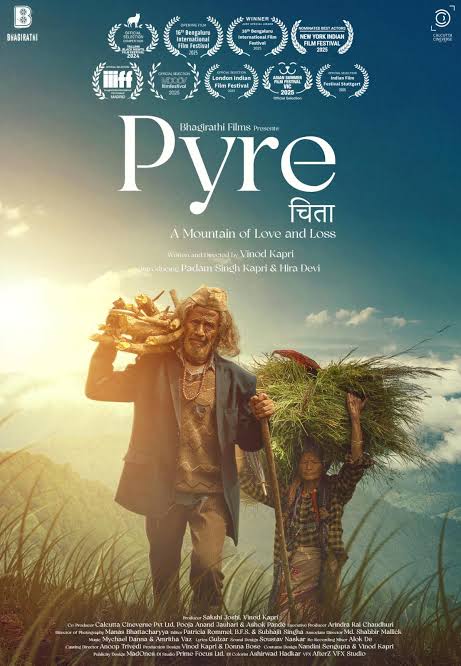
The scenic and meditative setting in the new Hindi film Pyre doubles up as a medium of claustrophobia. This is particularly true when the drama is viewed through the lens of its aging protagonists Padam (Padam Singh) and Tulsi (Hira Devi). Far from the escapist mode of the setting, the scenic mountains of Kumaon remain a jail of sorts for them – one that challenges their existence, and mortality alike. It is the kind of a double-edged sword given how solitude has plagued their lives – even whilst they may have previously resisted the urge of shifting from their homeland. The luxury of a decision may have expired soon – but as things stand, loneliness has become the unseen antagonist in their respective lives; not in a way of them being individually lonely, but more from a social perspective of people around them abandoning their homes. It is a very specific case of solitude that is mostly experienced in old age – the one that remains far away from the social media chatter, and is lesser talked about. In that sense, the proceedings unfold like a horror film veiled as a heartbreaking drama.
Written by Vinod Kapri, you notice a playful banter between the two protagonists in the film, Pyre. In a scene, he calls her a mad woman – she in return, calls him a foolish person who wastes time. The bickering also transpires over food, or their ways of living in their small hut, up in the hills. It is a specific mode of communication that treads on escapism – the idea of dragging each other in the midst of mortality. It isn’t coincidental either – but a more complex mode of wanting to survive for one another, in the midst of abandonment that the couple has been experiencing with the people around them. The subtext of fear is palpable – who will be present to even light their pyre, and see the remains of their bodies to their final destination. It is a specific sign of solitude that subverts the idea of fear, in ways that one could only experience in old-age.
The drama is laced with minute details about the couple – one being on how they are married for over 65 years. In a scene when asked about Padam’s age, the protagonist references the period of World War II, and the Hiroshima-Nagasaki nuclear bomb disaster to determine the age of his better half. It is a fleeting inference on how the existence of the couple is subverted by the stillness of time – having lived their life in a hot minute, only for their worst fears of being left behind christening their lives in their last leg. It must also be noted on how one of their own – their son, has shifted base to the city, 20-something years ago; even as the couple haven’t heard from him at all. It further creates an air of uncertainty mixed with claustrophobia and fear, wherein ‘worry’ is a constant variable of sorts.
In an early scene, you notice how Padam is tasked with taking his wife to the hospital in the valley – a task for which he seeks help from his neighbours, often in exchange of goats to keep them motivated enough to help him out. You can sense that this is his final straw – the urge of keeping his wife alive who has lost her will to live. The motive might be a selfish one of being left behind, but can anybody blame him for that? The horrors of old-age and abandonment is only a glimpse that we may have witnessed through the lens of our parents and grandparents.
There is a specific glimmer of hope, a minute miracle of sorts at one point in the film wherein you notice the couple getting a letter from their son, years after he shifted to the city. Ironically, this incident is subverted from the horrific reality of even their neighbours migrating to the cities – a bittersweet moment that offers to balance out their lives. But incidently, the wait for their son turns into a never-ending saga of sorts – one that borders on oblivion! And also in the same breath, you notice how the protagonist unsuccessfully tries ‘bribing’ his neighbours in order to stop them from venturing elsewhere, discreetly (or rather, even evidently so) wanting them to stay back and take care of them!
There is a very specific gender dynamic explored in the drama – wherein each of the protagonists react to a similar situation in a different manner. In a fleeting moment at one point in the narrative, Padam flirts with the idea of committing suicide with his wife – in a bid to end things whilst others are still around them, citing how they would atleast be able to find their bodies and dispose them together. This, whilst Tulsi disagrees while retorting on how she has a long life still to live – a differing perspective. Perhaps the idea of living in the midst of patriarchy has turned Tulsi into a resilient person, something that may not entirely be the case with Padam. And yet, it is the latter who invariably threatens to be the practical one – fearing how one of them being left behind would further account for a whole new take on solitude.
There is something Shakespearean about the drama, utilizing the ways of nature to define the tone of the proceedings. There is a subtext of a brewing storm – something that we get glimpses of at the halfway mark, and in moments of the second hour, that acts as a foreshadow for its haunting finale. It is immensely heartbreaking, and emotionally aching – even whilst employing an unforeseen twist that further sinks your heart in the realities and fate of the protagonist. The trajectory that the drama follows is also of an aging person – slowly sinking his way to the only truth of life…. death. But even in that moment, the writing continues to latch onto the horror embedded in the moment – be it a heartfelt goodbye, or a haunting new situation of solitude that promises to be a solitude-filled tear-jerker. It also is reflective of most of our realities in the final leg of our lives. The screenplay is wonderfully well penned, and stays with you long after the end credits roll.
The dialogues unfold as nuggets of conversations laced with fear and uncertainty, pertaining to the characters in question. And the emotions are embedded in these moments, as oblivious shreds that go a long way in depicting the heartfelt nature of the drama. The BGM blends seamlessly with the setting, creating a haunting synergy of meditative silence that cuts through moments of uncertainty and fear. The notes remain faint, but effective in communicating the layers of doubt engulfing the characters.
The cinematography uses its frames effectively to create a Shakespearean-esque setting – the one that is haunting, with an effective use of nature that works as a paradox of claustrophobia, as far as the characters are concerned. It is interesting on how the cinematography steadily keep isolating its characters, dwindling the population through its frames – while working in sync with the brewing themes of the narrative.
The editing pattern is non-hurried, allowing every moment to encapsulate the growing fears of uncertainty, almost reflecting the cruel nature of life through the dimension of time. It is a slow-burn, unfolding in the most frightening way possible – even as the editing refuses to add any sudden cuts as a means of remorse, never willing to dilute the realities of the protagonists.
Director Vinod Kapri delivers a masterfully restrained and deeply empathetic outlook, transforming a quiet Himalayan landscape into a powerful symbol of emotional abandonment. His minimalist staging and deliberate pacing allow the heavy silence of the emptying village to serve as its own poignant character. By prioritizing raw, atmospheric storytelling over melodramatic tropes, he grounds the narrative’s profound grief in an unflinching yet gentle sense of realism. His precise visual framing and sensitive execution turn a localized tragedy into a universally resonant meditation on aging and mortality.
The performances are exquisite by the members of the cast. The likes of Sadab Khan as Bishan, Subhash Chandra as Laxman, and Shubham Chaudhary as Jeevan are pivotal cogs in the narrative with regards to uncertainty and hope for the protagonists. And each of them have their moments to shine.
Hira Devi delivers an incredibly authentic performance as Tulsi, a frail yet fiercely resilient elderly woman living in a thinning Himalayan village. Despite having no prior professional acting experience, she commands the screen with a wonderfully lived-in presence that relies heavily on subtle gestures and poignant silences. Her playful bickering with her on-screen husband perfectly captures the complex love language of a lifelong partnership weathered by isolation. Her raw portrayal brilliantly conveys the heavy, heartbreaking burden of rural migration and maternal longing.
Also while having no prior acting experience, Padam Singh as Padam anchors the narrative with a powerful and deeply moving performance as a retired soldier facing the twilight of his life. His portrayal of a desperate father waiting decades for his son’s return beautifully balances gripping vulnerability with a fierce mountain resilience. He effortlessly brings a sense of realism to the screen, especially during the character’s profound moments of isolation and despair. His organic chemistry with Hira Devi transforms a simple story into a hauntingly memorable cinematic exploration of aging and companionship.
Featuring stellar performances by non-actors, Pyre is an emotionally consuming, meditative drama that steadily unfolds as a ‘horror film on loneliness’. Veiled as a Shakespearean tragedy, it masterfully explores themes of mortality, aging, and profound isolation. This brilliant watch captures a moving tale of uncertainty and fear, making it both deeply poignant and unforgettable. Available in a theatre near you, and Highly Recommended!


