

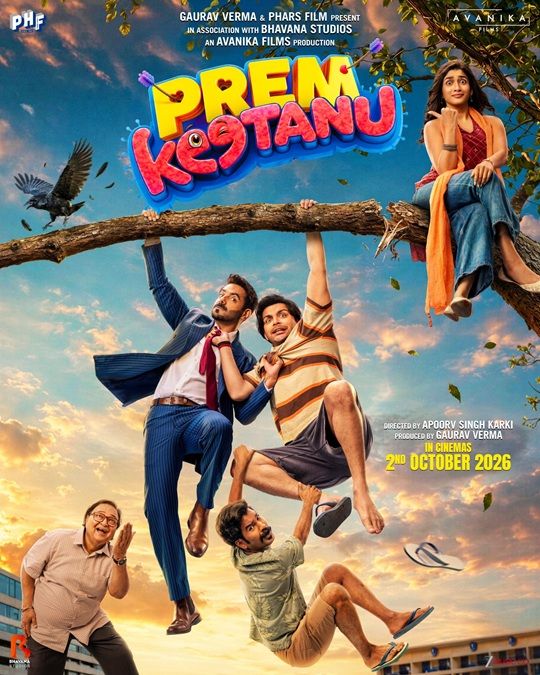
At one point in the second half of the Hindi film Prem Keetanu, there was a sound check issue in our auditorium – wherein all I got to witness was actors miming away in a song without music – a sight so funny that I invariably cracked up. Unfortunately for the film, this was my only form of escapism in a film that is inherently unbearable with its writing, despite borrowing material from the fun and frothy Malayalam film Prem Keetanu. In fact, I remember a very specific line from The Godfather (1972) racing through my head – ‘Look How They Have Massacred My Boy’; a line that coincided with some unhinged and insufferable antics of the protagonist Vishal (Veer Pahariya) who treats every subplot as a different genre. For those who are familiar with the character of Sachin (Naslen) from the original know on how he remains a perennial loser and an underdog, having the burden of the finances of his family, while seeking to pursue a future. But the antics of the protagonist range from a jilted lover to a mainstream hero dancing on a romantic track with his girl, amidst an underdog who is surviving with his bestie Magan (Nikhil Vijay). And ironically, there is no connecting tissue to either of his personalities, isolating his preposterous antics in one and making it his own in the next.
Written by Deepak Kingrani, Premal…Prem Keetanu is like that reheated comfort food that has gone stale, even while coaxing you to indulge in some of its hidden flavours – something that are ‘hidden’ for a reason. It is like reordering a cheese-burst pizza only to get pizza shaped as a cheese burger instead – for the writers here borrow the skeletal beats of the far more supreme Malayalam film, and magically turn it into a problematic mess. The original film was fun and frothy from its tonal POV, the ‘remake’ is loud and obnoxious in the same beat – almost like imposing an AI video on top of the original content. Except that, this ain’t an AI video but a content that successfully made in-roads into my brain.
To be fair, the first 20 minutes of the film were immensely TVF-coded, more specifically their underrated show Hostel Daze (2019) – that pleasantly felt like a feel-good vibe to the world. From the sequences involving ragging, to the frivolous moments of love; from a moment involving the start of a friendship over a druggie ‘plant’ to the campus interviews onboard – it all organically established the world that did not feel borrowed. But from the moment the writers began suffering from the Imposter Syndrome, things went awry.
One of the biggest assets of the original film remained its cross-cultural themes that ranged over the states of Tamil Nadu, Telangana, and Kerala – a beautiful amalgamation that added a distinct flavour to the proceedings. In the midst of it, a handful of characters that further enhanced the flavours. But let alone the absence of the cross-cultural themes in the narrative, something wherein dumbed down sets are passed off an a Delhi-NCR story; even the characterization remained faulty. For instance, the youthful exchange between the protagonists Vishal and Suhani (Aafiya Syed) felt like a millenial trying to vibe to the Gen-Z wave. The innocence was replaced by bouts of awkwardness and loudness, that drowned any semblance of a plot between them.
Furthermore, the characterization of Ranjeet (Aparshakti Khurana) felt immensely annoying (no, not because the character had to also come across as an annoying prick) – wherein the channelized and polished persona of a feminist in the garb of a repeat offender having the soul of an alpha-male, just wasn’t felt enough. It was one of those moves wherein the original character of Aadhi (Shyam Mohan from Premalu) had a tendency of a measured bravado, ending every sentence with JK, all while trying to woo the girl that he loved. That same quality, felt prickly and awkward – never fully organic in the moment, or through the shifting setting of a marriage reunion, or an exchange in office.
The same applied for the protagonist Vishal too, whose innocence and naivety of an underdog went through repeated transitions of a schizophrenic patient, never fully demanding empathy or allowing you room to even root for him throughout the narrative. Notice how the original film had bouts of the underdog syndrome, almost massaging the metamorphosis of an underconfident individual in love – wherein even the scenes wherein the girl asks for help, only for the guy to fall in love with her, did not come across as problematic (even when it is a problematic trait). The latter is dumbed down to the point of toxic masculinity here, wherein innocence paves way for toxicity. Yep, another instance of a guy (rather guys) who can’t take no for an answer.
It is ironic on how a film touted as a Rom-Com is devoid of the very genre that defines it. Neither is the romance palpable, nor does the humour land in any instance; this even as I uncannily found myself clutching the side arms of my seat with my body and brain threatening to give up. If that wasn’t enough, my fists were now clenching, seething at the unbearable plot points that were unfolding in front of my eyes. Or the invisible froth that I felt while spewing at some mind-numbing scenes including a road-journey on a motorcycle that metaphorically was the journey of love for the protagonists. Oh, the massacre was real!
It is also odd on how the writing treats its female character here – as someone being stuck between two walking red-flags, namely a man-child and an unbearing alpha-male, whilst having to compulsively choose one for herself. No, this wasn’t a happily never after for her – because why would you even give a woman a choice to say no, when you have two handsome (question mark in golden letters) men at her disposal. At one point, a particular sequence plays out like the main premise of the Hindi film Pooja Meri Jaan (2026), the other release from this week, except that a bout of realisation transforms into a bout of guilt for the girl, making her perceive on how she was wrong at rejecting the protagonist all along. This for me was the final nail in the coffin, a searing metaphor for my brain that was now subjected to cavities and ‘Keetanu’ in it. It is only this much that your boy can endure every week!
The dialogues are largely unfunny, something that never allowed me to settle into the drama at any point, besides being loud and tonally inconsistent throughout the narrative. For instance, Premalu was never a heavy-film to begin with, using its frothy demeanor to good effect. But here, the lines transition into melodrama that had me seeking refuge from the sudden attack on my braincells. The music is good here, but the utility of songs don’t gel with the personalities of the protagonists. The original Malayalam film did not have the protagonists breaking into a weird dance number to quench their inner stardom; sadly the equintessential nature of the latter is immensely visible, further disconnecting me from the narrative. This, even as the BGM tries too hard for the comedy to work; something that never does!
The cinematography comprises of frames that just don’t add depth to the proceedings, particularly given how most of the settings feel straight out of a film set. Remember how the city of Hyderabad played a cupid-esque character in the original; well, no such luck here – even as the frames also failed to emotionally resonate with the characters in the mix. The editing pattern comprises of lags galore, so much so that it may have been hard for the editor to trim off sequences without compromising on the continuity. It just felt like an endless labyrinth of mediocrity – scene after scene, a phrase that isn’t commonly employed for a Rom-Com.
Director Apoorv Singh Karki struggles with the proceedings here, briefly scoring in the first 20 minutes of the drama that felt straight out of his TVF comfort zone. However, this grounded momentum is quickly derailed by his reliance on the skeletal framework borrowed from Premalu. Instead of capturing the effortless, subtle charm and soft vulnerability that made the original Malayalam film work, the direction aggressively forces the story into a loud, fragmented Bollywood template. By trying to merge a TVF-style comedy with over-the-top toxic aggression and heavy melodramatic love triangles, Karki leaves the narrative tonally greedy and emotionally hollow, something that felt woefully unbearable by the end of things.
The performances are a mixed bag by the members of the cast. Rakesh Bedi as Suhani’s father features in all of a handful of scenes with two moods – one being that of a comedy, and the other an emotional one. And he does a good job here, despite the writing never quite allowing his character to blossom. Nikhil Vijay as Magan has his comic timing on point, it is made me reminiscent of his stellar act in Hostel Daze through which he made a name for himself.
Aafiya Syed delivers a standout performance as Suhani, commanding the screen with an effortless and magnetic confidence. She navigates a complex maze of shifting emotions, ensuring her character remains grounded and completely in control even during the film’s most turbulent segments in terms of the writing. Her ability to anchor high-stakes dramatic beats prevents the narrative from spinning into total chaos. And, her command over the language remains impeccable.
Aparshakti Khurana as Ranjeet, conversely, stumbles significantly by rendering his character as an insufferable and gratingly annoying prick. He completely fails to find the delicate comedic balance that made Shyam Mohan’s similar archetype in Premalu so delightfully memorable. Instead of endearing himself to the audience through witty eccentricities, his aggressive overacting quickly alienates the viewer. His grating choices disrupt the comedic timing of the ensemble, leaving his scenes feeling deeply exhausting rather than entertaining.
Veer Pahariya as Vishal turns in a remarkably flat performance, demonstrating an utter inability to convey depth through either his facial expressions or his stiff body language. He constantly shifts shapes and forms throughout the narrative, but this volatility manifests as jarring inconsistency rather than intentional versatility. His blank delivery fails to project the necessary stakes, leaving his character feeling hollow and detached from the surrounding plot. Without a foundational grasp of physical acting, his screen presence ultimately deflates every sequence he inhabits.
Featuring trashy performances by its leads (with the sole exception of Aafiya Syed), Prem Keetanu is an insufferable mess of a romantic comedy that is entirely devoid of both romance and humor, while aggressively massacring its source material, the Malayalam film Premalu, beyond recognition. The film’s title serves as a searing metaphor for the unbearable inroads made into my brain, carving out a cavity for the literal keetanu (microbes) to feast on. In hindsight, Don Vito Corleone’s famous line from The Godfather (1972)—”Look how they massacred my boy”—feels as though it were written not just for the written material here, but for the audience members watching this disaster with clenched fists and invisible froth at their mouths. Ultimately, this cinematic trainwreck proves to be a thoroughly painful and agonizingly unbearable experience in every conceivable way. Available in a theatre near you.


