

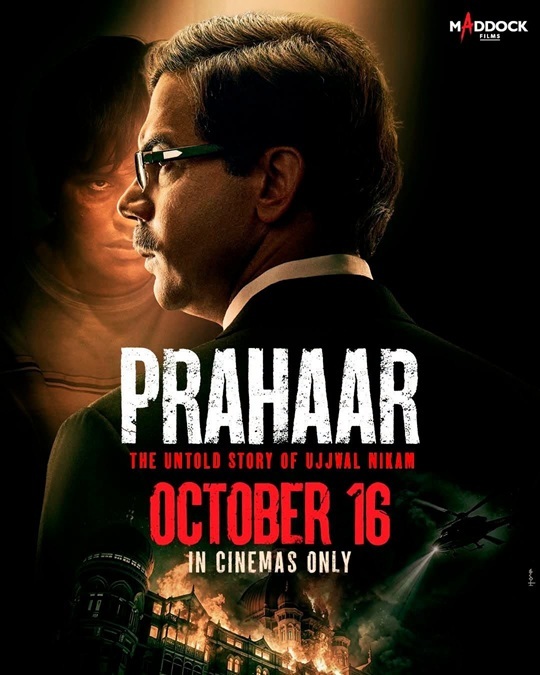
The subtext in the new Hindi film Prahaar: The Untold Story Of Ujjwal Nikam remains a story of two Indias – a quote famously highlighted by ace comedian Vir Das. The exception remains that both these versions aren’t embedded in the present, but divided over timelines. In one, famous personalities are given show-cause notices to leave the country amidst a series of detentions laced with unrest. In the other, it is the aftermath of an unrest wherein even the most infamously notorious terrorist is given a fair trial. It does also tell you a story of two democracies – a word repeated at various junctures in the film; something that cannot be ignored in isolation.
You do get an early glimpse of the personality of the protagonist Ujjwal Nikam (Rajkummar Rao), in the wake of a historic judgment that he has driven – only for him to mention that he hasn’t reprimanded those at the top of the 1993 blasts. It is interesting on how his life is consumed by the court cases that he has been involved in as a lawyer, often being ignorant of his personal life and his family. You see him being a secondary participant in his own daughter’s wedding, ignorant to his wife Jyoti’s (Wamiqa Gabbi) assimilating health issues, and a tough task-master to his lawyer son Aniket (Ritvik Sahore) who only wants to intern with him, and assist him in a case wherein he is the newly appointed public prosecutor in the aftermath of the 26/11 attacks.
Written by Sumit Roy, Dushyant Arora, and Vishal Tiwari, one of the key facets of Prahaar remains its compelling courtroom scenes that christen the narrative. In the aftermath of the 26/11 attacks, the setting remains that of the law trying to prosecute the terrorist Ajmal Kasab (Lalit Prabhakar), in what seems like an open and shut case. Whilst the public prosecutor being appointed is the protagonist, a ruthless personality who wishes to prosecute every action of the accused, the defending lawyer remains Abbas Kazmi (Sikandar Kher), who goes against the odds in order to fight for his defendent. It is interesting on how the latter masks his ‘misstep’ as his duty, in the process fighting his own battle of disrespect from his community which has been marginalized and equated to terrorism. In a pivotal scene at some point towards the end, you also see him unmasking the hypocrisy of the law by calling out the religious biases, in what felt like a tipping point for him.
One of the key subplots remains that of the protagonist and the thorny relationship that he shares with his son Aniket. You see a sense of superiority built around the invisible walls of miscommunication for the protagonist, even while reluctantly agreeing for his son to assist him in a case that, in his words, ‘won’t even allow them space to breath’. There is a hint of distrust, not stemming out of the incapabilities of his son, but out of the protection of his family in the wake of the unrequired limelight (and brickbats) that he has been getting in his newly accomplished case. And this arc acts as an alternate emotional anchor in the drama, something that spans towards his ignorant side to his other family members as well, whilst slowly warming up to their needs later on.
Another core dynamic of the drama exists between the protagonist and Zulfiqar Ali (Jaideep Ahlawat), the Pakistani representative in Kasab’s case. It is interesting because the latter remains a spiritual nod to Jaideep Ahlawat’s character from Ikkis (2026), a nationalist serving his nation only with an intention to improve its status quo. The common thread remains their fight against terrorism that bring them on the same page, a symbolic parallel to the characters in the film Joint Security Area (2000); even as they share a warm comaraderie in the wake of distinctly different legal procedurals across the two countries.
One of the pivotal aspects of the writing remains on how it chooses to humanize its characters, without overlooking the antics of the one accused. Over the compelling courtroom scenes that also touch upon the frightening turn of events from the night of 26/11 – one through the lens of a journalist stationed at the CST railway junction, or through the lens of a little girl witnessing her mother being shot during the terrorist attack, you also witness the decaying arc of the psyche of the antagonist – ranging from being in denial to being manipulative to later being inflicted with psychological pain. It is a natural progression in the mix that eventually transforms into bouts of guilt.
The proceedings lack a little finesse in a few moments that are incorporated only in isolation – like a character reflecting on how Eid is allowed to be celebrated in a country which he thought would never be true. And I say isolated because the realisation is restricted only to one scene as opposed to a steady buildup or a thread formed in a lead up to the same. Even another subplot involving the protagonist’s visit to Pakistan is slightly loose, whilst bearing little substantial relevance to the main plot, while abandoning the same later on. It almost gave me an impression that the subplot was edited out in a view of curbing the overall length of the drama. This, or even a faint chance of a rebuttle on behalf of a replacement lawyer for the accused. And the visceral politics on the fringes remained a topic that may have been deliberately untouched in the wake of the proceedings here. Having said that, the emotional beats in the narrative towards the end are also palpable – through a scintillating speech ensued by the protagonist towards the end. The screenplay is pretty compelling and definitely leaves a mark!
The dialogues are powerful, while enhancing the compelling moments in the narrative through most of the courtroom scenes. The music is good, but the BGM is even better tactfully denoting a restrained and intriguing atmosphere for the drama. Rather than telling the audience how to feel with melodramatic crescendos, the BGM relies on persistent, ticking percussion, that heighten the stakes during critical cross-examinations and legal battles.
The cinematography comprises of frames that offer a glimpse into the psyche of the characters – something that remained a pivotal addition in the armoury of the drama, grounding the characters in reality while offering them varied emotional beats. The psychological edge that the frames offer through tight frames, also adds to the claustrophobic setup of the crowded courtrooms that is balanced by wide mid-shots to cut a picture on the ensuing argument between the characters.
The editing pattern is pretty sharp, while deliberately maintaining a grounded pacing technique to create an immersive atmosphere during the courtroom scenes. There is a definite rhythm to the proceedings even when the editing style intercuts a bunch of flashback sequences that are juxtoposed against the setting of the court. And the rhythm considerably slows down during pivotal moments like a little girl turning a witness against the accused.
Director Avinash Arun infuses the drama his trademark atmospheric realism, masterfully grounding the high-stakes legal drama in authentic emotional weight. By blending a deeply sensitive human lens with precise, grounded storytelling, he ensures the courtroom tension never overshadows the raw human cost of tragedy. His naturalistic direction elevates the narrative beyond standard biography, seamlessly transforming it into a gripping and profound study of resilience.
The performances are wonderful by the members of the cast. The likes of Sandeep Kulkarni as Desai, Priya Raina as the female reporter, Ushaa Rani Mishra, Ajinkya Deo as Bipin, and Tina Bhatia are excellent in their respective performances, and each of them have their moments to shine. Pranali Ghogare as Sharvari and Milind Ukey are sincere and earnest with their respective acts. Ashish Vidyarthi as ML Tahaliyani brings a dignified restrained with his performance as the judge in the drama. A special shoutout to Dior Ranju Varghese as Komal who is outstanding to witness here.
Ritvik Sahore as Aniket delivers a brilliantly nuanced performance, capturing his character’s youthful innocence and internal conflict with genuine sincerity. His relatable screen presence allows the audience to easily connect with the high-stakes pressure driving his character arc. Sikandar Kher as Kazmi commands the screen with a gritty, imposing presence that injects immediate tension into the storyline. His understated acting style highlights a quiet, simmering menace that makes his character remarkably complex. By avoiding over-the-top tropes, he crafts a grounded and deeply impactful performance that stands out as a major highlight, also touching upon his vulnerabilities in a few straying moments.
Wamiqa Gabbi as Jyoti brings a powerful sense of empathy and resilience to the screen, providing a vital emotional core to a heavily intense plot. Her expressive eyes communicate a deep sense of vulnerability and unspoken strength without relying on heavy dialogue. She uses her slightly stooping body posture to communicate the age of her character, while bringing restraint to her wonderful act.
Lalit Prabhakar as Ajmal Kasab stands out by injecting an unpredictable, volatile energy into the narrative while delving into a psychological zone that humanizes his character, without being ignorant of his crime. His sharp expressions and fierce intensity bring an impressive layer of edge-of-the-seat drama to his critical scenes. He navigates the complexities of his role effortlessly, delivering a superb performance through and through.
Jaideep Ahlawat as Zulfiqar Ali delivers a searing performance laced with restraint, while bringing in palpable moments of nationalism that never venture into jingoism. There is a sense of rationality that laces his character, cut through by a sense of empathy that makes his performance affable. He was brilliant as ever here.
Rajkummar Rao as Ujjwal Nikam delivers a towering performance, capturing both the steely determination and complex emotional layers of his character. His impeccable vocal modulation (barring his inconsistent accent) and meticulous body language bring an incredible level of authenticity to the intense courtroom sequences. He masterfully anchors the narrative, proving once again why he is one of the most versatile actors of his generation. And this also acts as a complete metamorphosis from his act in the film Shahid (2013), something that completes a cinematic arc of sorts.
Featuring brilliant performances, Prahaar: The Untold Story Of Ujjwal Nikam is a compelling, layered drama that masterfully blends intense courtroom sequences with a deeply humanized yet uncompromising look at the 26/11 aftermath. The film creates an immersive atmosphere while grounding its characters in a realistic, morally conscious reality. Crucially, this humanization extends to the perpetrators without eliciting undue sympathy, ensuring that the sheer gravity and horror of the accused character’s actions are never overlooked or diluted. By maintaining this strict ethical boundary, the narrative powerfully balances gripping legal tension with unyielding accountability, making for a superb, deeply thought-provoking watch. Available in a theatre near you.


