

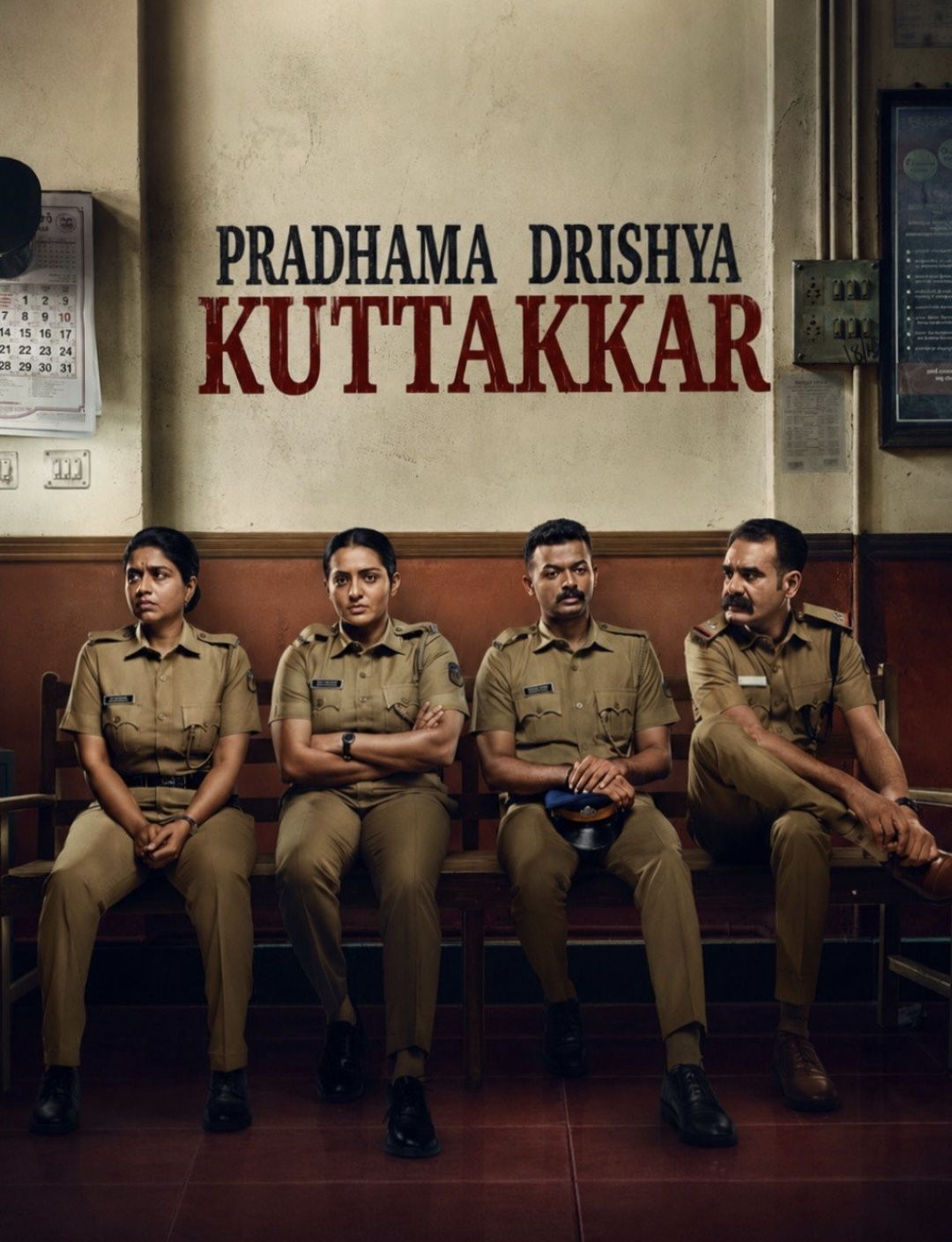
There is a hint of the Hindi film Santosh (2024) explored in the cold open of the new Malayalam film Pradhama Drishtya Kuttakkar. When you are first introduced to the protagonist Aleena (Parvathy Thiruvothu), she has just lost her husband during one of the cop skirmishes. She has a child and is suddenly a single mother, but her quest always remains of proving her identity by slicing through her phase of trauma. Hence in the same scene, you witness her insisting on opting for the role of a CPO in the police department, much like the position of her husband – an early signal of her being the ‘man’ of her family. In the same breath, you are also introduced to a handful of other officers – CPO Divya (Unnimaya Prasad) who in her personal life is striving hard to conceive, CPO Sreenath (Mathew Thomas) and ASI Dasan (Sidharth Bharathan) who are on the cusp of resolving and exploring new found relationships in their respective lives. The common thread that connects each character is their ability to be simpletons in their respective lives – a pivotal trait that acts as a crucial starting point of the drama that would soon ascend in unchartered territory.
Written by Vijesh Thottingal and PS Subramanian, there is an early commentary on the prevalent hierarchies of the police department in Pradhama Drishtiya Kuttakkar. And the same is represented through two separate characters – SI Xavier (Azees Nedumangad) and CI Prathap Mohan (Vinay Forrt). The former remains a hot-headed character who is known to be intrusive with his subordinates, an outburst that we witness in an instance during a lunch break. The latter also possesses traits of envy in an instance wherein he orders a character to carry out a task whilst expecting to take credit for it. And when that doesn’t happen, he further sends him on a wild goosechase. These dynamics would go onto not only play a major role in the narrative, but also expose the rotting law and order system in the state.
It is interesting to note on how a central incident acts as a companion piece between Pradhama Drishtiya Kuttakkar and Bharathanatyam 2 (2026). But the difference between the two narratives lies in its treatment – while the latter is in the zone of a black comedy, the former unfolds as a thriller. And herein lies the umbrella of a Drishyam template that formulates the narrative here. Like George Kutty, the underdogs here remain Aleena and her clan – who must go out of the way to hide a crime that was mistakenly committed by them at the police station.
The devil lies in the details here, even as the layers of the drama start peeling off – the deceased Jayaprakash (Sirajudheen Nazar) being a notorious thief himself who has previously committed murders too, whilst the actual focus remains on the crime being committed by the flagbearers of the law. The arcs are intertwined, and something that formulates an enticing narrative. In fact, the level of detailing can be judged through two separate instances with regards to the character of Jayaprakash – one in which he asphyxiates an elderly woman during his robbery stint, and in the other, overpowers a dominating counterpart by threatening to kill his puppy, and in turn stabbing fatal blows on him. The subtext remains clear wherein the writers do not wish to create any moment of remorse for Jayaprakash, even after being accidently bumped off.
The characterization remains a strong point in the narrative here, particularly with the introduction of Crime Branch DYSP Harris Meeran (Vijayaraghavan) who has been brought in for the investigation of the murders committed by Jayaprakash. The link obviously has its roots with Aleena and her clan, something that would eventually formulate a cat and mouse chase. But if you look closely, Harris follows an arc that is a mirror opposite to that of Aleena. While the latter is a simpleton being placed at the lowest level of the department, Harris is a well established cop, also doubling up as a crime writer based on the cases he is involved in. You witness his arc going from that of integrity to an ego battle that transformed into illicit practices – all in order to win at any cost. The subtext of justice isn’t his priority, in fact, justice itself remains a bout of broad strokes fot him. The protagonist on the other hand, turns to his crime novel to get a glimpse into his psyche – thereby ably completing the cat and mouse loop, with each character trying to edge the other out.
The proceedings thrive on the detailing that erupts out of a police procedural, with an added incentive of an invisible ticking timer that contributes to the urgency of the drama. This, even as the writing tactfully taps into multiple objects that double up as Chekhov’s Gun – an abandoned truck, a mobile phone, a bullet, each of which contribute ably in the cat and mouse chase. I did feel my heart pounding heavily at several instances – despite being extremely familiar with the Drishyam template.
The ability of the writers to go from point A to point B felt meticulous in everyway – particularly given how the screenplay was always two steps ahead of the viewers. So even when you would reckon that you have figured everything out – a small tweak would suddenly change – a piece of criticism that did erupt due to my familiarity with the ‘Drishyam’ template. But barring that, the screenplay is a compelling crime thriller that successfully blurs the boundaries between morality and accountability – even as you as a viewer are forced to root for the perpetrators despite fully being aware of their actions. In that sense, the arc of the film is inversely proportional to a film like Satluj (2026). And therein lies its beauty!
The dialogues are grounded in nature but there is a dash of urgency that christens the lines, something that had thoroughly invested in the narrative. The BGM is pacy while ably subverting critical emotions at frequent junctures in the narrative. The nature of the score also plays a pivotal role in elevating the thrill quotient that adds a new dimension to the standard police procedurals on offer. The cinematography comprises of frames that manage to keep you within close quarters of the shifting psyche of the characters. And that was enough to keep me emotional invested in the narrative, even when the emotional core of the drama got slightly manipulative towards the end.
The editing pattern is razor-sharp here, allowing the narrative to unfold at a break-neck pace without losing sight of the central conflict, and the different shades of morality on offer. The faster edits ably contribute to the urgency of the drama, without compromising on the detailing – unlike in a film like Toxic (2026) that heavily relied on the finale twist for the narrative to work whilst being consistently choppy through and through. The beauty of the edit is on how the drama never gets convoluted here, even while accounting for meticulous details to unfold in the most seamless manner possible.
Director Shahad Nilambur draws clear inspiration from the Drishyam franchise, but the key difference remains on the treatment. Unlike the former, the narrative here isn’t designed to rely on that ‘wow factor’ at the tail end of the drama (a trait that finally caught up with Drishyam 3 (2026), after 2 extremely successful outings). Instead, the procedural is always ticking, even as the filmmaking packs in a plethora of details that never make the drama convenient. Even from a characterization POV, Shahad also ably presents varied arcs that add to the layers of the drama whilst further blurring the boundaries of morality. And barring the minor blip in the finale (wherein I just didn’t feel that jaw-dropping ‘high’), the direction remains splendid here!
The performances are wonderful to witness by the members of the cast. Dinesh Prabhakar as the lorry driver, ans Balaji Sarma as Sainu have their moments to shine – the former in particular acting as an important cog that unwittingly transforms into a Chekhov’s Gun (a great example of a character being one too). Suparna S as Dharna, Vrinda Menon as Parvathy, Catherine Maria as Meera, and Jayashree Sivadhas as Shilpa – all of them are impressive to witness here, while delivering commendable acts despite a limited screentime. R Parthiban as Rtd Major Vasudevan excels in a solid combat sequence, thereby making his presence felt.
Sirajudheen Nazar as Jayaprakash is wonderfully intimidating with almost negligible traits of remorse – something that accounts for a subtly powerful act that you skews the boundaries of morality. Azees Nedumanhad as SI Xavier does a swell job in getting into the skin of his character who suffers from frequent bouts of anger management issues. Vinay Forrt as CI Prathap is excellent with his act that wonderfully contributes to the humour quotient of the drama. The best part about his performance was on how he was never trying to be funny – instead just reacting to the situation (and being oblivious of the entire crime that has transpired in his police station) that had me cracking up.
Unnimaya Prasad as CPO Divya offers an underlying streak of emotions that elevates her act in many ways. She wonderfully uses her expressions and body language to put forth a superb act. Mathew Thomas as CPO Sreenath is sincere and earnest, and his bout of innocence makes you want to root for his character. Sidharth Bharathan as ASI Dasan is natural to the core, using his body language to such good effect in communicating the suppressed urgency of his character.
The veteran Vijayaraghavan as Harris Meeran forms a wonderful nemesis to Aleena – having a mirror opposite arc to her. And this made his character complex, given how his integrity is transitioned into an ego battle while skewing his scale of morality. There is a chilling persona tagged to his character, something that is wonderfully tapped into – making his act excellent to witness here.
Parvathy Thiruvothu as CPO Aleena is in top form here. Her eyes remain a mirror to her soul – reflecting her guilt and trauma in equal measures, while having the ability to recalibrate and renew. In many ways, her character is representative of so many women who have been quietly leading their lives while shepherding their families along. She remains the glue of her group, while continuing to inculcate the trait of a simpleton – something that makes its very easy to root for her (despite her crime). She wonderfully uses her body language to convey a streak of emotions, while putting forth an act par excellence.
Despite adhering to a familiar narrative template, Pradhama Drishtya Kuttakkar masterfully revitalizes the police procedural genre by injecting the story with relentless intensity and a palpable sense of urgency. While its structural DNA clearly borrows from the suspenseful blueprint of Drishyam, the film distinguishes itself through its breakneck pacing and exceptional cast performances. These elements converged to elevate standard mystery tropes into a nerve-wracking, heart-pounding cinematic experience that kept me thoroughly gripped from start to finish. Available in a theatre near you.


