

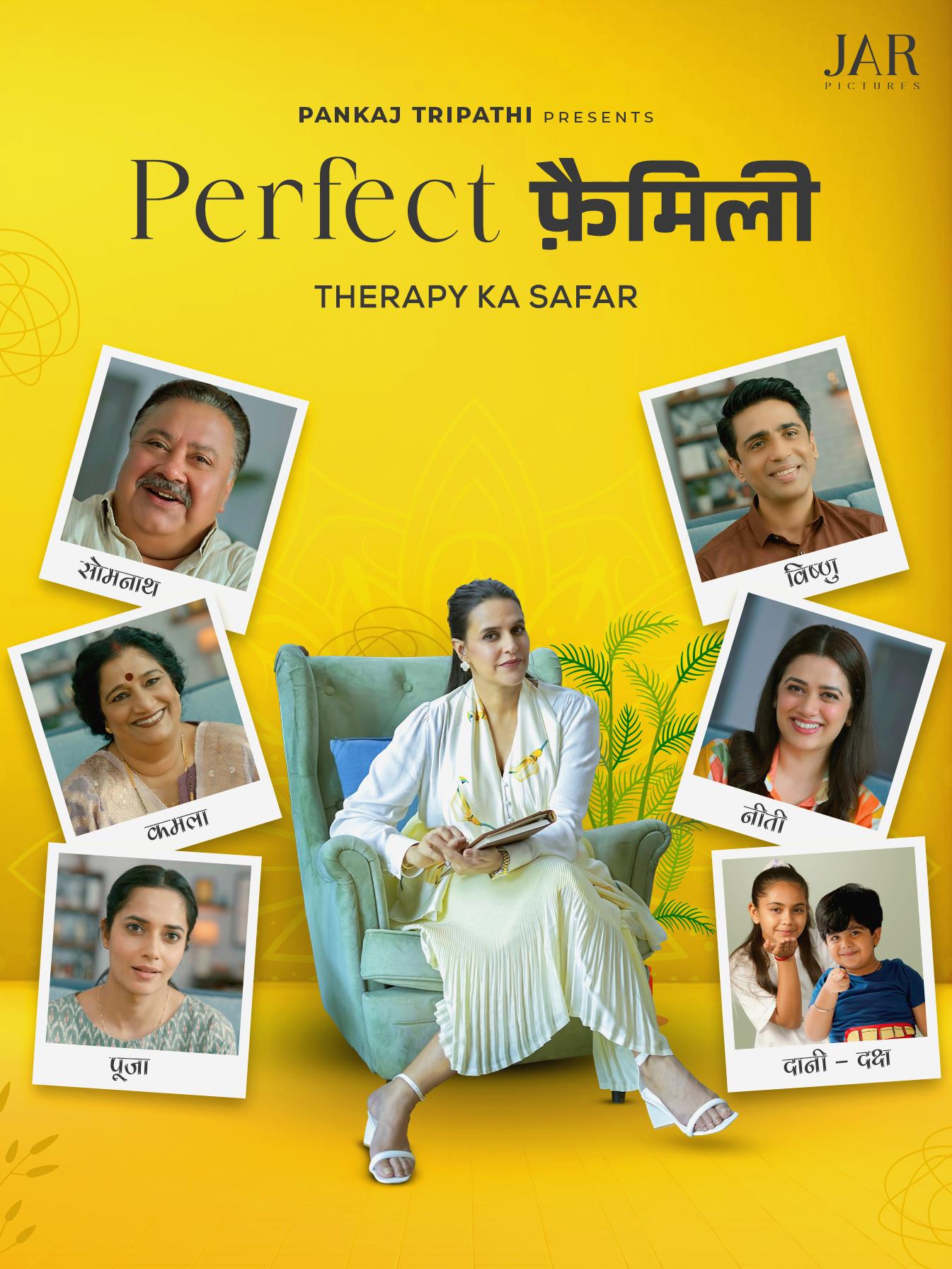
It is interesting on how the title of the Hindi show Perfect Family has an irony of its own when you are first introduced to the dysfunctional Karkarias, as a part of its cold open. Through the criss-crossing volley of voices in the dysfunctional Punjabi household, the drama wastes no time in deep-diving into the conversations of chaos and anger that are often away from the public eye – an alcolohic elderly Karkaria, Somnath (Manoj Pahwa) venting his anger at his son for wanting to move out, the mother Kamla (Seema Pahwa) further supporting his argument, the son Vishnu (Gulshan Devaiah) trying to calm the situation down while also turning up against his wife Neeti (Girija Oak Godbole), who invariably is the ‘outsider’ of the family, supporting her husband while also being yelled at, and the soon-to-be divorced sister of Vishnu, Pooja (Kaveri Seth) being a silent absorber of the chaos.
But more specifically, the entire sequence unfolds through the gaze of a young teenager Daani (Hirvi Trivedi) – something that immediately raises the stakes in the narrative. Here, the latter remains similar to the young character from Assi (2026), witnessing the horrors of the family unfold through her gaze, so much so that she shows early symptoms of depression – often found stress-eating Nutella, or raging at the pettiest of things in school. And one such incident lands the entire family at the couch of a therapist Megha (Neha Dhupia). On a side note, it is interesting on how there are two children prevalent in the Karkariya family – but the most receptive one to the ongoing chaos is a girl, even as the boy imbibes the patriarchal habits of the men of the household!
Written by Palak Bhambri and Adhiraj Sharma, the first season of Perfect Family subvert the genre of a family drama with a prominent flavour of therapy, something that immediately adds weightage to the drama. The gaze often oscillates in binary – one that unfolds through the society wherein the family paints a happy picture to the world, and the other being an intimate, layered and a textured gaze of a teenager that tells us a completely different picture of the family. And like most of us who have an underlying layer of trauma brewing somewhere, the first reaction of the family members remains that of denial – almost equating ‘therapy’ to ‘madness’, and the doctor to ‘Paagalon Ka Doctor’ (doctor for mental patients).
One of the strongest aspects of the drama remains its characterization, almost allowing the writing to dabble in different combinations during the therapy sequences – in isolation, the males together, the females together, and all family members together. It is interesting on how the trauma finds its origin from Somnath – the tipsy patriarch of the family who may not be the most affable character, but the writing treats him with sensitivity. For instance in a sequence, you see him groping his wife in public whilst being drunk. In another, you see him imposing his worldview on his daughter and wife – much like the kingpin of patriarchy in the household. Or even scoffing at a ‘Muslim’ teacher in his granddaughter’s school. You also see him imposing his masculinity on his son – forcing him to swim as a child, or be the ‘man’ of the house when he is all grown up. But most of his traits trace their roots to his own past, wherein he did get a similar treatment of isolation from his family, and masculinity from his uncle – thereby shaping his worldview in a certain level.
The same applies to Kamla, an ordinary housewife who has adopted the prevalence of patriarchy in her household – always willing to support her husband even when he isn’t right. There is a streak of sensitivity in her character, particularly when she recalls having icecream with her hubby before the kids were born, a distant memory that she labels as perfect. And yet invariably, the kind of compromises that she has made – makes her want to impose the same on the other women of her household too. In her eyes, it seems like a caring – even while coaxing her daughter to get married and be settled in life, or venting her anger at her daughter-in-law for wanting a separate home for her husband and children.
Both Pooja and Neeti are both similar characters with very different personalities in the mix. The latter remains like a ticking time-bomb, often finding solace with pain – something that she often imposes in the form of cuts on her thighs or her fingers. You can sense that Neeti was a very different person before marriage and children – she was jovial and very much in love with her then boyfriend and now husband, except that everything would change post marriage. Her identity remains a question – silently aspiring to apply for a writing job, quietly suffering from her childhood trauma of her father leaving her mother, whilst all responsibility would fall on her tender shoulders – only to be repeatedly reminded of classism by her mother, citing on how she would always leave a home ‘broken’ due to the class differences. Ironically, she isn’t happy with her husband too, and also imposing similar bursts of control on her daughter.
Pooja on the other hand, is a character that always has a mind of her own – whilst having to give in at times, for the ‘happiness’ of her parents. You see her entrepreneurial skills at play in a scene when she chooses to impress her dad’s client by willing to adapt to shifting times. Or even opting for a snack stall outside her sweet shop. Or willingly repaying her dad’s loan with her money. But the constant pressures of patriarchy christen her character, imposed by both her parents – her dad howls at the idea of handing his business to her ‘more’ capable hands Her mother emotionally blackmailing her into marrying a guy that she finds ‘boring’, whilst paying no attention to the one that she has fallen for – to the extent that there is an entire thread of them finding ways to patch them up together before divorce. And yet, you feel that there is a searing layer of trauma – something that she has accumulated over the years, somewhere buried deep within her, that is often tapped into during the ongoing family sessions.
Vishnu remains an interesting character in the mix too, a character that may well be relevant to many males from dysfunctional families. On the professional front, you see him pushing for a promotion – except that he is always insulted by his boss, so much so that he willingly releases his stress by locking himself in a toilet and jerking it off to boss-secretary p*rn. Stress plays an invisible but important character in his life – he is a practicing Buddhist who begins chanting to relieve it. You even notice the patriarchal undertones of his character – wanting to be the sole person who would arrange money for a new home for his immediate family, often snapping at his wife who wishes to work and contribute towards the funds. There is also a whiff of an affair at work, finding solace in a person who is far from his home – almost a form of escapism from his own reality. And yet, there is a hint of empathy even while being at the receiving end of the wrath of masculinity imposed by his father – something that prominently remains a dark chapter of his childhood.
The proceedings are layered, with the trajectory of the drama starting on the surface with the most frivolous fights, while delving deeper into the psyche of every character. I did have a few staging issues in a few sequences – a father-daughter dance competition at school, or even a photography competition, or a specific birthday party sequence that would invariably add flabby minutes to the narrative. But in hindsight, I felt that these sequences are as important given the dual gaze that the writing wishes to employ – almost painting a rosy picture to the world, while keeping the darkness buried within the realms of the home. And that remained a consistent trait in the narrative – something that would often act as a reminder on how all of us are riddled with trauma while having an urge to paint our happy side to the world. The screenplay is poignant, impactful and beautifully christened with emotions that absolutely hits home!
The dialogues imperatively inculcate the dual tones of the drama. So while the louder ones that you would associate in a Punjabi household are prevalent at varied instances, the same are also evened out in gentler and tender conversations that are deeply emotional and therapeutic in nature. The BGM perfectly emulates this trait as well, using silence and rawness to tap into uncomfortable spaces while utilizing breezy notes to denote the happier times – both evenly sprinkled in the narrative. The cinematography ably encapsules the dual tonalities through its lighting. The darker and greyer hues are employed during moments of intensity, isolation and chaos – while pleasant pastel shades are employed during the sequences of therapy, even as the frames allow you to invest in the emotional journeys of characters while offering a sneak-peek into their psyches
The editing pattern is a treat to savour, intercutting events of multiple timelines while retaining the emotional core as a connecting thread. This not only allows you to be emotionally invested in every character, but it accurately forms an emotional thread from one scene to another. Director Sachin Pathak offers a layer of sensitivity in treating his characters, often through bouts of empathy that humanises each of them. This, while presenting a world that gets increasingly dark and deep, in a manner that would emotionally appeal to the viewers. The main keywords remain chaotic and soothing – something that accurately defines the drama. The direction remains brilliant as ever, maintaining a stranglehold on the proceedings that essentially do not have an ending (given that there is no real end to trauma and depression).
The performances are wonderful to witness by the members of the cast. Aditi Gupta, Joanna Ashka, Puja, Satyam Srivastava and Akshaan Sehrawat are important cogs in the narrative, and each one of them have their moments to shine. Anu Menon, Abhi Khajuria as Ashok, Priyank Tatariya as Sumit are wonderfully understated, and each of them manage to impress. Aishwarya Shanker as Sandra remains a pivotal character staged around the bout of escapism for Vishnu, and she does a swell job here. Ronav Vaswani as Daani’s brother is impressive, using his innocence to imbibe the patriarchal ways of his household. Neena Kulkarni as Neeti’s mother has moderate traits of toxic parenting, and she pulls that off with a lot of flair and finesse.
Neha Dhupia as Megha is wonderfully grounded in a sincere act with soothing undertones. She is patient and earnest while using the softer side of her expressions to great effect, in addressing and communicating the pain and trauma of the characters. Hirva Trivedi as Daani is superb to witness here, given how her gaze in perceiving the chaos around her, sets the tone of the drama at the start. You witness early signs of depression creeping in, even as there are early signs of denial and gluttony prevalent through her character. These complex emotions are wonderfully exhibited in a wonderful little act.
Kaveri Seth as Pooja is a character similar to a sponge, tactfully imbibing the chaos around her in parts – while also having a mind of her own. This remains the central conflict of her character that extends to a different identity crisis – based on what she aspires in life versus what her family decides for her. She uses her expressive eyes wonderfully to represent this pain, in a performance that remains wonderfully restrained.
Seema Pahwa as Kamla offers different shades to her character. On the surface, she may come across as a person who is dominating and the one to impose her opinions on others. But there is a deeper side to her, resenting to the patriarchal ways of her household – willingly preparing food for her children and husband even when her fingers are swollen in a sequence. The quiet nature of resentment is often overpowered by the boisterous demeanor, and yet, it is the tender moments that create a stir. And she beautifully exhibits each of these moments in a wonderful little act.
Manoj Pahwa as Somnath is a character that would typically offer no solace or redemption. But such is the writing that it offers an interesting arc – something that can loosely be termed as the one addressing his flaws and shaping his core personality towards the end. There are traits of masculinity also addressed through his character, and you almost witness a dominating character in the fray. But upon reflection, there remains a softer side to Somnath – both of which are beautifully pulled off in a resounding act. His expressions and body language are to die for!
Gulshan Devaiah as Vishnu has stress written all over his face, almost having to drag himself to work in a quest for better opportunities, and then having to return to his hellhole. You can sense the amount of stress escalating in a few sequences, often being the cause of his rage or his decaying health. There is such control in his craft – through his demeanor or his behaviorial traits, that offer a deep insight into the psyche of Vishnu. And Gulshan pulls off this layered character with finesse – allowing you to empathize his stance, but not quite his antics, a balance that remains beautiful to witness.
Girija Oak Godbole as Neeti delivers one of the best performance of her career. There is a streak of unpredictability stemming from her traumatic childhood, that plays a pivotal role is shaping up her current demeanor. In multiple instances, you notice her finding solacr through pain – the very pain that is associated with her past and present. You see her maintaining and showcasing a polished side to the world, even while being submerged in a sea of trauma – often venting the same in a pivotal sequence at the end that reminded me of Marriage Story (2019). There are layers to Neeti that are reflective of her persona – at times featuring conflicting emotions, each of which are beautifully pulled off in a towering act that is brilliant as ever.
The first season of Perfect Family stands out as a masterclass in psychological drama. It offers a resounding, deeply therapeutic portrayal of a dysfunctional family, refusing to shy away from the ugly realities of domestic friction. By anchoring its chaotic plotlines in genuine human emotion, the show becomes more than just a drama – it serves as a mirror for the viewer’s own familial complexities, making it an absolutely brilliant watch. Witnessing the Karkaria family navigate their explosive therapy sessions provides such a profound sense of vicarious healing that you genuinely walk away feeling two kilos lighter. Available on Sonyliv and Highly Recommended!


