

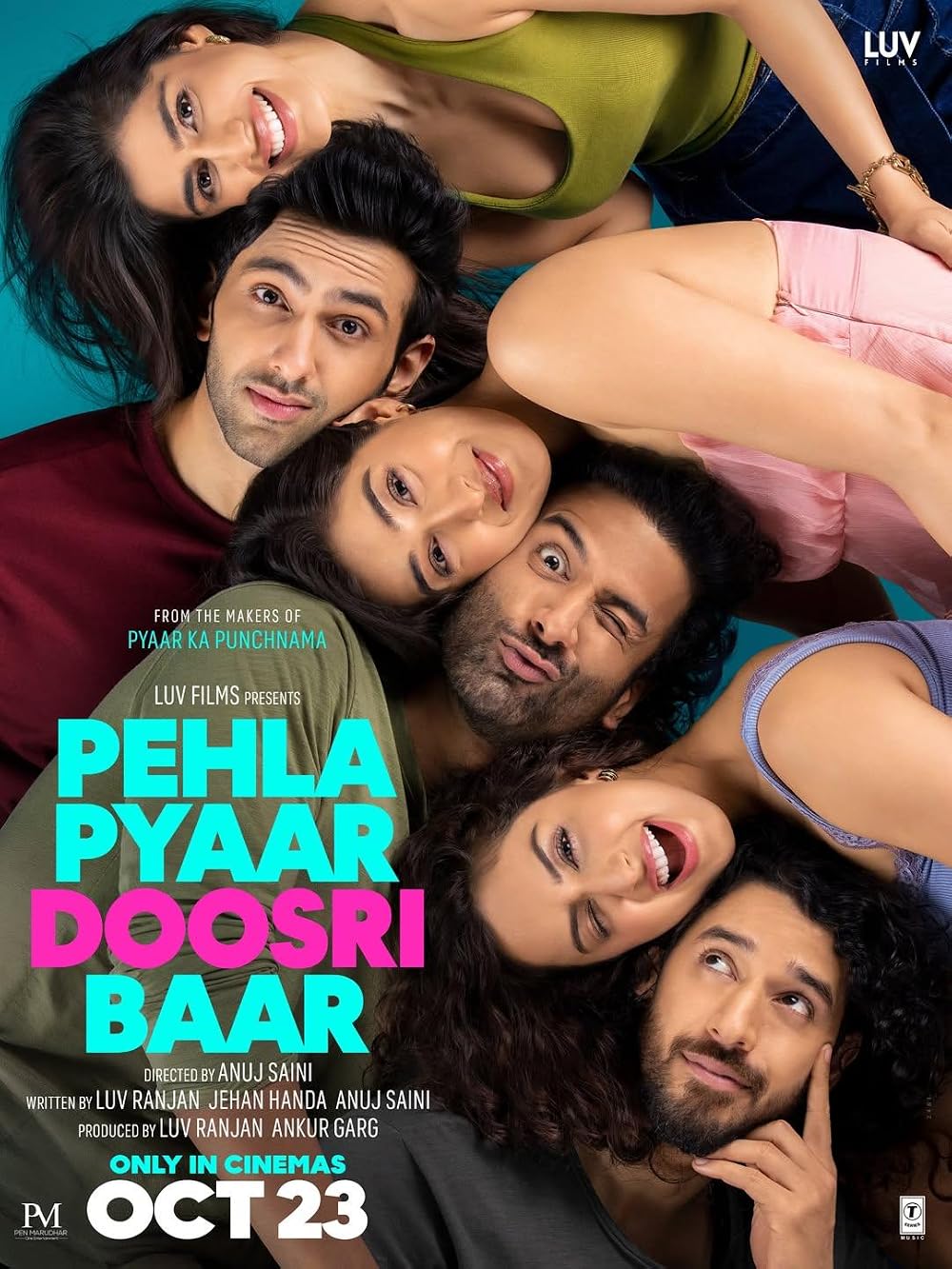
There is a specific subplot in the new Hindi film Pehla Pyaar Doosri Baar wherein a character is attracted to his childhood crush, only for the latter to continue to stalk and manipulate him. That is my tryst with the filmography of Luv Ranjan that felt refreshing at the start before spiralling out with repeated gags and situations, something that are more recycled than plastic at the moment. Take the dynamic here for an instance. You are introduced to the three protagonists – Vedant (Kunal Aryan Vaid), Gautam (Sparsh Walia), and Shivie (Sargun Kaur Luthra) – who seem like derivative variants of the trio in Pyaar Ka Punchnama (2010). The only change being the switch of gender of one of the characters, a way of warding off the evil feminists from the review, even whilst keeping the female-bashing banter alive (read on further to find out). It is the same kind of toxic relationship that people share with their exes – the one wherein moving on isn’t an option, and being overtly critical isn’t too!
Written by Anuj Saini, Luv Ranjan, and Jehan Handa, the concept of Pehla Pyaar Doosri Baar is similar to the Tamil film 96 (2018) – with the latter being focused on the beautiful dynamic between its protagonists following their meetup at a school reunion. But the tone employed here isn’t an emotional one. In fact, it is that of escapism for the protagonists away from their world of corporate slavery, and reuniting with their clan from school. The ‘Pehla Pyaar’ angle in the narrative is introduced through a specific cameo (Rajkummar Rao) who gives a monologue on how romanticizing ‘One-sided love’ has resulted in him being single on the day hia crush is being married off. It is a loose but effective moment in defining the callous nature of the drama, in what felt like a decent start.
It is interesting on how the setting of the reunion remains a buried fantasy of most of us wishing to boast our identities to our crushes and bullies alike. The whiff of nostalgia would be palpable in the air, amidst some unexpected reunion of folks that have been separated and out of touch for years. But the writing here isn’t interested in tapping into this zone – it is the wave of campy love that it wishes to tap into, thereby triggering a sea of mediocrity enough to drown its world and the characters alike.
The writing maintains its focus on its two male leads – with Vedant falling head-over-heels on his school crush Simran (Sakshi Vaidya), the front bencher and a topper from school. Gautam is weak in his knees for the school hottie Gehna (Alisha Chopra), wooing her by volunteering to open the lock to her room and his heart. In all of it, Shivie gets the least interesting arc – trying to woo the school playboy Karan (Tushar Chhibber), by going from a tom-boy herself to a s*xy siren in a little black dress. The issue isn’t about a superficial coming of age realisation. The issue is that she knew exactly what she was getting into, and still making her move. And this is just a small glimpse of her female characters are written here.
The proceedings immediately churn the men into being victims, and the females either redundant or walking red-flags. Take Vedant’s arc for an instance – spending most of his reunion weekend flirting with Simran, only to realise that she is engaged, while literally flipping the blame on her. And that is not all – he still can’t take a no for an answer, trying hard for her to call off her engagement by emotionally manipulating her, and later gatecrashing in on her wedding. Clearly, Vedant is yet to watch the much needed Hindi film Pooja Meri Jaan (2026), while riding on the arc of no-means-yes as far as ‘his’ girl is concerned.
The arc of Gehna also is a problematic one – designed to weaponize her looks, and trap innocent boys like Gautam in her fist. She is vilified to a point wherein she emotionally manipulates Gautam into falling for her, sleeping with him, and later unleashing her wave of obsession on him including conceiving a s*x video for ‘memories’. This, even as Gautam remains a distant cousin of the character of Kartik Aaryan from Pyaar Ka Punchnama 2 (2016), silently persevering through the toxic wave of a clingy girlfriend. A decade later – nothing has changed! Female gaze has clearly left the chat here, and victimhood is the new weapon of patriarchy. I mean who writes this sh*t in 2026?
The events traverse from an expensive music video to a gate-crashing wedding, almost treating its drama like an expansive influencer who loves to adore their looks by staring at the mirror. The subtle hints of the comedy are largely redundant, often falling victim to the same tropey Bollywood movies that it wants us to stop romanticizing. For instance, there is an extended sequence about the clan trying to elope Simran from her wedding, to which a character retorts on how consent is important. But he is also quick to remind the group that consent is a word that is exclusively reserved for females (particularly the woke ones), and it doesn’t apply on guys. Yes, feminism dies yet again in this film in the wake of some mansplaining bullsh*t.
Hell, there is also a random homo-kiss initiated by one of the more problematic characters of the film, just to prove his new-found love to his girl in what felt like a needless arc of redemption. This, while another female character doesn’t get a redemption arc too – weaponizing her clingy nature as a natural toxic trait of laughter. Feminism once again is robbed in clear daylight, in the wake of some low-hanging fruits of patriarchy. These examples can go on and on, and I still draw parallels of a gender bias. All while summing up a screenplay that paints men to be entitled victims, and females glorified villains (like Simran or Gehna) or redundant creatures (like Shivie who is designed to be a tom-‘boy’).
The dialogues are often utilize the lowest hanging fruit in trying to be funny – using words like ‘Ch**tye’ to induce laughs. The crude dialect of the Delhi-NCR region is a genre fatigue in itself, often mistaking loudness for comedy. The music is peppy and actually sits well with the vibrant and colourful mood of the drama. Ditto for the BGM that adds a comedic zing to the scenes in question, trying hard to induce laughter against the tide. The cinematography comprises of frames that are vibrant, and work on a certain aesthetic of freshness. Be it the colours employed that are pleasant to the eye, or the glossy exteriors that seem fantastical places away from the polluted cities like Delhi and Mumbai, all of which cater to the glistening ambience of the drama. But the emotional core is the missing piece in the jigsaw puzzle, particularly when there is an entire subplot around a jilted lover who just can’t take a rejection.
The editing pattern felt a tad too repetitive, particularly when the basic plot felt wafer-thin. I mean look at it this way – they all could have left at the halfway just as they did try to, and we would not have got to witness its manipulative second half. The isolated cuts though are good here, at times also contributing to some comedic moments in the narrative. But there is only so much the technical department can do to salvage a failing script.
Director Anuj Saini struggles to find his footing, delivering a flat narrative where the humor is rarely palpable or evident. His execution sorely misses the sharp, energetic touch that Luv Ranjan typically brings to the directorial chair for these contemporary buddy-romance comedies. Instead of landing punchy, relatable gags, the direction leaves the multi-character dynamics feeling forced, manipulative and structurally disjointed. The muted comedic timing prevents the film from ever truly capturing that vibrant, signature genre spark.
The performances are decent here by the members of the cast (and I am going soft on some of the debutants here). Tushar Chhibbar as Karan delivers a perfectly decent outing despite a very problematic character arc, making a commendable effort to navigate the script’s forced humor and situational gags. He displays a solid sense of screen comfort, playing off his co-stars with an amicable chemistry that keeps his subplots moving forward at a reasonable pace. <span;>Alisha Chopra as Gehna turns in a decent, reliable performance that effectively anchors her segment of the ensemble without ever quite breaking into extraordinary territory. She navigates the modern relationship dynamics of the script with professional poise, delivering her lines with a steady, commendable consistency. While her character suffers from a noticeable lack of deep development, she manages to maintain a pleasant and highly watchable presence throughout.
Kunal Vaid as Vedant provides a decent and stable performance, though his portrayal is held back by the deeply flawed, emotionally manipulative nature of his character. He approaches these toxic behavioral traits with a straightforward sincerity, capably embodying the calculating undercurrents required by the script. However, this inherent manipulation acts as a distinct demerit to his overall act, occasionally draining the necessary charm from his screen presence.
Sakshi Vaidya as Simran does have a good screen presence to boast of, although the writing lowers the impact of her performance by creating a confused outlook to her persona. But despite that, she does a fair job in creating an assertive and toughened aura that was crucial to the initial context of her character.
Sargun Kaur Luthra as Shivie shines as a major saving grace of the production, demonstrating impressive dramatic range despite being burdened with a rapidly failing character arc. She works wonders with the underwritten material, injecting a callous outlook and conviction into a role that frequently threatens to be one-dimensional. Her expressive performance is one of the underrated highlights of the film.
Sparsh Walia as Gautam delivers the standout performance of the film, grounding the chaotic multi-character narrative with a remarkably organic and effortlessly relatable screen presence. He brings a perfect blend of modern vulnerability and natural charisma to his role, making his character’s personal struggles feel both authentic and engaging. Even when the script falters, his precise comedic timing and grounded emotional reactions consistently elevate his scenes.
Decent performances by the debutants aside, Pehla Pyaar Doosri Baar feels instantly dated in both its comedy and its genre. The writing carries a blatant gender bias, turning men into entitled victims while vilifying women under the guise of lazy, patriarchal humor. Furthermore, forced pacing disrupts a manipulative narrative that pushes problematic themes just for a few cheap laughs. The end result is a fatigued drama that feels like a tired extension of the Pyaar Ka Punchnama formula – utilising tropes that are no longer funny. On a side note, there is something wrong about men writing female characters, particularly in recent times! Available in a theatre near you.


