

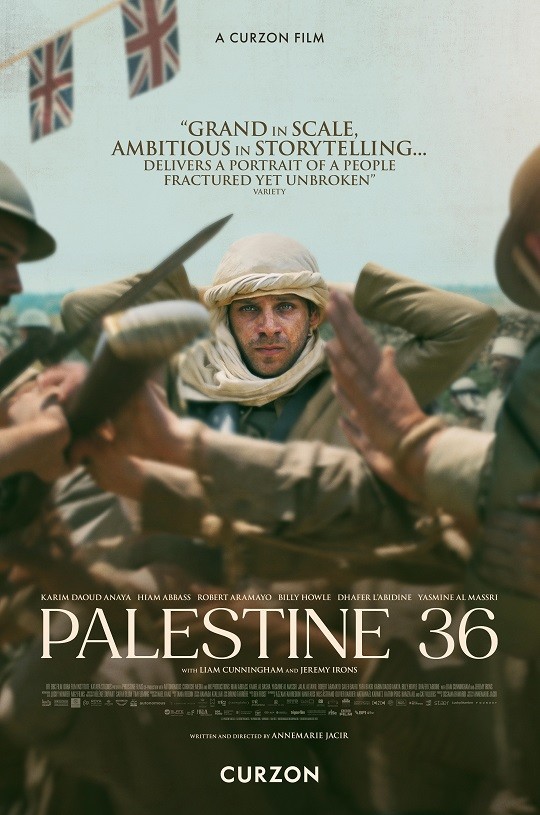
In one of the early scenes in Palestine 36, Palestine’s Official Submission to the Oscars of 2026, you see British Officials setting up a radio as a means of unity, peace and communication, often using these traits to mask the imperialism to the Western World. The year is 1936 wherein Palestine is a colony of the British empire, and the calmness that ensues at the start of the film is rather unusual. The general consensus remains a regular day in the life of Palestinians under the British rule, but the subtext tells you a different story. There are stray cases of chaos that are reduced to the headlines of the newspapers. The radio that is setup also ironically pours in announcements of the arrival of the European Jews as a part of the anti-semitism, an irony in itself given how they arrive in a land governed by the British (the very people they were escaping from). When you drill that down a bit further, you will realise that this ‘Divide And Rule’ policy of the British is the cause of the state of Affairs of Palestine with Israel today. The idea of handing over the land of the Palestinians to the Jews to solve a potential migration problem in Europe, is the stepping stone of a full blown war that has cost over a million lives today. That alone makes this film supremely relevant in today’s times.
Written by Annemarie Jacir, Palestine 36 offers a searing account of the Arab revolt in 1936, something that felt too close for comfort even in the Indian context. India being a colony of the British was divided – a part of it in Pakistan, and a part of it in Bangladesh. As things have turned out, the relations between each of these three countries is hardly peaceful today – much like the Palestine-Israel conflict that is met with silence from most parts of the world.
And you see seeds of the conflict early on when you witness a young widow Rabab (Yafa Bakri) explaining to her daughter Afra (whom you witness walking on an oil pipeline; a virtual metaphor on why Palestine was a British colony) that the Jewish settlers are here because they are unwanted by the British. It is also ironic in many ways because the entire contingent arrive with an intention to encroach the land of Palestine – so much so that Palestinians have to dig their own graves (literally and figuratively), or are even asked a permit to move from one village to another.
The drama offers a zoomed out perspective into multiple factions of the revolt, most told through its characters in the mix – an Arab Christian priest Father Boulos (Jalal Altawil) who is often met with suspicion even whilst his son spends time playing with Afra, Yusuf (Karim Daoud Anaya; apolitical at first but radicalized by the British later) who moves from his village to the city to work as a driver for a liberal leftist editor Khouloud (Yasmine Al Massri), even as the latter’s husband Amir (Dhafer L’Abidine) discreetly churns out propaganda through the editorials in exchange for money. This, even as the village hosts two rebels Hanan (Hiam Abbass) and Khalid (Saleh Bakri) who are known to speak their mind. On the other hand, the characterization of the British personnel remains a little binary – Thomas (Billy Howle) being the tender and understanding personnel who wishes to put humanity on the forefront, and Captain Wingate (Robert Aramayo) who wishes to impose the might of the British empire on the Palestinians.
The parallels that one can draw with the innumerous revolts against the British empire in the Indian context, cannot be ruled out. Be it Barrackpore or Jhansi or Gwalior – the story remains the same, even with the incorporation of the Peele Commission in Palestine that was met with bouts of revolt. In a scene, you see characters being trapped inside a house under blackout even as they witness gunshots at a distance. It is all but familiar with the state of affairs that unfolded later on as well.
It is interesting how certain visuals circling from modern-day Palestine make their way in the film, in a completely different timeline – a reminder on how the modern conflict had its roots traced to British imperialism and power. In a scene, you see a character being tied up at the front of a car while being used a human shield by the British, in another, you see pockets of hate being exercized by the British while trapping two characters inside their home and detonating it, or spreading out landmines to deliberately execute a bus full of ‘accused’ passengers, or even man-handling a woman who wishes to speak her mind out. One glance into the state of affairs today, and you would know that cruelty has a different name but the same address.
And each of these instances has a strong emotional core tagged to it – a boy witnessing his father for the last time, only to seek revenge in a game of hate that ensues, a family being displaced after a string of deaths, a couple separating on an account of their political ideologies, and the state of an ancient nation that is changed forever. In that sense, the events are heartfelt and reflective without wishing to compromise on its messaging. The open end is a direct continuation of where Palestine finds itself today – battered, bruised and fighting a lone battle, even as the world is silent and dismissive!
The dialogues are conversational but also slightly dramatized in a few places, but the pain and agony of the characters is seamlessly communicated through the lines. The BGM relies on the rawness of the surroundings, which coupled with the impeccable sound design add texture to the drama. The cinematography is special in many ways because this marks an incredible instance wherein a film is actually shot in Palestine (along with some parts in Jordan). So the streets of Jerusalem hold a sense of authenticity because of the creative decision to shoot on location. The oscillating aspect ratio marks a clever integration of actual footage that unfolded back in the day, while further creating a parallel between the dramatized events and the actual events.
The editing pattern is pretty interesting given how multiple subplots unfold at the same time. This could so easily have been choppy, but care has been taken to keep the viewers invested in the drama and its characters effortlessly. Director Annemarie Jacir does a remarkable job in constructing a world that marked the foundation of the violations in place today in Palestine. The narrative style is familiar but relevant, even while tactfully tracing through the History board in a lead up to the ultimate revolt that changed the history of the nation forever. There is definite stillness in her craft to not sensationize the event while using it as a form of reminder, effectively recreating events with utmost sensitivity. The direction remains stellar through and through.
The performances are wonderful by the members of the cast. Aya Khalaf as Jenin, Sofia Asir as Dyala, Mo’min Shaitat as Sameh and Joanna Arida as Dyala’s cousin have their moments to shine. Jalal Altawil as Father Bouros delivers a subtly heartfelt performance that haunts you towards the end. Ward Helou as Kareem is excellent as Bouros’ son, emoting beautifully at regular junctures in the film. Saleh Bakri as Khalid, Kamel El Basha as Abu Rabab and Hiam Abbass as Hanan are sincere and earnest in their respective acts. Dhafer L’Abidine as Amir will remind you of some of the news anchors of the media today who will spew lies and hate while peddling propaganda to the people. And he does a swell job here. Yasmine Al Massri as Khouloud using her body posture and mannerisms to great effect here, while conveying her liberal political lineage effectively.
Liam Cunningham as Charles is first rate. Billy Howle as Thomas is affectionate with his act, and delivers a rather affable act. Robert Aramayo as Captain Wingate will infuriate you with his mannerisms, and in that aspect, he is wonderful to witness. Wardi Eilabouni as Afra exudes of innocence mixed with maturity given the events she witnesses around her. And she boasts of wonderful expressions to convey the same. Yafa Bakri as Rabab has a solid screen presence with such expressive eyes, that you are instantly invested in her character. There is purpose to her character, at one point having to take care of her family, and in another, having to witness a sacrifice of sorts. The emotional core remains in tact with respect to her character, in what remains a brilliant performance. Karim Daoud Anaya as Yusuf has an interesting arc to play with – that of a character who is apolitical to begin with before being radicalized, only later on to realise the truth around him. There is a stoic presence that he builds his character around, and the deftness that remains a byproduct of his character is really heartening to witness. His minimalistic performance is what makes it a special and effective watch.
Palestine’s Official Submission to the Oscars of 2026, Palestine 36 is a searing account of the 1936 Arab revolt in what is perhaps the most reflective and relevant drama on the state of affairs in modern-day Palestine, something that makes for a brilliantly pondering watch. And in 2026, I sincerely hope that peace prevails!


