

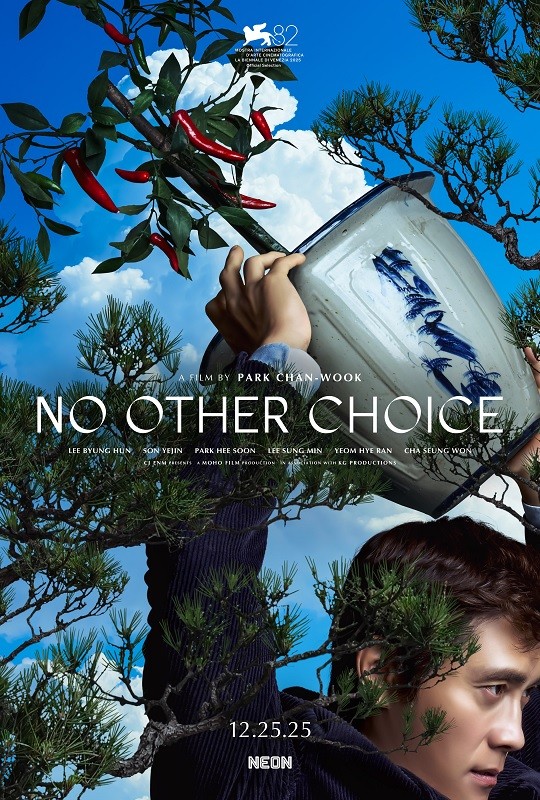
It is ironic how the setting of No Other Choice, South Korea’s Official Submission to the Oscars of 2026, can easily be labelled as a dystopian world – except that if you look around, it eeerily resembles our current times. For Man-su (Lee Byung-hun), it might seem like a lull before the storm, even as he presently finds himself in a state of comfort – sitting with his wife, two children and his two dogs in his lavish refurbished childhood home. In one of the few happier times, you see Man-su grilling eels while living a life of contention, something that his wife Mi-ri (Son Ye-jin) refers to as boosting his s*xual prowess in bed. It is interesting how in the same breath, Man-su’s step son Si-One refers to the eels as snakes (a hilarious foreshadow at a later point in the film), something that doubles up as an ominous sign in times to follow. In that sense, the undercurrents of a Shakespearean tragedy strikes early on for Man-su, given how he is shown to be laid off from his position of a paper industry expert by Americans, who can be referred to as “Snakes” too (something that Si-One was mistakenly referring to as well).
It is even more ironic on how the paper industry can be substituted for any industry that is in crisis today with the onset of Artificial Intelligence (AI) that has deeply affected the job market today. For Man-su, he promises to find another job in three months, just in time before his severance pay is used up, but you see him thirteen months later, working in a lowly retail store while having nothing concrete with his expertise in play.
Written by Park Chan-Wook, Lee Kyoung-mi, Don Mckellar, Lee Ja-hye, No Other Choice is quick to establish the contrasting life of Man-su and his family. For instance at the start, you see Min-ri joining her friends for a luxurious game of tennis or other luxuries including dance classes with her husband. But after Man-su’s lay off, the financial situation changes for the family – having to not only forego the luxuries of tennis and dance class, but also let go of their dogs and even cancel their Netflix subscription. The dark humour lies in the same breath while being reflective of a generation that is sold the idea of a lifestyle, while seldom wishing to take a step back even in times of a crisis (read : the job market). In that sense, we all are clones of Man-su in our real worlds – we are left with ‘No Other Choice’ even as the cruel world capitalism continues to thrive.
It is interesting on how the writers handpick a subplot related to the serial killer genre and practically deconstruct it with the inclusion of dark humour. The bizarre-ness of the plot can be determined from the fact on how Man-su, in a bid to get employed again, wishes to kill off three men from his sector, a couple of them who are more qualified than him and the other being a mouthpiece of the capitalist world. Come to think of it, it is a bizarre thought – but the film circles back to the relevance of the title, wherein Man-Su has ‘No Other Choice’. Ironically when you zoom into the lives of the two potential victims of Man-Su, both of them are suffering similar fates as Man-su himself in terms of unemployment.
Beom-mo (Lee Sung-min) may have had more experience in the paper industry than Man-su, but he hasn’t found a job himself for over a year. And his reluctance to branch out in another field, has also strained his relationship with his wife A-ra (Yeom Hye-ran). It is the kind of catch twenty-two situation that forms the dynamic of so many families today, wherein the respect of the family members is directly proportional to how much you earn for them. Likewise, even Si-jo (Cha Seung-won) is shown to be working at a shoe store. The cultural relevance remains on Koreans not wanting to ‘gift’ shoes to people fearing that they will run away, but Si-jo has ‘No Other Choice’ than to make a living for himself and his daughter that he needs to take care of. Just like A-ra, who is tired of her husband’s stubbornness, so much so that prompts her to have an affair with an actor – just to maintain her ‘lifestyle’ that was once a reality with Beom-mo. In other words, she too has ‘No Other Choice’.
It is interesting how any of the characters can be switched with Man-su, and the trajectory of the drama would remain the same. For instance, Beom-mo and Man-su remain the same people in a way, wherein even Man-su suspects his wife Mi-ri of having an affair with a younger dentist during her tryst as a dental assistant. It is ironic on how his tooth decay acts as a metaphor for his decaying wedding that he chooses to ignore as compared to addressing it, and getting it fixed. And it is also interesting on how Man-su is conflicted between warning Beom-mo about his wife’s affair and wanting him to kill him off, all of which transpires in some unhinged humour.
The parallels can also be drawn between the journey of Man-su and his grandfather, the latter who had committed suicide with a North Korean revolver after witnessing the slaughter of 20000 pigs in his farm. His grandfather was a pig farmer and the slaughter of the pigs meant that he needed to find himself a new job, something that had him anxiously kill himself. The motivation of Man-su to take up the job of a serial killer was more to do with the fact that he did not want to end up like his deceased grandfather – an emotional hinge in the screenplay that cuts through the dark humour quotient in the narrative. It is interesting how his step-son would perhaps imbibe the same trauma from Man-su, given that he witnesses Man-su burying a figure in his greenhouse. For Man-su, his childhood home always is an object of sentimental value – even while having to ensure bright futures for his children, one of whom has started stealing mobiles in order to sell them and earn a quick buck.
The entire killing episodes can be viewed as a metaphor for the corporate life, wherein corporate employees are nothing but crabs, trying to pull each other down while on their way up. It is the exact trap set by capitalists who are sure to exploit these traits for their benefits. In the same breath, the pressure is built even from the family members of the corporate employees, not willing to let go of the luxurious lifestyle that they are so used to. The case in point being A-re who lies to deflect the killings from Man-su to a character who is deceased, and Mi-ri, who does witness her husband burying a dead body but chooses to be quiet – maybe out of fear of being killed herself, but also because turning her husband in would mean giving up on the luxurious life that she has experienced until now.
In that sense, you do seem to think that the ending for Man-su is a happy one. You see him getting a job of a manager at a Moon Paper company – a dream job for many. He doesn’t really have to bother about competition too given that he has bumped majority of them in his bid to the top. And he is devoid of any suspicions too. But when there are no people under him, and given how everything around him is automated. And with AI coming into the picture, even his job is short-lived, his luxuries having a shelf life, his family being only moments away from ‘maybe’ turning himself in. So when you see him celebrating at the end, it is more about living in the present for Man-su, an imagery that makes for a haunting watch! And that sums up the screenplay which is a scary reflection of the endgame, something that threatens to impact millions of lives like Man-su. Is contract killing the option then? Or would be see people like Man-su switching to the job of ‘The Front Man’ in a Squid-Game like setup?
The genius of the writing lies in how well it controls the lines to exhibit the tone of a black comedy, as opposed to a drama that is serious. The gentle traces of comedy often overpower the seriousness of the drama so much so that the drama itself doesn’t get preachy or weighed down in anyway. The BGM is sparingly used while being mounted on a layer of silence that allows the rawness of the drama to seep in. The cinematography comprises of some wacky frames that further contribute to the dark yet playful absurdity of the drama. Be it the zoom in on the tooth decay, or a camera being placed inside a glass of whisky, the innovations are there for everyone to see.
Speaking of innovations, some of the best transition shots can be spotted here with an editing pattern that runs absolutely bonkers here. Be it a top view of the house cutting away to a log of fire, or a person bending his face over to cut-away to a flashback, the innovations are there for everyone to see. Director Park Chan-wook is a master of disguises given how the tone of his dramas deliberately veil the seriousness of the plot. He beautifully chooses to keep the narrative simplistic while incorporating various themes of capitalism and greed seamlessly in the screenplay. Even from a tonal point of view, the dark humour is palpable but also haunting and poignant, with every character invariably being on the same boat as the protagonist. In that sense, the direction is pretty wholesome in combining all these factors and presenting you with a drama that has the tendency of slowly growing on you. And that is the trademark of a master like Park Chan-wook who is absolutely phenomenal with his craft here.
The performances are wonderful by the members of the cast. Choi Do-yul as Ri-won and Kim Woo-seung as Si-won are wonderful actors, and both have their moments to shine. Yeom Hye-ran as A-ra is competent and effortlessly contributes to the humour in the narrative. Lee Sung-min as Beom-mo, Park Hee-soon as Seon-chul and Cha Seung-won as Si-jo are superb in their respective roles, while you get space to empathize with each of them. Son Ye-jin as Mi-ri has a stellar screen presence, while also adding layers of complexity to her performance with some great use of expressions. Lee Byung-hun as Man-su is in top form here, almost surrendering to the absurdity of the drama while exploiting the emotional core of his character with measured doses of zaniness. He does such a fine job in demanding an empathetic outlook to his situation even when committing to the wrong side of the law. He was brilliant and an absolute treat to witness here!
South Korea’s Official Submission to the Oscars of 2026, No Other Choice is a haunting glimpse into the endgame in Park Chan-wook’s brilliantly absurdist dark comedy that absolutely hits the bullseye. The drama has a tendency to grow on you while completely engulfing you for days after the film has ended, thereby making it an excellent watch.


