

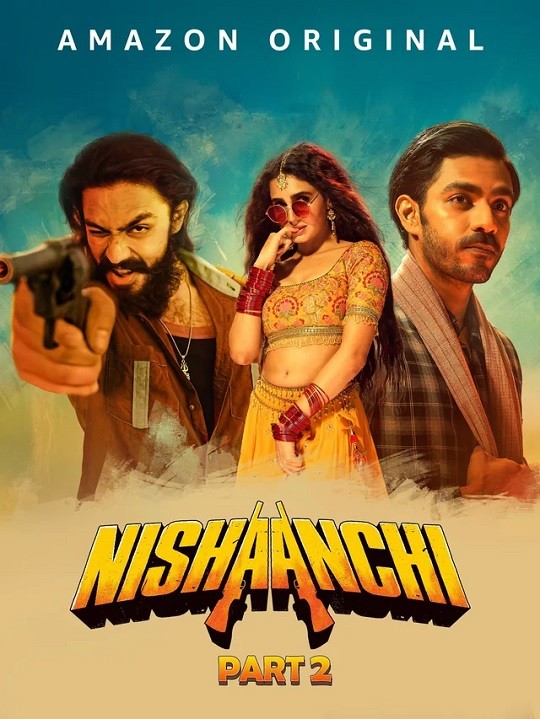
The unceremonious release of the second part of Nishaanchi aka Nishaanchi 2, has got everyone talking. But more importantly, it tells you a lot about an ecosystem that is rotting – the audience isn’t receptive enough to a good film, the cinemas aren’t interested in lowering the ticket prices too, and even the OTTs don’t really care now. The shocker wasn’t so much of the fact that Nishaanchi 2 had got a direct OTT release – somewhere we had all anticipated it after the lukewarm theatrical reception of the first part. What remained shocking was the zero promotional strategy of the OTT platform, randomly dropping part 2 with its first part. But guess what? The joke is literally on all of us – Nishaanchi 2 is a better film than Nishaanchi 1, something that is heartbreaking in retrospective, even as the audience continues to rant about the lack of Hindi films being released, while refusing to visit theatres to support the good ones (Kanu Behl’s Agra says hi). How many more interviews must the likes of Anurag Kashyap give in order for his fanbase to standup during the theatrical run of his films? Infuriating is the word!
Written by Anurag Kashyap, Ranjan Chandel and Prasoon Mishra, Nishaanchi 2 hinges more on the dynamics between the characters in order to take the narrative ahead from the world building and characterization of Nishaanchi 1. And like most Anurag Kashyap films, the politics is used as a subtext here – both Rinku (Vedika Pinto) and Dabloo (Aaishvary Thackeray) are unemployed at the start of the film. Rinku continues giving auditions while aspiring to be a dancer, and Dabloo continues giving interviews in order to get himself a job. Interestingly at a later stage in the drama, you also witness Babloo aka Tony Montena (again Aaishvary Thackeray) wandering for a job, while willing to turn over a new leaf. Compare that with the start of Nishaanchi 1 wherein the trio are involved in a bank robbery, and you just know on which people continue to prosper in the town. In the same breath, both Ambika Prasad (Kumud Mishra) and Manjari (Monika Panwar) exhibit similar contrasting traits as well – the former once a gangster, is now an MLA while the latter, once a national level sharp shooter aka Nishaanchi, is now reduced to her household, just about making ends meet. This setup tells you everything about the politics of the land, even as Babloo in a scene claims on how he can fight an election citing ‘Aajkal koi bhi chunaav lad leta hai’ (Nowdays, anyone does contest an election).
The dynamics between the characters take centerstage here with a couple of revenge plots in play, almost as an undercurrent. Rinku distancing herself from Babloo, simply with the knowledge that the latter had killed off her father, while getting involved with his twin brother Dabloo, probably also because it would hurt Babloo that much more. It is her form of revenge to begin with, even as the faint-hearted Dabloo doesn’t have the gall to reveal his relationship to his brother. And interestingly, the dynamics between the two brothers is a straight up nod to the Hindi film Deewaar (1975). The broader strokes of a revenge angle with Ambika Prasad takes a backseat initially, also intertwining the shifting but steady character arc of Babloo – going from absolute power to angst to frustration and later revenge.
The writing follows the character arc of Babloo in its second act, pitting him as the worthy opponent in this generational revenge saga of sorts. In that sense, the proceedings can be termed as a series of bouts between two heavy-weight giants – Babloo and Ambika in this case – even as Babloo is lured into an assassination ‘sharp shooting’ attempt by Ambika, while he wishes to turn a new leaf. There is a political subtext with respect to the power employed on common citizens, even as any attempt at employment for Babloo is foiled by the hired ‘bad cop’ Kamal (Mohd Zeeshan Ayyub), in a display of ‘win-at-all-cost’ politics in play.
The magic of a two-part Kashyap film isn’t always in its setup, that treads multiple plots and subplots before getting to the point. It is usually in the culmination of a tale that brings about an-edge-of-the-seat volcano that is intense and compelling. Here, it remains the magic of the final 40 minutes wherein the amount of tension just mounts in the narrative with a full blown dual revenge plot that unfolds in layers. Not only is it a nod to the title of the film, but it also accounts for a bit of unfiltered fun, even as the body count rises in a layered fashion. The staging remains excellent here, so much so that you do anticipate a tragedy in play at some point – even as the writers keep delaying the inevitable. Even the finale is riddled with tension while paying a homage to Mother India (1957), except with the addition of pulp – a key ingredient that is interspersed throughout the narrative. If this isn’t enough to prove the brilliance of Kashyap as a filmmaker, I don’t know what else could work for you.
The dialogues are authentic with the place that the drama is set in while laced with an inherent sense of humour that is at this point an Anurag Kashyap trademark of sorts. If there were film references to be deciphered by cinephiles (one of them being Scarface) in Part 1, the humour really kicks in here with lines like ‘Dead Body Ki G@@nd Nahi Maar Sakte, Woh N*crophilia Ho Jayega’. The lines are sharp and witty without being overindulgent or explicitly filled with expletives.
It wouldn’t be wrong to say that Nishaanchi is a musical, with music playing an integral part in the narrative. The varied themes of the narrative with respect to the film itself, or the politics in play, is ably enhanced through the songs that add texture and substance to the narrative. And when you have a rap song being played out against a small time setting with a context of violence as a subtext – you just know that it adds to the texture of the film. The cinematography by Sylvester Fonseca is delightful wherein the camerawork allows you to invest in the journeys of the characters. The idea of keeping the obvious revenge angle at bay is more pertinent with the frames that are content with following the characters around. And I cannot stress how authentic the setting looks just because the filmmaker chooses to shoot his film in real locations, something that makes the setting an important character in the mix too.
The editing by Aarti Bajaj is much more taut this time around (and at this point I am unsure on whether some subplots were snipped out on the edit table given how the original film was 6 hours long as opposed to 5 and a half hours in its final cut), making the drama actually more focused despite a couple of abrupt cuts. Director Anurag Kashyap does a phenomenal job here, particularly with the way he handles the character dynamics this time around. There is a lot of flair in his direction while being less indulgent this time around, and more self-aware of how he wishes to utilize his characters. His actual brilliance lies in the last 40 minutes wherein he amps the tension in the drama with a clear mood shift wherein his staging is a standout. The direction remains pretty solid here with a touch of his trademark humour that invariably adds freshness to the drama. Yep, it is safe to say that vintage Kashyap has regained his mojo and is here to stay!
The performances are delightful by the members of the cast. Gaurav Singh as Pankaj, and Prateek Pachauri as Phlunky have their moments to shine. Sahaarsh Shukla as Puraane is sincere and earnest while managing to impress here. Erika Jason as Anjana is a firecracker, and she absolutely hits it out of the park with her performance despite a limited screentime.
Mohd Zeeshan Ayyub as Kamal is another character that will infuriate you with his mannerisms. In terms of his body language, Zeeshan seemed to have partly borrowed the antics from Pankaj Tripathi’s Kaaleen bhaiyya to an extent, with the manner in which he mouths the dialogues. He is playful and a delight to watch here, while being effortless with his craft. Girish Sharma as the younger version of Ambika is a revelation shines yet again despite a limited screentime.
Kumud Mishra as Ambika remains an underwritten character, perhaps being at the receiving end of the his subplots being chopped off perhaps. But he still manages to bring the vile in his body language in a couple of scenes. He remains intimidating and understated but you do witness the vulnerability in his character when challenged by Manjari. He is effective in communicating the perverse traits in his character, and he does a solid job here. Vedika Pinto as Rinku has a radiating screen presence, while managing to tap into all the right emotions with respect to her character. She is unhinged and confident with respect to her mannerisms that her character possesses. This may well be a career defining performance wherein she charms you while being natural to the core onscreen.
Aaishvary Thackeray is a revelation here, excelling in both the roles of Babloo and Dabloo (also, can we take a moment to praise the brilliant VFX of the film wherein a seamless shot involves both characters standing next to each other, also…also, Sinners (2025) who?). As Babloo he is fiery but also vulnerable this time around, wanting to turn over a new leaf against the shackles of the politics in his life. And as Dabloo, he is understated and an introvert, restricting his movement and coming across as affable. Aaishvary uses his body language and expressions to great use, creating a contrast that would genuinely make it hard to think that both these characters are played by the same actor. This remains a super impressive debut, something that accounts for multiple moments of brilliance along the way.
Monika Panwar has to be one of the most talented bunch of actors doing the rounds currently. And like her brilliant outing in the Amazon Prime show Khauf (2025), she excels as Manjari here too – in a character that is Richa Chadha-coded from GoW. She is understated but assertive, almost being well aware of the politics around her that resulted in a tragedy for her family. She is cautious with guile but also righteous, thereby putting forth a commendable act that will only explode even more in the next part. And she absolutely owns the finale here with her riveting act of the highest order!
Nishaanchi 2 is an engrossing drama backed by incredible performances that makes for a solid watch. This is particularly true when you view Nishaanchi as a single film, something that holds up wonderfully well. Either way, the drama here remains a brilliantly pulpy followup that absolutely hits it out of the park with its trademark Anurag Kashyap magic in the final 40 minutes! Available on Amazon Prime and Highly Recommended!


