
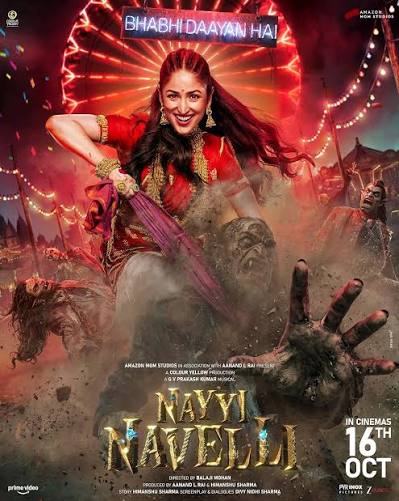
Offlate, I have come to terms with the shifting landscape of cinema – something wherein stories of today have ceased to exist on celluloid. The only forms of storytelling that we as viewers are accustomed to is in the zone of escapism, or historical biopics, or mythological fantasies that maybe good stories on paper. But the idea of resorting to the past is a way of selling people hope, particularly in the times today that are dark. And the new Hindi film Nayyi Navelli rides this wave from the start to finish!
There is something Stree-coded about the drama here, particularly as you witness a group of characters kidnap and lock a female inside a room. On probing further, a character named Bantu (Anurag Thakur) claims that his sister-in-law is a Daayan (witch), much to the surprise of his brother Raja (Addinath Kothare; notice the name on how men are treated in this universe). On paper, this seems like an interesting anecdote on feminism – the one that would play with metaphors to drive home its point. Unfortunately when most of the metaphors are replaced with shouting and reactions that are largely unfunny – the same drama not only becomes irritating but also exhausting in many ways. That is the problem at hand for the film, except that we are still just in the first hour!
Written by Himanshu Sharma and Divy Nidhi Sharma, Nayyi Naveli at the start struggles with its setting, almost in a literal sense given how the houses in the background overlooking the balcony of the household (where the drama unfolds), felt like a wallpaper on my desktop. I just couldn’t focus enough on the drama taking centerstage, all of which seemed like an hour of rambling by the folks of the house, arguing on whether Mohini (Yami Gautam Dhar) is a witch or not.
The humour in the first hour blows hot and cold, even as the protagonist is said to leave a trail of bodies behind – particularly the men who have misbehaved in any shape or form. Be it a chandelier that randomly drops on a character for intruding her personal space, or a character’s tongue being cut-off only to mime his way throughout the narrative. One has a serious tone tagged to it, the other is playful – no prizes for guessing which one is which. And this mishmash of tones continues even as seeds of doubt are sown into the minds of the characters, one of whom is married to the elder-now-aging daughter of the family who isn’t a spinster anymore. The Jacqueline Fernandez joke is the only time I smiled in the moment! The other jokes comprising of an elderly character uttering ‘No Uterus No Opinion’ or ‘Burn Your Bra’ felt largely unfunny and a desperate attempt to make one smile. I felt like feminism wished to enter the chat largely ruled by patriarchy, but she was charged and fined for being unfunny in a horror comedy group! But that wasn’t even the worst part yet…
The writing suffers from a structural brainfade, something that it chooses to pivot right before the interval block. The loving dynamics between the characters suddenly transform into a template of good versus evil while literally mythosplaining the details in the plot through some AI slop. Clearly, logic was detained and the arena was captured by forceful bouts of mythology, not even let-off with a warning – but arm-twisted for using intelligence in a drama that did not warrant one.
I am all for mythology and the grounded, earthy storytelling that it brings with it. But this one felt similar to the famous words of Vijay Raaz from the film Run (2004) – ‘Chhoti Ganga Bolke Naale Mein Kudwa Diya’. The problem remains on how this was never the DNA of the conflict at the start of the film – relying on an unfunny but important commentary on defining the concept of feminism as viewed through the filters of the society. But when that is abandoned, and led to a forced integration of mythology only to please a section of the crowd, then even the very intentions of the writing are corrupt and woefully exposed in the narrative here.
The mythology is literally a meeting point here, relying on zombie-esque creatures to define the ensuing dangers of the evil spirit of a villified mytho-figure, or the integration of a resounding Godly figure but reducing him in the shadows of a mumbling setup that is conflicted between giving the protagonist powers and encashing on the popularity of the mytho-god. In between all you get is a weird face-off boasting of caricaturish action set-pieces that reminded me of the graphics of Bal Ganesh as witnessed way back on television.
In a scene in the final act, even the vilification of a particular character at the end came literally out of nowhere from a wave of convenience, even as the prior vilification of a noble soul also felt forced. In a way, the subplot felt straight out of the Hindi film Raaz (2002) minus the mytho-angle. And no prizes for guessing on how the drama ends, something that had begun with a disclaimer on how it doesn’t believe in spreading blind-faith but instead chose to tell a story as mind-numbing as this! The Vvaan (2026) has a new relative already, even as questioning folks like me would eventually be trampled by this wave that doesn’t seem like it would stop in the near future! As the rule of a mytho-horror (comedy) film goes – the one who doesn’t believe, dies first!
To be fair, some of the dialogues in the first half land in terms of humour. But largely, the frothiness of the setup is shortlived, often pivoting into a zone that would make the lines critic-proof. It is like the lines flipping that wildcard in the mix, so much so that it attains immunity from the poor jokes that it intends to narrate in the garb of feminism and religion. The music is largely forgettable, with not a single song that stands out. The BGM wants the viewers to over-familiarize with the world and its characters, almost manipulating the viewers to think in a certain way. This isn’t incidental but a measured step to shadow the obnoxious writing in the mix.
The cinematography comprises of frames that lack any sort of the depth with respect to the proceedings. Instead of immersing me in its environment, the camera work feels entirely detached, rendering the backdrop sterile and completely devoid of emotion. The visual language relies heavily on obnoxious, over-the-top compositions that distract from the narrative rather than enhancing it. This lack of subtle artistry is further worsened by glaringly poor VFX, which makes the overall imagery look cheap, artificial, and poorly integrated. If one were to compare it to the much hyped frames from the trailer of the soon to be released Ramayana – then the difference (and sincerity) is as clear as night and day. Also, the exposition mixed with animated AI slop must stop now. It is lazy in every sense of the word!
The editing pattern isn’t entirely seamless, intercutting scenes of the past and present timelines with jarring after-effects. Even the editing style during action set-pieces felt way too abrupt, never fully creating an impact that is long lasting. Director Balaji Mohan falters under tepid execution, failing to breathe life into what could have been a compelling narrative. The film suffers from jarring tonal shifts, abruptly lunging between horror, mythology and comedy without establishing a cohesive narrative rhythm. A critical lack of characterization leaves the talented ensemble cast stranded, as he prioritizes rapid plot progression over genuine, human depth. His disjointed staging prevents the audience from ever truly connecting with the emotional core of the story.
The performances are a mixed bag by the members of the ensemble cast, and most of thr issues stemmed out from the lack of characterization. Two of the funniest performances in the narrative arrive in the form of Aditya Kulshrehth as Vishal and Mita Vasisht as Pinky Bua – both of them being supremely impressive with their body language and humour in short-lived but steady bouts of unhinged humour. Prateek Pachori as Pannu and Babita Pandey as Rekha are decent but the writing doesn’t fully allow their performances to shine. The veterans Sunil Sinha as Awasthi and Sushmita Mukherjee as Dadi are reduced to high-decibel seniors without much returns with the laughs. Sunita Rajwar as Asha Devi is fairly good here, while trying her best to rise above the shoddy writing tagged to her character. Sonal Jha as Sumitra is done in by a jarring transformation with regards to her character, that felt against the tide – without the writing offering a steady buildup. She was decent otherwise, maybe slightly over-the-top (an issue with the briefing perhaps), but there is nothing major to write home about.
Anurag Thakur as Bantu infuses life in an otheriwse exhausting drama with his comedic act. While the writing isn’t the best, his performance is wonderful with crisp comic timing and antics that would atleast force one to take notice of him. And it won’t be wrong to say that he does much of the heavy lifting in the drama here with regards to the tepid comedy that is on offer. He was a treat to watch in an otherwise forgetful drama.
Addinath Kothare shines as Raja Awasthi, grounding the supernatural chaos with immense charm. His portrayal of the doting yet caught-in-the-middle husband displays a wonderful balance of sincerity and effortless humor. Kothare holds his own remarkably well alongside a veteran ensemble cast, anchoring the emotional core of the household. His engaging screen presence proves he is a versatile actor capable of handling complex family dynamics.
Yami Gautam Dhar gives a decent and earnest performance as Mohini, executing the intense dramatic and action sequences with sharp precision. She brings an admirable physicality and fierce energy to her unique avatar, showing a distinct dedication to the role. Unfortunately, her efforts are heavily let down by a disjointed script and fragmented character development. The writing fails to seamlessly blend her character’s comedic and mythological layers, leaving her performance constrained by the weak narrative choices.
Featuring mixed performances, Nayyi Navelli is a sloppy, painfully unfunny horror-comedy that shifts needlessly into a tired mythological space, something that left me utterly frustrated and exhausted. The film suffers from a severe structural brainfade, introducing an initial conflict only to abandon it for an entirely disconnected resolution. What makes this project truly infuriating is how its blatant mediocrity is masked as spiritual reverence, exposing the drama less as a cinematic effort and more like an ungodly, impious money-grabbing gimmick designed to exploit the audience’s faith. By joining The Vvaan in the ranks of recent cinematic disasters, this film successfully turned my brain into a complete graveyard. Available in a theatre near you.


