

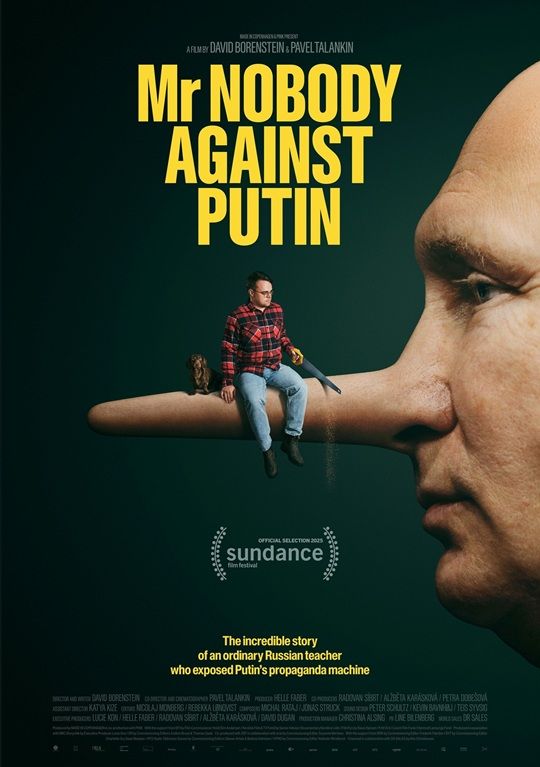
It is funny on how the protagonist Pavel Talankin of the documentary Mr Nobody Against Putin (Bafta Winner; Best Documentary Feature Nominee – Oscars’26) mentions on how his little staffroom remains the only democratic place in Russia – something that completely engulfs the spirit of the unfolding drama. The backdrop remains that of late 2023 wherein a regular day in the life of Pavel is turned on its head when He is asked to document the classroom lectures of his students even as Russia is on the cusp of invading Ukraine. Pavel is a teacher and an events coordinator who in his words ‘wastes his time’ in shooting the lectures as opposed to imparting qualities and teachings to his students. In that moment, the entire dynamic of the country shifts from nationalism to hypernationalism, even as bouts of propaganda begin to make their presence felt in the school curriculum. It is eerily similar to a lot of events happening across the globe, in a drama that may be set in the small town located in the Ural mountains but has its ‘polluted’ spirit extended to many countries veiled as democracies in current times.
Directed by David Borenstein and Pavel Talankin, it is interesting on how the journey of Pavel coincides with the journey of his town in the Ural mountains. Being touted as the most polluted town in the world, you witness Pavel pointing towards the smoky black mountains that have endured the wrath of humans over the years. But ironically when you are witness to Pavel in his formative years, the education system felt seemingly grounded – gently nurturing the analytical ability of young minds without polluting them with propaganda. But the scenario completely has changed in modern times, particularly as Pavel is handed over the camera and left to capture the sanitized and measured speeches of teachers imparting bouts of propaganda to the young impressionable minds.
The proceedings are increasingly shocking while mounted on the personality of the two individials – Mr Nobody (Pavel Talankin) and Vladimir Putin. In a scene, you witness how the students are fed with a fixed ideology of ‘unity’ on the lines of how anyone would be considered an enemy if they question the welfare of the ‘motherland’. It remains eerily close to the power dynamics in place almost everywhere wherein the idea remains to polish the ones in power by creating an enemy out of folks or communities that are marginally different from the majority. If it was the Jews for Hitler, it remained the folks of Ukraine for Putin – even as history lessons are twisted to cater to the hyper-nationalistic sentiments of the motherland, more so with an intent to prepare the next lot. This, while labelling everyone opposing it as enemies – much like Pavel who as a totally different ideology.
In a crucial scene, you see Pavel arguing with his mother on how propaganda finds its voice in the education sector, along with a general discussion on how war isn’t the solution. For context, the Russia-Ukraine war has already gone down in history as the second most bloody war in Europe since WWII, with as many as 1000 soldiers being martryed each day only in Russia. For Pavel, the modern setting is far from the Russia that he had grown up in – something that forms a bout of relatability for me too with the changing surroundings around me. And this also makes Pavel impulsively quit his school, only to take back his resignation following a letter that he receives, prompting him to collect material and form a documentary to expose the system.
To make matters worse, the state also is shown to appoint a particular teacher who favours the current regime. In an important scene, you see the man talking about his historical heroes – sadistic folks and genocide propagators, including Lavrentiy Pavlovich Beria, chief of police under Josef Stalin, who designed the gulag system. That tells you a lot about the mindset that Pavel is dealing with, even with people around him. This, while the concerned person also managed to win the ‘Best Teachers’ award at a community gathering. So much for data manipulation, so much for perception manipulation.
For Pavel, the journey is ridden with internal conflicts given how he is tasked with carrying out his duties, not out of choice but out of fear of being caught. The fact that he managed to keep himself undercover is a story in itself – something that potentially would form a premise of a Hollywood film. But the situation worsens when an Order is passed that prompts young students to serve a time period in the army. This basically meant that Pavel’s students who were close to him would either be martryed or their families would be scarred for life.
Notice how the hairline of young students gets shorter and shorter even as they camoflague themselves in an army uniform with guns stationed in their hands – a sight that is enough to haunt the caring undertones of Pavel and his personality. In a shocking scene, you witness how just an audio recording of a mother wailing at the passing away of her child in war, a sequence that went beyond the optics of storytelling.
The entire final act has traces of nostalgia sprinkled in the narrative, particularly when Pavel begins reminiscing his childhood that was free from politics. In his words, he mentioned on how he loved the polluted town of Ural, the black mountains in the background, the stained walls, his room that had a democratic flag of Russia pinned on his wall, and the school that he was brought up in after the passing of his father. In a moving scene, you witness the dual nature of the setting – that of Graduation Day that coincides with Pavel’s last day in his homeland. In a sharp contrast, you see his speech moving even one of the propagandist teachers too, who is shown to quietly wipe out a tear.
And yet the aftermath boasts of narrow corridors of the schools, even as you get a feeling of walls closing in. The town wears a sad look even while pretending to serve the notion of hypernationalism towards their motherland. The real loss would never reflect at the top, but more so on the streets that would result in quieter moments of sorrow drowned beneath the silence of power and dictatorship. Soldiers would die, so would fathers and sons, and mothers and daughters but the people at the top will remain unmoved and unaffected – continuing to divide people, crushing criticism, silencing opposing voices and nullifying the art of analytical thinking, manipulating data and history for impressionable young minds, rigging ‘elections’, and enjoying power in its supreme form. Sounds Familiar?
The Bafta ’26 Winner, and a nominee under the Best Documentary Feature category at the Oscars of 2026, Mr Nobody Against Putin is a frightening sneak peek into the propagandist education system in dictatorial Russia, something that makes for a brilliant watch. Highly Recommended!


