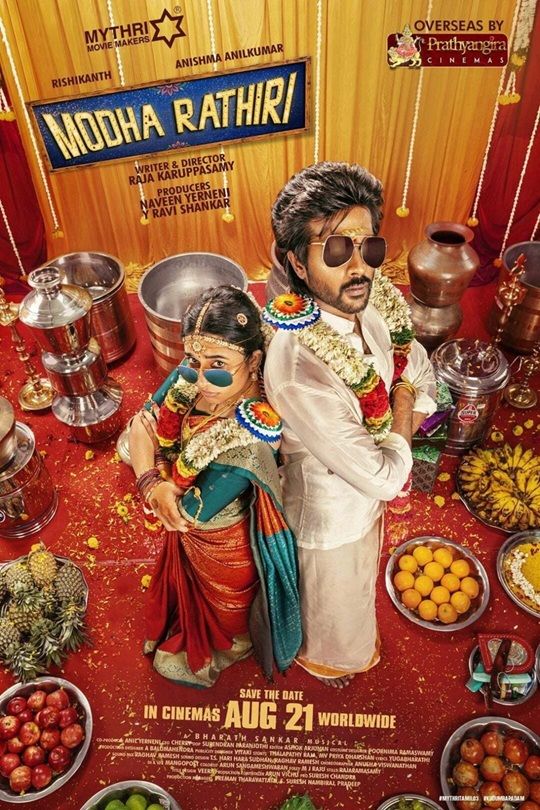

As they say, marriage in India isn’t just between individuals but also the families. In that sense, the Tamil film Modha Rathri forms an early companion piece to the Malayalam film Thinkalazhcha Nischayam (2021) with its setting of a jittery wedding in play. And you get only hints of the early jitters in play – the groom is being called out for to arrive for the ceremony by a priest, the chatter between the guests reeks of a brewing tension, there is a talk about a wedding cot that hasn’t arrived yet, and dollops of confusion that it associated with the setting. It is almost symbolic of the ceremony itself being played out as a rehersed act, almost like an unsaid battlefield that is submerged in a sea of chaos. As a foresight in a previous scene, you are also witness to a local priest Poosari (Chetan) who is left out (along with his God) by the villagers for the wedding ceremony; to which he places a curse mocking the ceremony by stating ‘Let’s See How The Marriage Will Be Conducted’. It is almost like an alternate Shakespearean premonition by a soothsayer, something that invariably would lead to further bouts of confusion and chaos – all unfolding across a single night in a nod to the title of the film.
Written by Raja Karuppasamy, the central conflict in Modha Rathiri appears as a bout of comedy being played out against the setting of a wedding. And it is particularly hilarious because both the bride and the groom doubling up as protagonists, are a match made in oblivion. When you are first introduced to Maruthu (Rishikanth), he remains completely oblivious of his own marriage – having been told to fly in from Dubai for a supposed ceremony of his nephew. On the other hand when you are introduced to Muthu (Anishma Anilkumar), she is relying on her ‘irresponsible’ boyfriend (Raja Karuppasamy) to elope from her own wedding.
I liked how the writing incorporated layers in this drama – you notice a hesitation in the body language of both these characters, be it in the lack of eye contact or their nervous smile, in trying to come to terms with the fact that they are forcefully getting married by their families – the latter who have imposed a decision on them. In between, the bouts of humour are branched out in two parallel subplots – one involving the boyfriend of Muthu who just doesn’t like taking up responsibility, or should I say is incapable of it – setting an alarm for 5 PM for a 5 AM wakeup time, having just Rs 3000 in his bank account in a bid to settle with his potentially ‘eloped’ wife, and aimlessly seeking for help from his equally loser friends😅. The other being that of a cot who was to be delivered for the first night, but instead is broken down accidently, and later assembled – only for the delivery folks to keep meeting an obstable through their journey at night.
I liked how the title of the film remained a metaphor for the couple to understand each other, a deeper deviation from the standard tropes of intimacy associated with the ‘first night’. This is also where the characterization of the protagonists come to life – often also associated with bouts of symbolism. You notice an unsaid tattoo on the arm of the Maruthu, something that is tagged to his past while resulting in bouts of grief in his present. His idea of not wanting to marry would also translate into helping his newly wed wife to elope with her boyfriend – given how his definition of love was devoid of any boundaries with related to caste or religion.
On the other hand, the characterization of Muthu – someone who is wonderful in studies but eventually enforced and married off to an unknown man despite her heart lying elsewhere. A mini arc with respect to her character also is highlighted in a scene wherein her boyfriend refuses to take her with him – almost underlying a metaphor on how loving someone isn’t always guaranteed with the idea of responsibilities that are positioned around it.
In a separate moment, you also notice a seamless thread of suppressed emotions forming the crux of her character – having an eventually outburst only twice in the film; one during her unperturbed dance on stage at her wedding, and the other during a screetching outburst towards the end. The suppressed trait remains consistent – and best observed in scenes wherein she fails to emote and pacify her husband in two separate occasions; one when he steps on a glass, and the other, when he is narrating an emotional chapter from his past. Perhaps, she was taught to stay numb even in moments of care and comfort; perhaps the world had suppressed her emotions to the point of her being numb.
Some of the other characters in the mix also contribute to the fabric of the drama. I liked how there was a clear distinction between the collective psyche of males and females in this world. While the males would end up being drunk, violent, and insensitive to their wives in the moment, the females would be more mindful of family secrets being spilled. In a scene, you witness a male character exclaim in a drunk state on how he had pushed the case of his nephew to marry Muthu, despite the former being penniless – while holding onto the irony of the death of his brother-in-law for the same reason. In another, you notice a female character narrating a heartfelt incident of a missed opportunity to join the police force and create a record in a long jump event, only to stutter in the moment and divert the topic after being prodded further by her daughter. The subtext of patriarchy and the difference of privilege through these exchanges is as clear as night and day!
There is also an isolated moment shared between two characters belonging to different castes who in a turn of events, have to share a ride on a motor cycle. Previously, one of them had reprimanded the other character for using wet hands on his motorcycle, only to concede in a rainy moment of an emergency. The little exchange between them around a caste divide is meant only to trigger a thought without necessarily providing any lectures or solutions around it – another subtext that contributes to the fabric of the drama.
The drama does get slightly melodramatic and repetitive in certain moments, something that gave an impression of it trying too hard to impress with a premise that was wafer-thin and slightly stretched by the end of things. This is true in the second hour when there is a brief lull in the comedy, giving way to bouts of seriousness – particularly in the dynamics between the characters that still work well in isolation. But the moment the writing circles back to the comedy.
Be it in a hilarious sequence of reveal between two groups of women, each linked to a character in the washroom, or a brawl between the two groups of men, or the eventual call-back to a character amidst a surprise reveal, or the arc of the cot that is finally delivered by morning – the writing does enough to keep the story on track. More so, it also remains an arc of discovery and understanding for two strangers who may have sailed through a tough start, and now are ready to stay together after a night of turmoil. Guess, there are happily-ever-afters afterall, summing up a screenplay that is hilarious and entertaining in equal measures.
The dialogues are quirky, and true to the situation being setup around the characters – using humour as a pivotal armoury of entertainment. But the lines also make an impact in the softer moments, that add nuance and poignancy to the proceedings. The BGM contributes well to reiterate the rural ambience of the drama. This, despite the decibel levels of the score being slightly on the higher side – something that did overshadow some of the lines exchanged between the characters in a few straying moments.
The cinematography comprises of frames that capture the chaotic energy of a rural wedding by utilizing tightly framed, claustrophobic shots during dense family gatherings, which effectively mirrors the suffocating weight of social and generational expectations. Conversely, the camera pivots to wide, isolated frames when focusing on the leads, beautifully emphasizing their deep emotional estrangement amidst the surrounding festivities. Since the plot takes place over the course of a single night, the visual language relies extensively on a naturalistic, low-light aesthetic. By masterfully employing flickering streetlamps and deep shadow plays, the cinematography transforms an ordinary village backdrop into a rich, atmospheric stage that elevates both the film’s situational humour and its tender emotional breakthroughs.
The editing pattern does enough to flesh out the world and its characters here, without necessarily incorporating faster jump cuts. As a result, the emotional core of the drama is intact – despite intercutting subplots in the second hour. If anything, the lesser moments of repetitiveness could have been trimmed out for a crisper narrative – but that is just me nit-picking here.
Director Raja Karuppasamy brings sharp, mature direction to rural wedding chaos. His ambitious, symmetrical narrative unfolds over a single night, balancing a sprawling ensemble cast with natural situational comedy. He subverts traditional tropes by contrasting loud, patriarchal wedding duties with the quiet, intimate healing of two wounded protagonists. His patient staging weaves subtle commentary on caste and financial independence directly into the film’s humorous framework.
The performances are wonderful to witness by the members of the ensemble cast. Velan as Chermadurai and Kowshik Kabilan as Somu is hilarious as the two friends of Muthu’s boyfriend, raising the decibel of laughs despite a limited screentime. Karthikeyan DK as Karuppu is sincere and earnest, while delivering a poignant act in the midst of chaos. Varshini Karmegham as Ramya has an understated presence while being supremely impressive with her subdued act. Deepika Raja and Iniya Ram ably contribute to the fabric of the narrative with commendable acts.
Abdool Lee as Kannan, and Sumithra Devi as Keerthi remain an epitome of an ideal couple – often engaged in a banter but also showcasing moments of coy in softer moments. In a sharp contrast, Bagavathi Perumal aka Bucks as Saravanan, and Banu Priya as Devi are a coupled marred by indifferences, particularly with the former being a stooge of patriarchy. Both of them have their moments to shine, particularly Bucks who is subtly hilarious with his antics and expressions.
Sangeetha Balan as Gomathi and Shelly Kishore as Selvi, both remain female characters that are consumed by patrairchy in different ways – one trying to enforce her marital briefs on his son, and the other wanting to control her daughter. And both of them have their moments to shine. Raja Karuppasamy is hilarious to the core as Muthu’s boyfriend, having an arc of an irresponsible partner to a hopeless lover – something that is elevated through his unhinged body language that is ticklish in many ways.
A Venkatesh as Maruthu’s father offers a bias towards a caste in a setup of superiority, and he does a fine job in establishing this argument with tinges of humour. And his minute arc of realisation at the end alao reeks of sincerity. Chetan as Poosari stands out as the eccentric temple priest, acting as a hilarious catalyst for the chaotic events of the wedding night. His brilliant execution of bitter resentment and sudden comical outbursts adds a unique layer of superstition and wit to the narrative.
Anishma Anilkumar as Muthu delivers a stellar performance by infusing her character with an authentic blend of maturity and emotional complexity. Stepping away from conventional tropes, she masterfully captures the genuine nervousness, secret baggage, and underlying vulnerability of a reluctant bride. Her expressive acting beautifully anchors the chaotic single-night narrative, making her transition from resistance to unexpected emotional connection incredibly convincing.
Rishikanth as Maruthu shines brightly with his impeccable comic timing and grounded portrayal. He plays the moody, unsuspecting groom with a perfect balance of exasperation and charm, anchoring the film’s situational humor. His natural screen presence transforms what could have been a standard comedic character into a highly endearing protagonist.
Featuring brilliant performances, Modha Rathri is a refreshingly sharp comedy that traverses the chaos of a traditional marriage setup, deftly subverting it to expose underlying themes of patriarchy and caste divide. As a hilarious turn of events unfolds between the bride and groom, the film balances its social critique with genuine humor. Despite a few repetitive beats in the screenplay in the second hour, the authentic rural ambience combined with delightful, witty writing makes this poignant drama a thoroughly enjoyable and entertaining watch. Available on Netflix.