
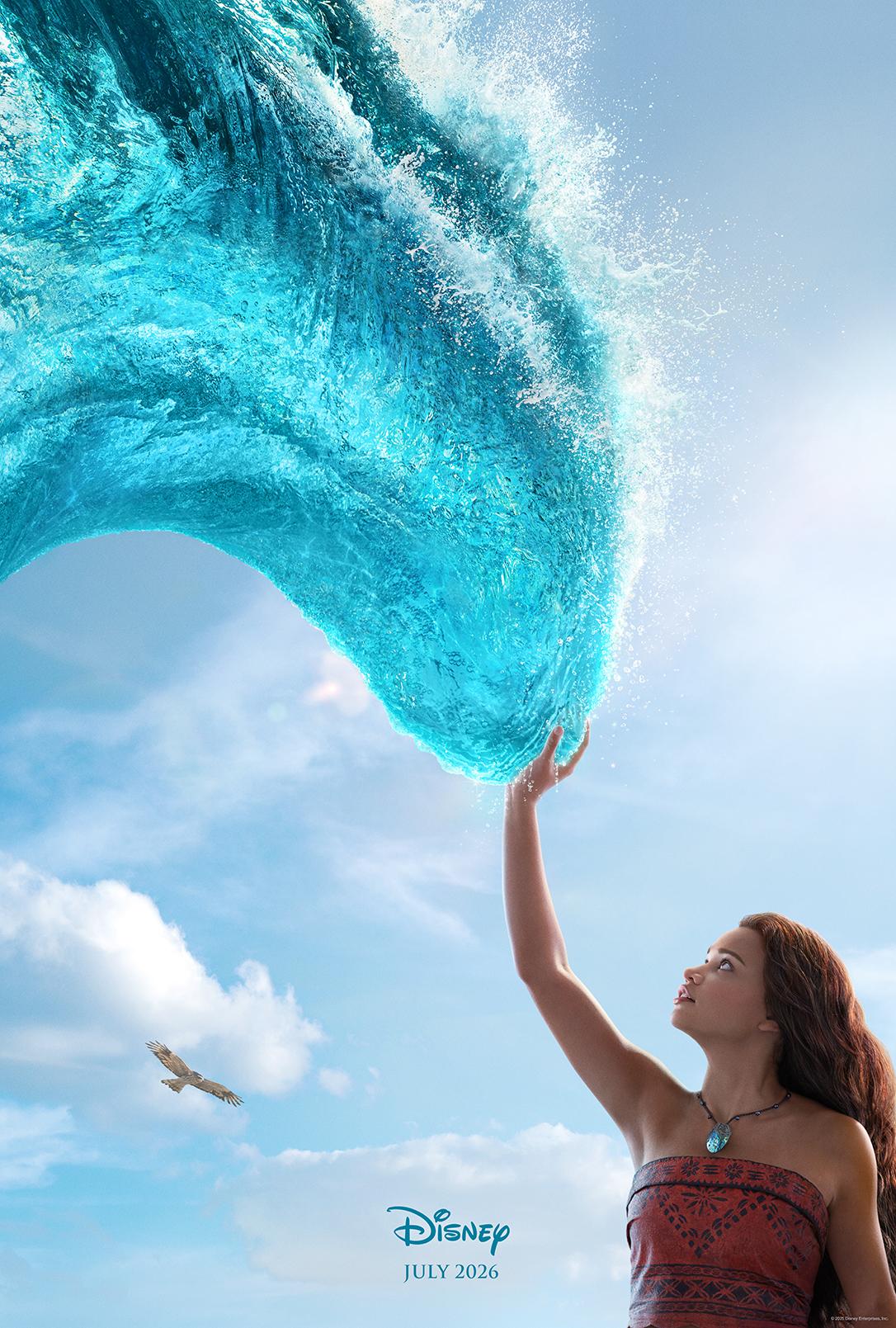
From the onset, the new English film Moana isn’t a bad film. Rather, it is pointless film that had no business to exist in the first place. This is because this live-action film adapted from the much loved 2016 animated Disney Film Moana, felt like a scene-to-scene, frame-to-frame copy that also felt that much more soulless. Imagine this – a restaurant being freshly opened with the same name as that of the competitor, and serving the same kind of food in it. The new restaurant will never be able to do the same kind of business simply because the brand sentiments of the people would always lie elsewhere. The issue lies with the quality of the copy-paste technique that would significantly go on to degrade the emotions – something that animation would usually pull off with much aplomb. I mean think about it – who wouldn’t enjoy a beautifully curated ocean that is witness to a young animated teenage girl pull off a never-before-seen voyage of her own, while retaining her innonence. The last bit is something that humans with flesh and bones just cannot pull off, almost making the live-action remake an instant cash-grab that has no identity of its own.
An official adaptation of the 2016 Animated film Moana, and written by Jared Bush and Dana Ledoux Miller, Moana can best be termed as a coming of age story of the protagonist Moana (Catherine Laga’aia), who remains a extremely protected by her Polynesian community, until she decides to make a voyage beyond the reef in order to save her island from extinction. To give her company is the narcissistic but kind-hearted Maui (Dwayne Johnson) who had once stolen the heart from the goddess of nature, Te Fiti – only to be driven in exile by the volcanic demon – Te Ka. And whilst the duo form an unlikely team, for folks who have watched the original animated film – will know exactly where this is headed.
One of the main reasons for the writing failing despite it being a bar-to-bar recreation, remains on the recency bias of the film. The original film was out in 2016, which basically means that an entire generation who had witnessed magic unfold previously, haven’t totally grown out of it. What the writing truly needed was an upgradation, for instance – formulating a deeper concern with regards to an ongoing environmental crisis, that in turn was a key driving factor in the narrative. The allegory needn’t have been this safe, willingly wanting to modify it based on the times today for more relevancy.
There was something affable about the animated versions of the characters that created a heartwarming vibe, simply by playing on the feel-good innocence that nicely formulated an important trait in the original version. But with the onset of humans, there are pauses and interruptions in spoken-dialogues, that invariably took me out of the intended moment. The inconsistency in this facet of the drama, resulted in the drama being bloated and a bit of an uneventful drag (for folks who are aware of the original source material).
There is something about the distraction of animated films that doesn’t let you focus on the matters of convenience along the way. For instance, the irony of Moana randomly landing up at an island that is now home to Maui, is a convenient piece of writing that was never brought to my attention given how beautifully invested, I was in the original film. But when one isn’t invested, these flaws immediately come up – like the ones here that had the same plot-points.
There are crucial curveballs in the drama – be it the culture Polynesian community, or the significance of the adventures in the ocean, or even individual coming-of-age arcs of Maui and Moana, that formulate a heartfelt narrative. But little things like diluting the impact of the tattoo of Maui – something that doubled up as his alter ego encompassing his moral consciousness, wasn’t such a good idea after all. All of it instantly made me clock off from the narrative that definitely fell short in a final act that felt like all motion and no emotion (oh, why did that rhyme?). In other words, the screenplay isn’t bad but offers nothing new – while retaining points of convenience in the narrative.
The dialogues ironically feel increasingly soulless here, lacking a strong emotional core that grappled viewers with magical lines that offered a sense of connection. The music remains the only aspect that personally connected with me here, even as the songs wonderfully encapsulate the mood of the drama. The cinematography comprises of frames that were bound to be flat, given the excessive use of CGI that would immediately flatten out the visuals. This is the same complaint that I had with a film like The Little Mermaid (2023) that was guilty of a similar output in another live-action adaptation that just wasn’t needed.
The editing pattern ought to have been crisper, given how even a tender runtime of about 115 minutes felt increasingly bloated in a few instances. Director Thomas Kail was perhaps too focused on the exact shot breakups, and the frames that were invariably similar in shot compositions to the original too. But in the process, the strong emotional core of the drama felt missing – often being replaced with superficial feelings that just didn’t connect with me. Again, the direction isn’t a trainwreck but only scoring on the technical front while letting go of the emotions, meant that this was a red mark in the report card.
The performances are decent by the members of the cast. Rena Owen as Tala is fairly good but the performance needed to go deeper with the emotions, given that she formed the emotional hinge in the drama. John Tui as Chief Tui and Frankie Adams as Sina have little to do here. Dwayne Johnson as Maui definitely infuses life to the proceedings with his majestic screen presence, seamlessly shifting sides from a voiceover to now being in front of the camera. It does help that he understands Polynesian culture really well, and it reflects in his mannerisms. Catherine Laga’aia as Moana makes a pretty impressive debut, doing well to add life to her character while using her expressions and body language rather effectively. But the common criticism for both these performances remained in the fillers – wherein the pauses invariably took me away from the proceedings.
Disney’s live-action Moana (2026) is a soulless and pointless adaptation that struggles to establish its own identity, standing as a blatant exercise in nostalgic baiting and corporate cash-grabbing. This production reeks of creative bankruptcy, offering nothing new to justify its existence. Available in a theatre near you.


