

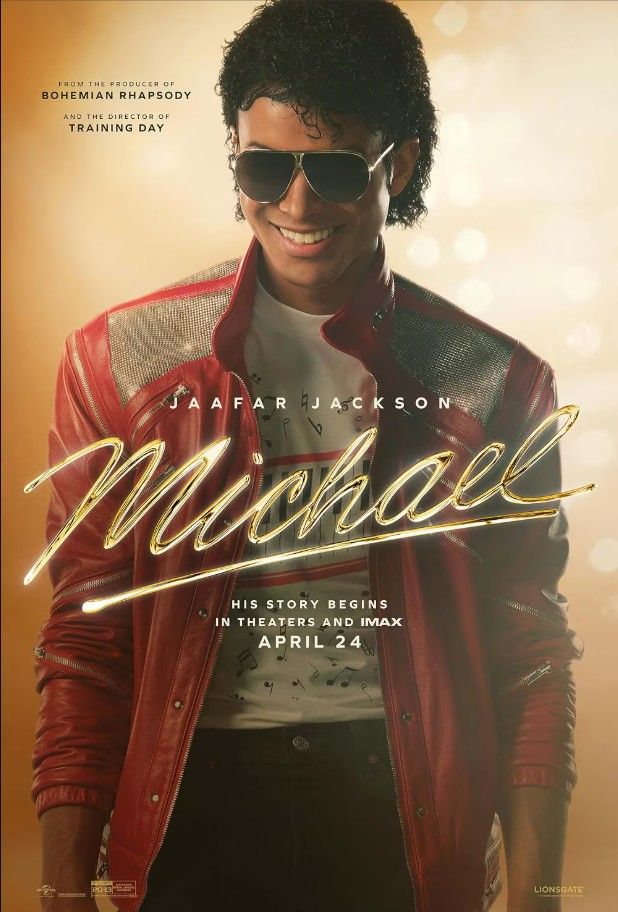
The opening sequence of the new English film Michael is a nod to toxic parenting – a trait that has now been done to death in many films lately. In the scene, you see a young Michael (essayed brilliantly by Juliano Krue Valdi) being subjected to a variant of torture by his abusive father Joseph (Colman Domingo) – with the latter being a distant cousin of Rannvijay from Animal (2023), even as his wife remains a mute spectator to the trauma endured by her child. You see Joseph pushing his children to the hilt – almost like Terence Fletcher pushing the skin of Andrew Neiman in Whiplash (2014), emphasizing on the phrase on how there are winners and losers, and the poor need to fall in the former category.
The issue for me remained exactly this from a screenwriting POV – the protagonist Michael (Jaafar Jackson) often is reduced to playing a victim of the circumstances here, as opposed to having a personality of his own. In that sense, the best way to describe the biopic of Michael Jackson is with the word ‘Vanilla’ – something that doesn’t break boundaries or offer anything new in terms of its writing. In a scene, you witness the protagonist saying on how he wishes to be a star with a mystery around it – well unfortunately, that mystery is still alive after the first film. Notice how this wasn’t the case with the Freddie Mercury biopic – Bohemian Rhapsody (2018), wherein there was an internal conflict of identity with the protagonist. That just wasn’t the case here.
Written by John Logan and based on the life of the King Of Pop Michael Jackson (MJ), Michael is what I would call a Spotify tracklist of MJ as opposed to his biopic. Or even a Wikipedia page of MJ as opposed to an organic flow of his life events. This is because the writing jumps timelines at the drop of a hat – in one scene, you see Michael performing at a bar, in another, you see him recording his first single, and before you know it, a new star is born. The subtext to the drama is woefully missing – what remained the psyche of a child performing at an ‘adult’ bar? Which of his siblings remained close to him and what was his interpersonal relationship with each of the folks around him?
The generational trauma that is subjected to the protagonist, doesn’t come across as anything powerful. Instead, it is mild and fleeting – an important flaw that would never go onto have the same kind of a pay-off at the end in terms of its impact. Vanilla is the word to describe the chain of events here – even as you see the protagonist shaking a leg as smoothly as a rush of beer down your throat. It feels amazing in the moment only to transition into a bit of a daze after a while. Therein lay the conflict of me as a viewer – do I enjoy the drama as a concert film, or should I criticize the writing for reducing the biopic to mere chapters in the life of the protagonist?
At a point, you do see two films trying to overpower each other – one involving the several performances of MJ on stage that were pulsating, and had me grooving to his beats. And the second remained that of an ongoing biopic that offered no real conflict to the protagonist, almost being content with playing second fiddle to his star-power that essentially featured his fans crying and fainting – both in the same breath. Ideally, I would have flipped the very sentiments of the “two” films in play – allowing the biopic to be at the centerstage, and the concert film being a byproduct of it. In fleeting moments, you see Michael trying to search for father figures in his life, mainly by looking upto his bodyguard Bill (KeiLyn Durrel Jones), or his manager Branca (Miles Teller) for advice. But these relationships are so surface-level that you don’t really tend to invest in them on an emotional level.
There are important chapters in the life of the protagonist – be it a streak of philantropy resulting in a resounding track ‘Just Beat It’, or even his tryst with MTV who until then did NOT feature any black artists (that was an untapped identity crisis right there), or even the iconic video of his record ‘Thriller’, all of which have mere passing references. In his personal space, the writing never elevates his interpersonal relationships – coating his closeness to his mother, or his rocky relationship with his father with the same brush of paint. And therein lay an issue too – why were the stakes in the drama so low? Why was this an image whitewash exercize? Ahhh well – Just Beat It!
The final act elevates the impact of the drama to some degree, while transforming the events into a concert that is so throbbing that it had me momentarily distracted from the surface-level writing and the interpersonal relationships at stake. Suddenly, my feet were tapping at the beat of the King of Pop – similarly to a snake swaying at the behest of a snake charmer. In that moment, I fully understood the crazy fan-following of MJ – through his moonwalks, or his agile visual language on stage that ascended the drama into orbit.
This basically was a shame – given how the writing did nothing to acquaint its viewers with the legend while steering clear of all his controversies. Whether or whether not the latter will feature in his second film is something only time will tell. But overall, the screenplay works as a concert film but fails as a biopic – and unfortunately, this wasn’t a concert film in the first place. Hence, this will go down as a red mark in its report card.
The dialogues are more focused on imitating the voice of the legend, as opposed to bringing in a strong emotional core in play. In that regard, the drama is hollow, even as the lines flatten the impact of the narrative even further. The music remains the highlight of the drama here – doing enough and more to invest in the proceedings. In fact, the usual complaint of songs being the buzz-killers of a narrative, doesn’t hold true here. The MJ tracklist is iconic and the songs along with their picturization elevate the impact of the drama into a ‘watchable’ category here. It won’t be wrong to say that the songs cater to the concept of a concert film – allowing you room to groove a little along the way.
The cinematography remains a bit of a mixed bag here. The portions involving the concerts or the set-pieces of MJ grooving to the beats – are ably captured, while creating a throbbing effect on the viewers (thank you IMAX). But on the flip side, the frames don’t always convey the plight of the protagonist or his psyche. The setup is basic – a shaky frame to showcase the chaos on the outside, or the zoom-ins to try and capture an ounce of vulnerability of the protagonist – but given how the writing is surface-level, the frames don’t exactly score beyond the concert parts.
The editing pattern although being episodic and fragmented, is crisp and sharp which works to the film’s advantage, given the intended idea was never to dig deep inside the psyche of the protagonist. Hence, the tender runtime of 120 odd minutes is just enough to keep you distracted with the glitz in play. Director Antoine Fuqua misses the mark here with a narrative style that is hollow on many levels. The focus clearly is directed towards some unadulterated fan-service as opposed to delving deeper into the personality of Michael Jackson. And that remained the fundamental flaw in a narrative that was just ‘vanilla’, without any real conflicts. The direction scores with the fan-service concerts pretty well, but on every other account, it doesn’t quite score.
The performances are decent by the members of the cast. Juliano Krue Valdi as young Michael exudes of innocence, and puts forth a superb act to kickstart the narrative. Miles Teller as Branca is letdown by the writing of his character, something that treats his a tertiary ‘important’ character in MJ’s life, while reducing the impact of his performance. KeiLyn Durrel Jones as Bill is sincere and earnest, as is Nia Long as Katherine. Colman Domingo as Joe puts forth a commendable act, being restrained with his abusive nature while also showcasing traits of edginess and greed along the way. Jaafar Jackson as Michael Jackson aces the mannerisms of his uncle, while exuding a towering personality onscreen. But in the same breath, his acting is questionable in a few scenes that required him to emote with fluidity. In that sense, the acting is found wanting but as a package (that includes singing and dancing), Jaafar definitely manages to impress.
Michael remains a mixed bag here with conflicting thoughts around it. It works as a concert film (my IMAX Experience is reflected in my overall rating too), but fails as a biopic. The writing is so hollow that it does nothing to tap into the personality of the King Of Pop. And that remained such a shame in a film that really flattered to deceive. If you are an MJ fan, you are bound to like it – but, MJ deserved a better biopic. Ahh, well – JUST BEAT IT! Available in a theatre near you.


