

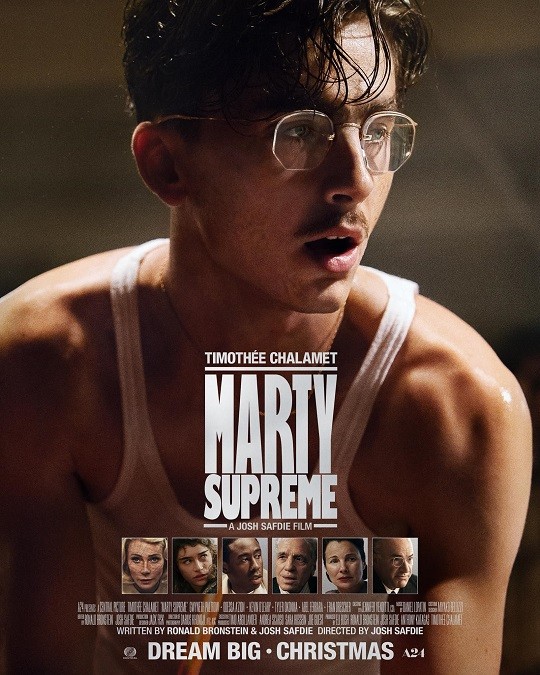
In a recent podcast with Raj Shamani, the legendary Michael Phelps revealed on how he did not take a single day off for a period of over 5 years that eventually resulted in several bouts of greatness. The emphasis of his life and passion for work ‘not being rocket science’ was good enough to tell you a story about his greatness and his achievements. In the new English film Marty Supreme, the protagonist Marty Mauser (a phenomenal Timothy Chalamet) has similar seeds of the attitude of Phelps. The only difference being that Marty, unlike Phelps hasn’t quite achieved much with his ping pong game – something which still makes him believe that he is the best player in the world. It also wouldn’t be wrong to say that Marty is furiously focused towards his goal – something that is reiterated in an absurdly funny and hilarious opening scene wherein the camera cuts away from a scene involving Marty making out to sperms swimming towards an egg – only for that egg to take the shape of a ping pong ball. It tells you everything about Marty while acting as a foreshadow – nothing comes in the way of his goal of playing the ping pong sport, not even ‘his’ child.
Written by Josh Safdie and Ronald Bronstein and loosely based on the life of American table tennis player Marty Reisman, the interesting bits of Marty Supreme lay in the period that the drama is set in. The setting remains that of New York in the year 1952 – a period just after WWII, that still is witness to the aftereffects of the conflict between America and Japan. This geo-political aspect is introduced in the ping pong arena wherein you see a clash between Marty and his much superior Japanese opponent at the start, Endo. The nationalistic angle is transcended into bouts of an ego clash for Marty, even as he is enamoured by his opponent’s grip of the ping-pong racket, or the colour of the ping pong ball that he strongly pushes for to be ‘orange’ as opposed to ‘white’. But in the same breath, the surroundings give you a strong 70s feel of the NY streets – something that you would immediately associate with the iconic 70s gangster films. That tells you two things right away – Marty is ahead of his time, and Marty is a ‘gangster’ of sorts who would go to any limits in achieving his goal. Yep, Phelps would have been proud!
The character study of Marty itself remains an engaging prospect given how he views his life like a giant ping pong game of sorts. And that includes people, animals, objects alike. In a scene, you see the opportunist in him come to the fore – even while trying to woo the Hollywood actor Kay (Gwyneth Paltrow) whom he sees not only as a status symbol but also as a means of economic survival. It must also be noted that he chases Kay’s husband Rockwell (Kevin O’Leary), an influential businessman who would later go onto take an interest in his sport. All of this while he refrains from acknowledging a now-pregnant-with-his-baby childhood friend Rachel (Odessa A’zion), only later to oblige when she feigns her ‘strained’ relationship with her husband. All the world is a ping-pong game for Marty!
It would be interesting to evaluate the basic trait of Marty if he were to have absolute power at his disposal. But therein lies the subtext of the financial state that he is accustomed to – often living off other people’s money without losing focus of his sole goal of playing ping pong. The overlapping virtues of pride and ego are still very much instilled in him, but he doesn’t have the luxury to evidently unleash them – often trascending these virtues into a street smart attitude, of finding opportunity in difficult situations. Be it a meagre reward following a freak accident that he chooses to gamble at a local club, or using his ‘love interest’ to find a prized possession of a ‘gangster’ acquaintance, or even tactfully snitching a jewelry during his shower sessions with a character, or even convincing his cabbie friend to rent him a few dollars. Life on the fringes seems like a ping pong game for him, something that makes him swallow his ego too – while willing to play an exhibition game with a seal in Cairo, or even volunteering to be reprimanded on his buttocks by Rockwell, who wishes him to lose an exhibition match with Endo. And each of these incidents are presented by several bouts of black humour that was crucial to toning down the hatred for the protagonist.
There are several tense moments that expose the desperation of Marty in his bid to beat his rival once, while allowing his ego to have a field day. Losing is never an option for him, even as you see him drawing a personal line that could be breached by no one – during the final act wherein he challenges Endo for a clash even after losing once. He is willing to risk the idea of being stranded by Rockwell in Japan, trusting his attitude to eventually get him out of the country. But his pride remains the top-most priority for a sport and rivalry that he cherishes the most. And yet to close the loop, the only time you see him emotional after returning is when he has his child in his arms – it may seem to be a character transformation, but the crucial point to be noted remains on how this acceptance arises ‘after’ he has fulfilled his goals. Yep, Marty is an opportunist and that virtue remains untouched! And yes, this remains a screenplay writing masterclass if ever there was one!
The dialogues range from being profound to infusing subtle bouts of black comedy at various junctures in the narrative. Likes like ‘I Have A Purpose….’ hit home in highlighting the unwavering goals of the protagonist, even while being backed by gems like ‘How do you earn money…’. The two extremes comprise of varied tonal shades that are beautifully balanced without any one shade sticking out like a sore thumb. It is interesting on how the music by Daniel Lopatin and the cinematography by Darius Khondji contribute to the fabric of the drama. The chaotic lens representing the muddled life of the protagonist replicating a ping pong match has strong undertones of a 70s gangster drama. This, whilst the ticking needle drop music is reminicent of the 60s – both representing eras that are widely different from the 50s. It remained an interesting choice to disillusion the viewers while taking them away from the actual period such that the overlapping timelines effectively represent the chaos brewing in the fragile life of the protagonist. Oh and the sport itself was captured brilliantly, with straight-up ‘break-free’ shots that added to the intensity of the drama.
The editing pattern has a definite rhythm to it, often hand-picking and air-dropping the protagonist from one situation to another – something that never takes you away from the chaos. Director Josh Safdie employs various techniques to stream the proceedings away from.the generic tropes of a sports drama. The world building remains spritely intense with frequent bouts of dark humour that often aide the vibrant character study of the protagonist. It is incredible how the humour cuts through the problematic traits of the protagonist, weirdly justifying his stance, even though the character itself is not very likeable. This for me was the victory of a filmmaker in many ways, even as Josh excels with the execution here.
The performances are excellent by the members of the cast here. Pico Iyer as Ram Sethi and Luke Manley as Dion make their presence felt. Koto Kawaguchi as Endo is fabulous to witness in intense match situations. Tyler – The Creator as Wally, Fran Drescher as Rebecca and Larry Sloman as Murray have their moments to shine. Kevin O’Leary as Milton Rockwell was an interesting casting choice given his actual roots of being a businessman, and he possesses the right body-language that is shrewd in many ways, while putting forth a commendable act. Gwyneth Paltrow as Kay Stone remained an interesting character drowned in a sea of stardom, who expected love and adulation from all quarters – be it from the capacity crowd who had come to attend her play, or a random ping-pong f*ckboi who would make love to her frequently. And this streak of stardom was wonderfully tapped into in what was a phenomenal act. Odessa A’zion as Rachel also is excellent here, bringing her own set of vulnerability and insecurity of her character with utmost ease and precision. She uses her mannerisms and expressions beautifully to convey the fractured psyche of her character.
Timothy Chalamet is taking home the Oscars this year in all probability. Marty Mauser is by no means a very likeable character – he is flawed and extremely repulsive with his behavior, while always being imminently punchable. But the charm that Timothy brings to the fray is incredible, softening his stance and sprouting bouts of humour on the way whilst always doing his bit to justify his stance. The focus always remains on his goal which is the driving factor here, and everything else acts as a blur or a medium to achieve it. This complexity is met with a highly skilled performance that is not only brilliant but barely misses a beat. Timothy Chalamet was phenomenal and how!
A top contender for “Best Picture” at the Oscars of 2026, Marty Supreme is an acid trip of goals, ambitions, and hustle packaged in a screenplay-writing masterclass that makes for a brilliant watch. Available in a theatre near you (in India from 23rd Jan’26 onwards) and Highly Highly Recommended!


