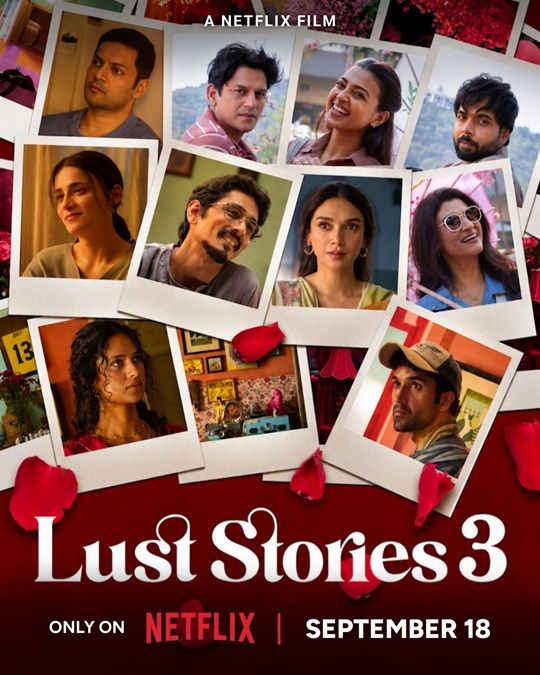

One of the ways of describing an anthology would be an assorted box of chocolates, or a variety of food items served on a platter. The subtext remains that there is something in it for everybody, even when entangled together in a single viewing medium. But interestingly, I did notice a minor thematic connection in the stories unfolding in the anthology movie Lust Stories 3. Yes, one may argue that the connection spells itself in the name and I would agree – but if I were to drill down a step further, the common thread remained lust unfolding through a female gaze, a trait that you would notice in each of the four short films here. The idea remained on using lust as a visual language for escapism (Vikramaditya Motwane), an alibi (Kiran Rao), a mode of therapy (Shakun Batra), and a mode of communication subverting a secondary theme of patriarchy (Vishal Bhardwaj). It added a definite purpose to the narrative with different styles tied together by a common thread of lust – except that the strands this time around (from Lust Stories 2) weren’t isolated from each other.
Vikramaditya Motwane
Written by Avinash Sampath and Sumukhi Suresh, this segment involving two women caught in a s*xless marriage, choosing to swap husbands instantly reminded me of the English film The Invite (2026) – except that the gaze here remains strictly feminine. It is the exact phase of a mid-life crisis for the 40-something year olds Padma (Radhika Apte), and Shonali (Konkona Sen Sharma) who have had their share of adventures in the form of marriage, an event that has brought them children – but all they want at the moment is to be seen. I liked how the writing demarcated both the protagonists – Padma is the reserved one, often double guessing her next move. Shonali is outgoing while having a sea of microaggressions. The reverse traits also apply to their onscreen husbands – Shonali’s husband Debu (Abhishek Banerjee) remains the callous one, whereas Padma’s husband Hemant (Vijay Varma) remains the moralistic one.
I liked how pop-culture tied the conflict together, even as the two women turn to a sleazy K-Drama to inflict the swap. The writing forms a subtext of a tongue-in-cheek humour with a central theme of escapism, invariably creating several enjoyable moments along the way. If anything, the conclusion felt slightly overindulgent, although it continued to stick the respective arcs of the two protagonists. And knowing their traits, it wasn’t very hard to predict the fate of the characters.
I liked how the cinematography by Siddharth Diwan added a sense of pulpy edginess to the proceedings that were wonderfully rounded up by Vikramaditya Motwane. Vijay Varma and Abhishek Banerjee play their parts really well – each being sincere and adventurous in their own rights. Konkona Sen Sharma is terrific here, naturally possessing a playful energy that taps into her adventurous streak without the baggage of morality. Radhika Apte hits it out of the park as a character too afraid to take the plunge (something that she nearly does), while returning to base with her morality at the end! Thoroughly enjoyable, I must say despite a gimmicky ending!
Kiran Rao
Written by Kiran Rao and Tanaji Dasgupta, this segment taps into the pulpy nature of lust – almost flirting with a commentary on classism even when you are introduced to its protagonists Karan (Gurfateh Pirzada), and Lisa (Sana Thampi). He is a pizza delivery guy, she is a nail stylish – both cross paths in a bustling street in Mumbai, and instantly take to each other. However, the twist is in the form of Karan being a discreet drug dealer also sharing a room with his twin brother Arjun (Gurfateh Pirzada again), while using Lisa’s room to stack up his cash and weed, supposedly oblivious to her. The concept of lust is used as an alibi here, a theme that plays out both ways by the end of things.
Structurally, the short played out like a palindrome – but that also added to the predictability of the drama. Kiran Rao does a fair job with the direction, often using her ‘Dhobi Ghat’ sensibilities to stage the drama by the messy coastline of Mumbai subverting it with a faint commentary on the plight of the middle-class, although the pulpiness in the narrative takes a convenient turn later on. Gurfateh Pirzada does a fair job as Karan and Arjun, landing a few beats quite ably. But it is Sana Thampi who shines as the ‘alibi’, creating an easy going atmospheric with a twist. A low-stake and decent short overall, but one of my least favourites from the listing!
Shakun Batra
Written by Shakun Batra, Sameeha Sabnis, and Ashwathi Namboodiri, this segment is easily one of my favourites, simply because of the kind of depth it showcases with its emotional core. When you are initially introduced to Varun (Ali Fazal) and Sainee (Radhika Madan) – they are probably in the happiest phase of their life. Cut to 5 years later – and they are on the cusp of undergoing a divorce. And it is interesting on how lust here continues to form a connective tissue between the pair marred by the ‘marriage’ tag. She can’t stand his controlling mother and his image of a Mr Nice Guy, he is fed up of her microaggressions. But ironically, both are unable to communicate with each other, instead opting for the language of lust as a means of therapy. The subtext remains that of comfort wherein the most honest that they are together is when they are physically in bed.
The urban language of lust mixed with grief and trauma is often reflective in the individual gazes of the two protagonists. The conversational nature of the proceedings allows the drama to go deeper with the unsaid emotions, without the need to isolate or judge any character along the way. There is a rhythmic softness to the interactions that may seem steamy on the surface, but visceral and layered from within – an element perfectly substantiatee by Batra with the direction.
Both Ali Fazal and Radhika Madan are outstanding to witness here – feeding energies of each other, even while treading on an unconventional path that breaks the stereotypes around relationships. Their performances feel therapeutic in many ways, simply given the emotional baggage that each of them have been carrying in the name of a tag (of marriage)! A special mention to Vijay Maurya and Shreya Gupto who shine as the individual lawyers of the couple, subverting heavy themes with subtle bouts of humour! This short was my absolute favourite!
Vishal Bhardwaj
Written by Vishal Bhardwaj, Utkarshini Vashishtha, Nitesh Bhatia, and Sumukhi Suresh, this segment focuses on the fabric of lust as an emotion through its protagonist Saira (Aditi Rao Hydari), who is dealing with issues of intimacy with her husband Badru (Siddharth). The issue isn’t necessarily about satisfaction but about a subverting commentary on patriarchy – given how s*x also comes across as a male dominated act. The lesser-talked about the desires of women makes this an immediate companion piece to Karan Johar’s short from Lust Stories (2018) – except that the subtext remains pulpy. It almost felt like words being laid out to form a texture for lust, even when the act in itself can be goofy.
It also helped that the drama was set in the late 1980s, when s*x as a concept was still a hush-hush phenomena, and Saira is a teacher herself to a group of young girls on the cusp of adolescence and hormones. It is interesting on how Saira is coaxed into writing her ‘lust stories’ as a form of literature – with a pretext on how her desires as a woman could be studied and implemented by males. The contrast depicted to the gaze of lust from the POV of the two genders is as clear as light and day, ably controlled by a poetic piece of direction by Vishal Bhardwaj, only minutely faltering in its resolution that felt slightly more convenient.
Husne Shabnam, Aayat M, Deepika Khanna, Yashita Damani, and Snehal Kulkarni – all leave a lasting impression as young femalea dipped in the poetry of lust and hormones. Gajraj Rao offers a few comedic moments along the way as the paan-chewing father-in-law, mixed with subtle gestured heartfelt moments. Aditi Rao Hydari and Siddharth play the yin and yang ably – each offers a unique mode of communication with regards to intimacy, and each of them offering a unique gaze of lust – one that is slightly over-the-top and pulpy in their own ways, just like the book by Saira. Quite an enjoyable short with a specific detail to its lyrical language that is pulpy and ticklish with streaks of literature posing as palpable emotions of lust.
Despite being a niche with its themes, Lust Stories 3 emerges as a compelling anthology that ably explores the intricate layers of desire, intimacy, and human connection. What truly elevates this collection is its commitment to an understated narrative style, steering away from overplayed tropes to focus deeply on the nuances of the female gaze. This deliberate perspective establishes a distinct visual and emotional language, allowing most stories to feel both authentic and subtly powerful. By presenting a diverse assortment of emotional shades and textures, the film delivers a thoroughly satisfying viewing experience, securing its place as one of the most fruitful anthologies in recent times. Available on Netflix.