

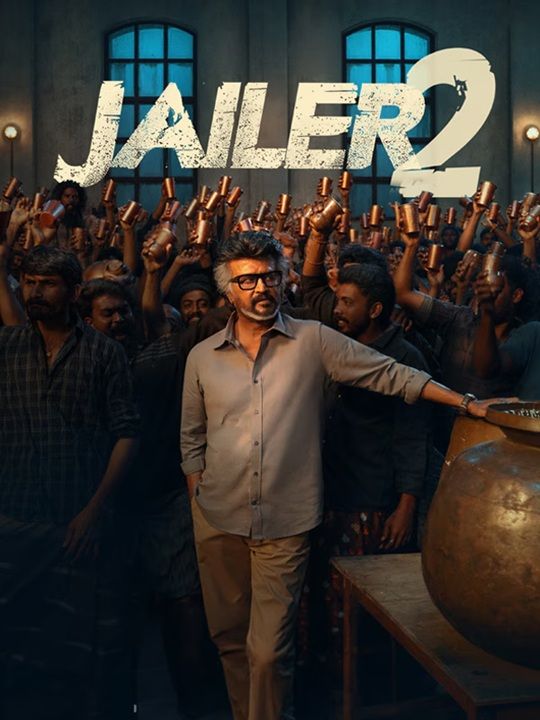
Imagine opening a food delivery app, and pausing and craving at every instance of your favourite food before scrolling past it – all in a bid to find a tastier option. The idea stems from the human psyche and their short attention spans, allowing short-lived craving moments that the algorithm feeds on. If I were to draw a parallel with this feature, the new Tamil film Jailer 2 will be a perfect example for it. There is something in it for everyone, in a film that is essentially a mass masala entertainer subverted with strips of comedy. You do get an implied glimpse of its thread from the first part, wherein you are tactfully introduced to a new ‘Malayali’ villain Dileep (Suraj Venjaramoodu) who would take the reigns from Varman (Vinayakan), whilst facing off with the perennial superstar veiled as a simpleton, Tiger Muthuvel Pandian (Rajinikanth). The subtext of priceless idols being smuggled remains the same, just that the stakes are supposedly raised – even as the protagonist has to take on goons and CEOs that are higher up the food chain from the first part. This, whilst having to keep a secret about his son’s ‘death’ from his family – all in a bid to curb the emotional turmoil that his life may have on offer.
Written by Nelson Dilipkumar, Jailer 2 carries the trademark dark humour of the auteur that is now synonymous with his filmography – a way that could also be termed as genre-bending in many ways. Make no mistake – this is the film and world defined by the protagonist, almost carrying a cloud of snipers along with him, only to be sprayed upon at the most sudden moment. But this is what implied innovation is; creating a bout of unpredictability in the most predictable star-driven template ever. So in a scene when a group of goons are randomly shot in the leg, with the protagonist looking on; or a provocative skirmish of the antagonists ending up with metal wounds in their heads, against a steady and calm demeanor of the protagonist – you know that the right strings are being strum for the potential crowd to go wild! In moments like these, less is more – unlike most star vehicles that are weighed down by their own heavy-weights (pun-intended).
It is also interesting on how the writing weaves bits of humour by aura-farming the simpleton image of the protagonist. In multiple occasions, you notice a character referring to the protagonist as a ‘driver’ – someone who wouldn’t usually take centerstage in a face-off between two gangsters. This unassuming thread of keeping the protagonist focused on the side, while sharing a secret of the entire drama being orchestrated by him – was invariably a win in my book, particularly given the ability of the writing to not take itself too seriously. The nonchalant persona of the protagonist was in direct conjuction to the plot that invariably reflected on its self-indulgent and self-aware humour.
This is also true for some of the quirky characters in the mix. For instance, a small time gangster Moorthy (Namo Narayana) who runs a fruit shop of its own – but thinks he is The Godfather of his land, invariably resulting in several bouts of humour landing seamlessly. Or even a hilarious sidekick in the form of Vimal (Yogi Babu) who miraculously and unceremoniously finds himself in a pickle due to the protagonist. Their face-off with an unassuming character like Dileep will go down as one of the funniest sequences of the film, even as the writing keeps the ‘threatening’ persona of the protagonist in check – the one highlighted in a particular sequence involving a violent ‘gunfire’ decimation. Or even the phenomenal interval block that is reminscent of the one from the first part.
Most of the proceedings unfold like reels that don’t have a coherence tagged to them, allowing the algorithm to build the pipeline of the events to follow. This is true for that one isolated sequence after the halfway mark too, wherein an important character is suddenly killed off against the run of play – in the most simplistic and unassuming way possible, whilst opening the floodgates for bigger villains to enter the arena. The writing is quick to define this step in a bid to create a mirroring world for the viewers, wherein the introduction of the new family of villains – namely Bodhi (SJ Suryah), Chakri (Mithun Chakraborty), Kantha (Vidya Balan), Ved (Jatin Sarna), and Sharva (Hakim Shahjahan), are pitted against the protagonist and his family. The parallel remains that of how the members of each family are close-knit while having opposing ideologies that pit them against each other.
I couldn’t help but think that the characterization takes a backseat here while bartering it with a star-studded massy vehicle. The new villains definitely add scale to the proceedings but aren’t always threatening, even though the writing does just enough to avoid a landslide. There are entertaining moments in spurts amd jerks – be it the wildly entertaining kidnapping of a particular character by the protagonist, in response to a friend’s family being kidnapped previously. Or even a flirtatious face-off between the protagonist and another character. But these moments become immensely repetitive, almost signalling a glitch in the very algorithm that the set of reels were catered to.
The events play out in a pretty safe manner, without taking any wild slogs with respect to the writing. It is similar to a Tom-and-Jerry kind of a chase, with each stakeholder trying to gain an upper-hand from the other. The issue remained a contrived timeline of having to develop and shepherd the identities of the antagonists, something that felt largely challenging, particularly given the integration of cameos too. As a result, the proceedings are watchable with a hugely rushed and flawed final act that didn’t entirely land for me. The beats of exploring an emotional core in one sequence, followed by the introduction of a starry cameo in the next one, and later an amalgamation of both these tones may have been fascinating on paper – but it felt pretty rushed for my liking on celluloid. And the simplicity with which the villains were nullified followed by a sequel-bait meant that the screenplay was in a rush to conclude too. But still, it did have its moments – particularly in the fiest hour that was supremely entertaining.
The dialogues are pretty quirky, and self-aware of the humour it wishes to touch upon, while maintaining the sanctity of the star-led vehicle. It almost resembles a game of hide and seek with the viewers, where the predictability of the moment is met with the highs of the lines, while subverting it with bouts of comedy. The music and BGM by Anirudh is really good once again. While the buildup to the smash-hit number ‘Hukum’ acts as a tease in the first hour, the score acts as a glue in keeping the second hour together. Each time there is a narrative dip, the BGM does enough to hold your attention and thereby, paper over the cracks in the narrative.
The cinematography comprises of frames that doesn’t shy away from gore and violence, while maintaining a stylized aura-farming approach through multiple slow-motion shots in the mix. The callous nature of the violence also does its bit in keeping the sensationalism of the moment in check, often maintaining the subtext of style and emotions in check to keep the sequences palatable. And the ‘masala’ beats in the narrative are wonderfully exploited by the frames that create several starry moments for the viewers to bring down the roof of the auditorium that is playing the film. And this is where I am extremely skeptical and cautious of a similar impact on OTT platforms, outside the community viewing experience.
The editing pattern literally resembles a reel, except that the ‘reel’ (read: scene) itself has some breathing space along the way. The connecting tissue from one sequence to another is missing, but that is the kind of a shortcoming that I was willing to overlook, given the format of the narrative employed.
Director Nelson Dilipkumar remains a unique voice in contemporary cinema, crafting a distinct filmography defined by the quirky, deadpan sensibilities of Kolamaavu Kokila and Doctor, both films that were phenomenal to witness. Here, he once again showcases this signature talent, scoring wonderfully in the first hour with brilliantly executed dark comedic moments and sharp situational humor. However, the second hour sees him slightly tempering this eccentricity, opting instead for a safer, more conventional star vehicle to cater to mass expectations. Despite this tonal shift, his directorial stamp ensures the sequel maintains the stylized flair that audiences eagerly anticipate from his films.
The performances are wonderful by the members of the ensemble cast, despite the writing slightly fumbling with the characterization here. One thing though that felt slightly forced were the cameos. Remember how organic the cameos by Mohanlal, Jackie Shroff and Shiva Rajkumar felt in the first film – almost playing an accomplice to the madness of the protagonist everytime he needed that assistance. But here, each of the cameo including the much-hyped one by Hrithik Roshan felt slightly forced and under par – never completely being formulated by the script or justifying the need of the protagonist. That said, Bagavathi Perumal and Sujith Shankar are wonderful to witness in their respective cameos. Both of them leave a mark in roles of varied shades of humour and intimidation respectively.
Apeksha Porwal, Edin Rose, and Bani J manage to leave a mark despite a short screen time, with each of them ably showing off their combative moves in a wonderfully choreographed moment in the second hour. Ramya Krishnan as Viji, Mirnaa as Swetha, and Rithvik showcase the much needed restraint that also doubles up as an emotional anchor for the drama. Yogi Babu as Vimal and Namo Narayana as Moorthi are top notch with their comedic moments, something that is enough to tickle you and make you chuckle particularly in the first hour.
The likes of Jatin Sarna as Ved and Hakim Shahjahan as Sharva brings several bouts of raw aggression to their characters, despite being underwhelming from a writing standpoint. Vidya Balan as Kantha and Mithun Chakraborty as Chakri maintain a sense of poise with their unperturbed demeanors, each of them having several moments to shine despite the writing never quite allowing each character to blossom. Suraj Venjaramoodu as Dileep is phenomenal, treading the line of menace and humour with utmost ease, and putting forth a commendable act. SJ Suryah as Bodhi puts the simmering eccentricity of his character to good use here, while putting forth an impressive performance, despite his character being written in a rather generic manner.
Rajinikanth as Tiger Muthuvel Pandian redefines swagger, effortlessly standing our with his unmatched “aura farming” ability. While he commands the screen with immense power, he brilliantly shifts gears during comedic moments to maintain the charming, humble demeanor of a simpleton. This masterful contrast between a ruthless force and an innocent everyday man is enough to keep you captivated. And, his ageless charisma proves that nobody handles mass heroism quite like him. He was brilliant to witness here in a character that is iconic in many ways.
Featuring solid performances, Jailer 2 is an entertaining actioner that scores immensely well with its comedic first hour, even as it dips slightly in the second half while trying to cater heavily to mass fandom. While the pacing stutters during these fan-service sequences, the fairly engaging writing does enough to anchor the narrative, culminating in an entertaining drama tailored for a fun-filled community viewing experience. However, this collective theatrical energy is precisely what makes it hard to imagine the film fully translating into the same electrifying experience once it premieres on an OTT streaming platform following its four-week theatrical window. Hence, a theatrical watch is necessary for this ‘Thalaiva’ outing, despite its flawed writing with respect to its villains! Available in a theatre near you.


