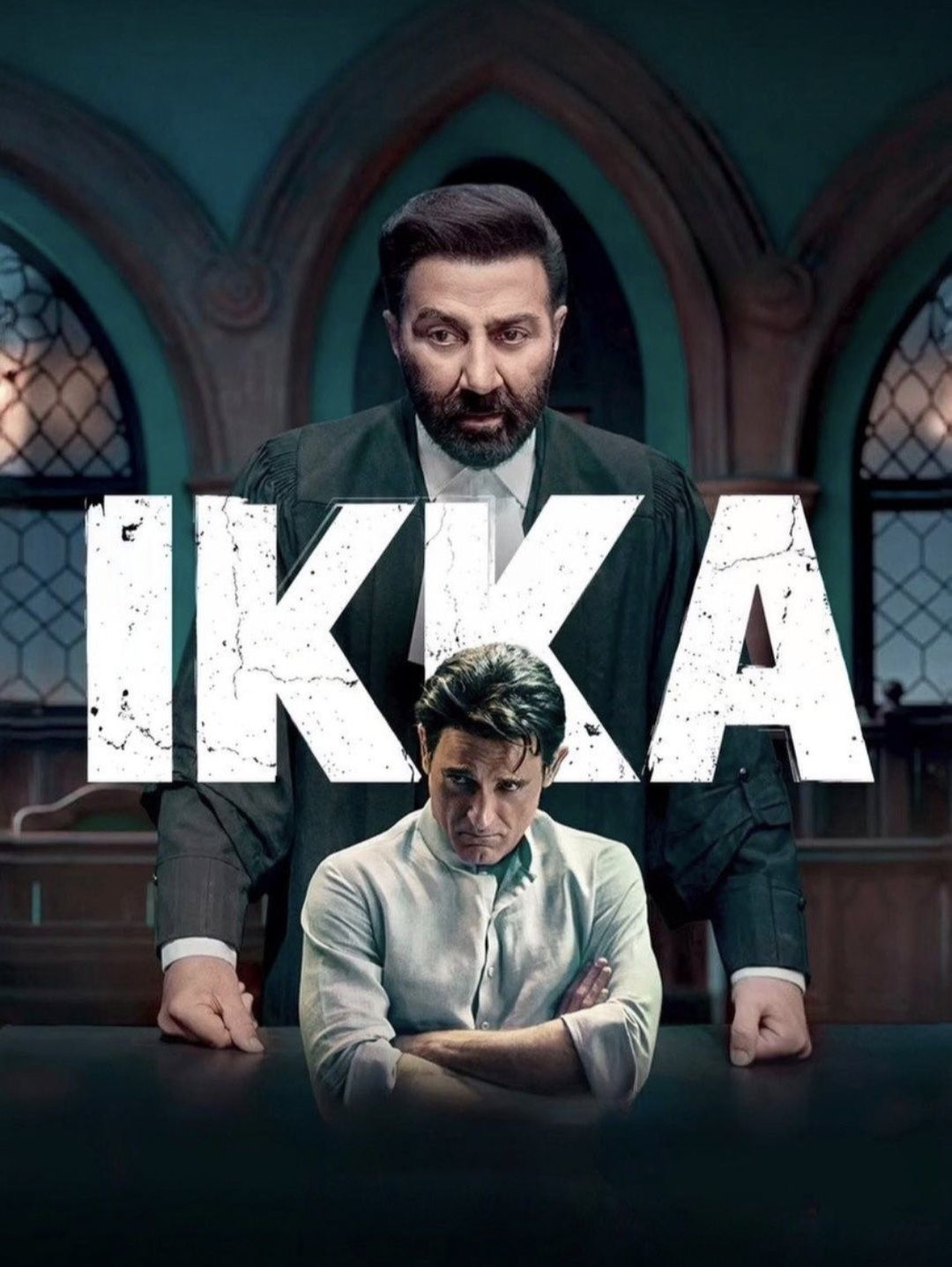

I don’t generally prefer to start my review with criticism. But the new Hindi film Ikka has left me with no other choice. My biggest criticism around the film is the binary vision employed to a crime being committed as a part of the cold open. And by that I mean that I knew exactly who the culprit was – even as you are introduced to two characters invested in each other at a bar, before one of them ends up ‘nearly dead’ by the roadside. The accused – Shouryaman Gaur aka Shourya (Akshaye Khanna in a Rehman Dacait hangover) is a spoilt rich brat, a politician’s son who finds himself on the other side of the law. In a fleeting moment, his callous nature is infuriating – even as he instructs his legal team to fight in order to get a clean chit, a nature that significantly feels like an extension of his industrialist turned politician father who has everything at stake in an upcoming election. Elsewhere, Shourya is pitted against a decisive lawyer Arjun Mehra (Sunny Deol) who has never lost a case, and always has an ace up his sleeve (hence the title), only for him to be blackmailed into fighting the inevitable case in return for a favour in saving his ailing daughter’s life. Instantly, the proceedings feel stale and two decades too late!
Written by Althea Kaushal and Mayank Tewari, Ikka felt like a film looking for a conflict – particularly given how the events of the crime felt like a clear demarcation of right vs wrong. And despite the idea to create doubt in the minds of the viewers at regular instances, there is something binary about the creative brief laid out to underline every character – be it the heroic walk of a character accused in the court of law that instantly had my red herrings raised about him, or even the saintly treatment of the protagonist who still wants to fight the case as per his ‘gold standards’, only to make a U-turn at a point and later regret about it (what was the point even). It reeks of a very confused approach of trying to convolute a straight-forward case – allowing the viewers to anticipate a twist, before tying itself into knots. Every little move is a giveaway into the apparent mystery behind the crime that is clear as night and day.
One of the interesting dynamics of the film that largely remained untapped, was the love triangle between Arjun, Shourya and Avantika (Dia Mirza). Now this maybe a legal thriller – and I agree with that notion, but Avantika remained a key link between the palpable conflict of the alpha males here. Without getting into the spoiler territory, the dynamic felt like a reimagined take of Rehna Hai Tere Dil Mein (2001), say 15 years after the events of the film – or specifically in a parallel world that features the interjection of crime. But sadly, the dynamic is only suppressed into a few scenes..
Another interesting character that flattered to deceive from a writing POV was Madhura Banerjee (Tillotama Shome) – a perennial underdog who is pitted against a very senior advocate in the form of Arjun. But here is the problem – the character is designed to be lower in stature, while allowing the protagonist to always have an upper hand. My reaction was similar to hers when she exclaims that a witness is overstating, in a scene. That is exactly the feeling that I got with respect to the protagonist, who felt like spoonfeeding every single detail to the viewers at regular intervals in the drama.
The amount of times he exclaims that his daughter isn’t well, or that papa will save you – made me change my expressions that would resemble Shourya during the legal proceedings. Do I blame him, really? This, while Madhurima is just handed out distressing signs of having to double guess the moves of her counterpart – even while having to stumble upon witnesses that have no real significance in the proceedings, in hindsight (or so told through the writing).
While there is a sincere attempt to maintain the understated tone of the drama, the inconsistencies are glaring. It almost felt like the writers were reminded of the fact that they have Sunny Deol as their lead – almost prompting them to include events of fist pumps on the wooden table, or a dramatised moment in the court of law involving another fist pump. Ironically, my facepalm worked perfectly in sync with these moments, even as the drama did get increasingly tone-deaf and painfully repetitive to witness. If there was a dollar to earn from the latter, I would have walked away with a huge fortune!
The drama literally ties itself into knots (even further) in the second hour, with twists followed by reverse twists that had me wondering what is the point of this film even. And more so, even the court proceedings felt immaculately superficial and staged – with the growing influence of melodrama, in turn also making a mockery of a serious issue of domestic violence. All of this, in order to cater to twists and turns in an otherwise straight-forward case that felt overtly complicated by the end of it (while reaching the same destination as I had envisioned). And the events of the final act is nothing short of being atrocious to say the least – wherein the writing may have reverse engineered the proceedings to such ridiculous effect that I could literally sit all day and count the number of loopholes in the mix. Oh and did I mention about the facepalms, already? Dated and then outdated are the words to describe this screenplay.
The dialogues are painfully repetitive and overtly inconsistent in their tone, wherein the writing never finds a balance at any given point. The BGM is instantly forgettable, doing nothing significant to raise the stakes or the levels of tension in the proceedings. The cinematography comprises of frames that are fairly lit and manage to do a fair job in atleast trying to create an element of uncertainty with a hint of thrills during the courtroom sequences. But my criticism ran a little deeper here – even as I felt no real emotion towards its characters, neither bouts of seething anger or tense moments of uncertainty. None of them were accounted through the frames.
The editing pattern ought to have been crisper, given how several moments of lag were prevalent right throughout the narrative. The repetitiveness needed to be trimmed out, something that in turn would have kept a check on the runtime that eventually stood at 140 minutes. Director Siddharth P Malhotra has a very confused approach to the drama here. There was a deliberate attempt to create uncertainty in the minds of the viewers, but the same were backed by such confused character briefs that it literally had me scratching my head. And the idea to spoonfeed every little detail to the viewers was not such a good idea, while also misfiring with the inconsistent tone of the proceedings, and loose ends (whatever happens to Madhura’s husband and the conflict of their family?). Nope, after a point – nothing makes sense, in a piece of direction that felt instantly mid and increasingly in free-fall.
The performances are a mixed bag here, majorly due to the writing and execution. Akansha Ranjan Kapoor is a serious talent to reckon with, but as Soma she feels pretty much wasted. Shishir Sharma as Harshvardhan is faurly decent here, but the issue lies with the writing that never pushes his character towards an unredeemable territory, whilst always playing second fiddle to his son. Jyoti Mukherji as Soma’s mother has her moments to shine – but thise moments are guilty of tonal inconsistencies and melodrama. Vijay Vikram Singh as the judge is phenomenal to witness here – calm, collected and very well restrained, making this a performance to savour. Daria Bedi as Samaira has her moments to shine too. Sanjeeda Sheikh as Gauri suffers from a confused piece of writing, something that negates the sincerity of her act.
Dia Mirza as Avantika is well restrained, and sincere – but she is getting slightly repetitive in her choice of roles. But she still delivers a solid act. Tillotama Shome as Madhura is brilliant to the core, finding humour at the most unexpected instances, despite having to play a character lower in stature to the protagonist. And yet, she utilizes her cheekiness and restraint to such good effect, while putting forth a commendable act.
The character of Rehman Dacait is proving to be a boon and bane for Akshaye Khanna. The man has achieved a lot of credit for his immaculate performance in Dhurandhar, but therein comes a warning too. As Shourya, his performance felt like a hangover of his iconic previous outing – similar to the issue even Aamir Khan faced post PK (2014), with his wide-eyed expressions that felt like a misfit in Laal Singh Chaddha (2022). Likewise, Akshaye’s expressions and his head titled downwards felt increasingly superficial – and a literal giveaway to the ultimate verdict of his character. He is good but the Rehman Dacait hangover remains.
In a sharp contrast, Sunny Deol as Arjun delivers a much restrained performance, than his electric high-intensity avatar in Damini (1993). There is a polished vibe to his aura, something that marginally breaks in a few tonally awkward moments – but it still felt like refreshing and reassured outing that created an alternate dimension to his persona. He was pretty good to witness here.
Ikka aims for the high-stakes tension of a gripping courtroom thriller but ends up trapped in an exhausting, dated cycle of its own making. Instead of building dramatic momentum, the script becomes deeply repetitive, cycling through the same narrative beats until all suspense is completely drained. Ultimately, Ikka is a bloated, predictable legal drama that settles for being a thoroughly average, easily forgettable watch. Available on Netflix.