

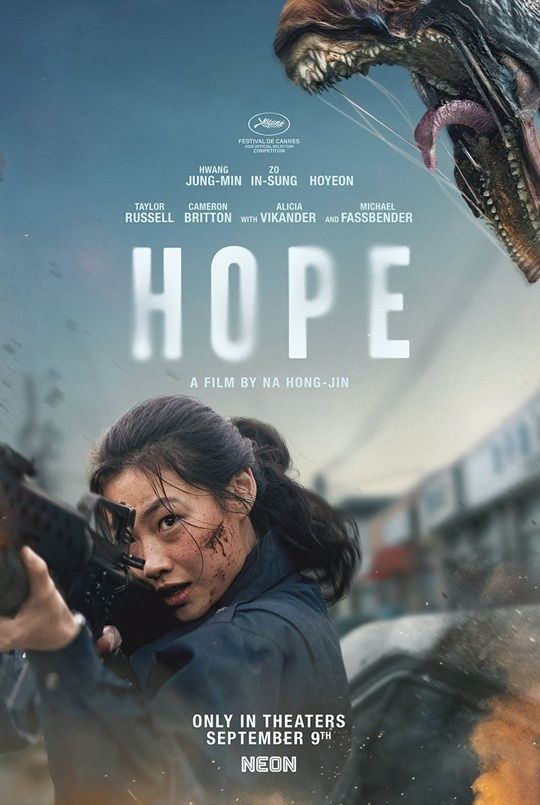
There is a sense of uncertainty that plagues its character and the setting in the new Korean film Hope, something that could be an uncanny companion piece to Alien (1979). As a part of its cold open, you are introduced to one of the protagonists Bum-seok (Hwang Jung-min), a cop who gets a call from his hunter cousin Sung-ki (Zo In-sung) about a terrifying sight of a dismembered animal lying dead on the road, with flies and maggots greeting its leftover body. There is a hint of the characters estimating it to be an attack from a ‘ Siberian Tiger’ – a seemingly unfamiliar metaphor of North Korea, particularly given that the setting remains that of the border town named ‘Hope Harbour’ (again, notice the name). But the reason why one could draw parallels with a film like Alien is in the mystery itself – wherein the ‘face’ of the ‘attackers’ remains largely concealed and under wraps, in what is one of the best first acts of the year. The tension remains palpable, the humour erupts from a case of unfamiliarity, and the wrath remains in the form of mutilated bodies flung on abandoned cars, or even the latter being flung in open grounds in classic Rohit Shetty style!
Written by Na Hong-jin, it is interesting on how the writing treats its characters in Hope. For instance, the camera treads on the tense landscape following the journey of its protagonist Bum-seok to begin with. He has a heroic presence, almost letting out an aura of having the situation in control, or even better being the ‘chosen one’ to save his own people who have been unceremoniously attacked by unknown beings. But what follows is a steady degradation of his aura – converting his style into fear, and his persona into a steady mode of survival, and his uncertainty into unhinged bouts of humour; even as you witness him maneuvering his car aimlessly around town, or even pumping a bullet on one of his own people assuming it to be the ‘killing being’.
The events are as much riveting as they are ticklish, the latter erupting out of the fact that the protagonist always remains a couple of steps behind the attackers in question. And in the moment, the writing ably subverts bouts of comedy in several tense chases in the first hour – steadily leaving ‘footprints’ that do their bit in painting a chilling and terrifying picture in the minds of the viewers. It is not until the 50th minute (or so) that you actually get a glimpse of one of the terrifying ‘blood-sucking’, destructive creatures – but not before allowing paranoia to settle in, allowing the humans to be picky aggressors who have been reacting out of fear, also using illegal weapons as a mode of survival.
Like the filmmaker’s previous film The Wailing (2016) that was a metaphor on the Japanese invasion in the land of Korea, the searing metaphor remains that of foreign invasion on Korean soil – a case that could be viewed in multiple ways. The first one remains a direct take on Western culture that has invaded the land, leaving the petty locals to defend themselves and the culture dangling on the last strings of relevance. The second remains a metaphor on anti-immigration sentiments, an instance that is particularly highlighted in a scene wherein the protagonist realises that the ‘alien’ in question doesn’t mean harm and is only looking for her misplaced baby; and the attack is purely out of a survival instinct of being attacked in return.
The concept of anti-immigration is further established in one of the more deliberate callous moments in the narrative, wherein a character exclaims on how he invariably killed a ‘small-sized’ alien, just because it looked unfamiliar to him. The measure remained that of defence, but the writing also steadily offered a searing commentary on how people would actually react to things or people who are unfamiliar to them – be it that of a clan belonging to a different race or caste, or religion, or simply based on looks; like it was the case here. Or even an alternate debate between the insiders and outsiders of the film industry, the former being ruled by bouts of insecurity and vulnerability to keep the latter at bay.
The second act considerably slows down from the pulsating opening act, but it is the uncanny comedic moments that subvert the thickening tension in the film. For instance, there is a hilarious sequence centered around a character who claims that he witnessed the rampant glimpse of the aliens, while having a dump – bringing his ‘other’ senses in play also during the moment. In any other case (like in a dud like Masti 4 (2026)), the toilet humour would feel misplaced. But credit to the writing for tactfully integrating it organically in the narrative (no puns intended), while slicing the tension with an ‘unfamiliar’ bout of ticklish humour.
That said, there are a few sequences that overstay their welcome too. This includes brilliantly shot sequence in the woods, this time focusing on the antics of Sung-ki who is in the midst of an attack, and in survival mode. The sequence mounts itself in a sea of unpredictability, but it did get a little too lengthy and repetitive for my liking. And yet, the final chase sequence on the highway felt iconic in many ways – steadily building nuggets of tension, even as I found my heart pounding away during several moments of the ongoing skirmish.
I also liked on how the final ‘sequel-bait’ revelation circled back on the question of who the monster really is – given how the ‘aliens’ remained a deeply traumatized clan, also seeking to survive and avenge the loss of their youngest one. The fleeting theme of humanity being caught in a permanent state of hyper-aggression could not have come at a more appropriate time, permanently poisoning the act of peaceful harmony and coexistence. This, also felt like an alternate take on the title of the film (and the setting), wherein the irony would write a joke for the ages. All of it while the gulf between humans and aliens would only widen in times to come. The screenplay subverts poignancy amidst scattered bouts of chaos, humour and paranoia.
The dialogues are sparingly used here, just doing enough to create a sense of chaos or humour or both. The BGM is tense while ably creating an ambience of fear and unpredictability – two vital ingredients that form the fabric of the narrative here. The cinematography beautifully transforms the rural, ominous landscapes of the DMZ into a visual pressure cooker. The film’s fluid tracking shots brilliantly sweep through the chaos, pulling viewers directly into the heart of the action with an almost video-game-like immediacy. During the thrilling scenes of combat, the camerawork becomes fiercely dynamic, capturing the raw, chaotic energy of the community’s clash against otherworldly forces. Crucially, the deliberate composition of each frame traps characters within tight, moody spaces, expertly cultivating a suffocating ambience of tension that lingers long before the monsters even strike.
The editing pattern needed to be slightly more sharper for a crisper edit, particularly in parts of the second and third acts that are minute traces of lag creeping in the narrative. The indulgence was there, that wasn’t a bad thing – but the line was slightly towed.
Director Na Hung-jin delivers a masterclass in cinematic tension, deliberately weaving an atmosphere of suffocating dread that keeps viewers completely spellbound. His sharp visual instincts and fearless narrative pacing transform the film’s bleak landscape into a canvas of profound emotional and psychological depth. By meticulously calibrating the story’s gravity, he pushes his cast to breathtaking emotional extremes while maintaining absolute aesthetic control. This gripping execution firmly cements his reputation as a visionary force capable of turning structural suspense into high art. He is guilty of overlooking some moments of lag scattered in the narrative, but largely, the direction remains super-effective in creating bouts of tension and chaos in the narrative with subtle hints of humour thrown in.
The performances are wonderful to witness by the members of the cast. The makers invert the US savior complex of films by literally casting Michael Fassbender, Alicia Vikander, and Taylor Russell in the role of the aliens. And each one of them have their moments to shine. Um Mun-suk as Yang-bae and Im Hyun-sik as Hae-sul are hilarious in their respective characters, bringing a fresh new dimension to the ensuing fear, palpable in this setting.
In a breakout cinematic turn, Hoyeon plays the rookie officer Sung-ae with a captivating mix of vulnerability and steadfast resolve. She brings a fresh perspective to the chaos, anchoring her character’s frantic panic with an endearing , survivalist instinct. Her demanding physical preparation shines through in the film’s practical, high-speed driving stunts, ensuring that her journey remains central to the film’s tense atmosphere.
Portraying the headstrong local hunter Sung-ki, Zo In-sung injects a fierce, unhinged intensity into the film’s pulse-pounding tracking sequences. He perfectly handles his character’s transition from an arrogant predator tracking an unknown beast to a frantic survivor facing an unknown threat. His expressive performance captures the core theme of human ignorance, showing how quickly fear can twist local pride into devastating violence.
As the small-town police chief Bum-seok, Hwang Jung-min delivers a masterfully grounded performance that captures a flawed man descending into frantic desperation. He commands the screen with a raw, kinetic energy, shifting from a skeptical local officer to a fiercely protective leader navigating a crisis beyond human comprehension. And the subtle bouts of humour that he brings to the table was refreshing to witness in a world of chaos.
Featuring strong performances, Hope is a tense, chaotic survival thriller that serves as a searing metaphor for anti-immigration sentiment and foreign intrusion. By cleverly flipping the traditional savior trope and injecting subtle bouts of humor, the film manages to impress despite a few pacing lags in its narrative. Available in a theatre near you.


