

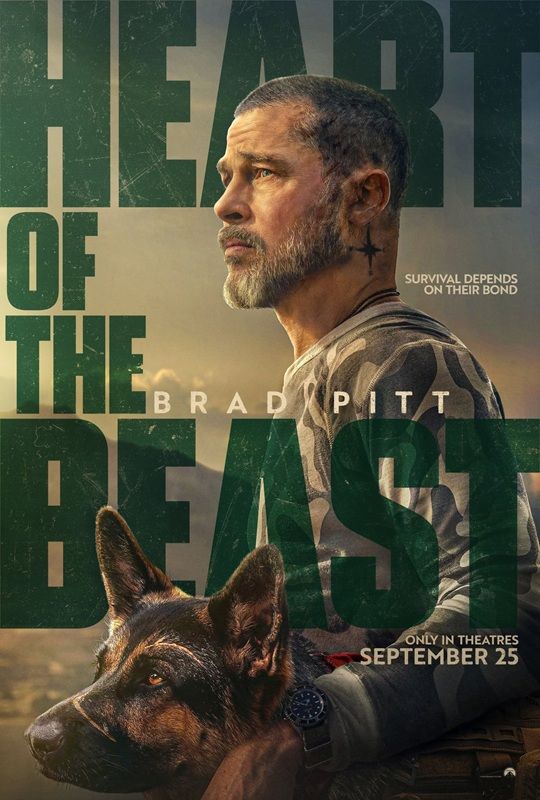
The title of the new English film Heart Of The Beast serves as a symbolic metaphor from the beginning. The ‘Beast’ in question is James Belmont (Brad Pitt), a Special Forces officer who is spending his quality retirement time in the wilderness of Alaska. The ‘Heart’ in question is his combat dog Odin, a German Shepherd who has also retired, and is accompanying his pal through the conifers of Alaska. It is ironic on how interchangeable these two terms are with regards to its two protagonists – each being the heart to the beast in so many ways. There is an imminent bond that forms an uncanny third wheel in their relationship – wherein loneliness of each of the two beasts is subverted by accompaniment and friendship. The latter isn’t established as well at the start – often providing fleeting moments of their bond from the past, the one ridden with pain and trauma of the battlefield. In a pivotal scene, you witness Odin waking up from the nightmares of his past, only to be pacified by Belmont – a favour that would be returned in a totally different context at a latter point in the film. But the core dynamic here is undoubtedly the heartfelt bond that Odin shares with Belmont, something that formulates the crux of the narrative.
Written by Cameron Alexander, Heart Of The Beast can be termed as a survival thriller in many ways – particularly given its premise involving the two protagonist who have to make their way through the bushy corridors of wilderness in order to survive after a chopper crash. And this facet immediately makes this a template drama that would eventually tread on a three act structure. This isn’t to say that the emotions in the narrative don’t work – they do! But the writing remains pretty predictable and cliched, almost formulating derivative moments from a few iconic films. For instance, the premise borrows its essence from the Tom Hanks film Cast Away (2000), with an added angle of dog-love. In another moment when the principal characters encounter a grizzly bear – the derivative undertone forms its roots from a famous scene from The Revenant (2015), partially ending in a bit of an anti-climax. But having said that, all is not lost in this narrative that still formulates a handful of moments which kept me invested.
There is a fleeting moment in the first act wherein the dynamic duo encounter a wanderer named Walter (J. K. Simmons), who unintentionally threatens to intrude the privacy of the two protagonists. I use the word ‘intrude’ here because the welcome that he gets at the start isn’t too warm. And whilst the duo eventually warm up to Walter over the course of the night, the reason this becomes a pivotal moment is only understood in hindsight – wherein the duo have to fight through the elements of nature without any human presence in the vicinity. The contrast is what makes this fleeting event interesting, deftly rising above the wobbly foundation of friendship established at the start.
In a spiritual alternate viewing, the journey of the two protagonists also is reflective of their individual bouts of evolution. So whilst the idea remained to find peace and return to nature, the ultimate evolution always remained to return to civilization – something that is immensely (and forcefully) reflective in their journeys of survival. And in this moment, the central theme of friendship only grows to be stronger by the minute – even as Belmont leads the way in a moment to cross a creaking log, or Odin voraciously tracking and helping Belmont after he falls into the ridge, in the process injuring himself too. This, or even an event transpiring in wilderness with the duo pitted against a pack of wolves. The events feel momentarily isolated, but do enough to elevate the bond between the two protagonists.
The resonant emotional core of the drama is reserved for its final act, something that is heartfelt and moving in so many ways. It felt like a replicate of the Jai-Veeru moment from the climax of Sholay (2026), with a specific subversion of the setting that hinted at the idea of global warming. And yet, the commentary remained fleeting – allowing the moment of togetherness to formulate the main character, even whilst showcasing traces of loneliness in the midst of survival. It is also here that the arc of Odin feels completed – as a voiceless animal trained specifically for combat, and someone who hasn’t experienced peace in its life amidst the pain and trauma that are now a part of his DNA, to finally getting a chance to lead a normal life comprising of love and joy. It was a specific instance of unrequited love that elevated the finale, in a ‘template’ screenplay that was largely generic but had its moments to shine.
The dialogues are used pretty sparingly in the context of the drama, often designed to aide and elevate the micro-heartfelt moments in the narrative. The BGM is decent but it needed an emotional edge to its armoury to truly ride on the warmth of the narrative. To be fair, the BGM does get soothing and heartfelt towards the end, and also does score in some thrilling bouts of survival. But the missing link was in the first act, wherein the established animal-man bond felt underpar – wherein the notes were yet to find a pertinent voice.
The cinematography is incredibly good, not only allowing the viewers to invest in the unyielding bond between the two protagonists, but also being immersive as a survival thriller. Be it the frames capturing the harsh contours of the land, or a specific sequence through the waters that reiterates the dangers of the land, or a followup sequence of a squirming bone-protuding injury, or even a combat sequence involving the wolves – the cinematography is fabulous, also featuring some VFX that seem top notch. The latter only suffers in a specific moment towards the end in a ‘flooded’ setting that felt like it was shot indoors. But that was me just nit-picking here.
The editing pattern is crisp enough to justify the runtime, even as the narrative gets steadily better by the minute. The minor lags in the first act had more to do with character establishment rather than the editing pattern. But the edit scores wonderfully well in a few thrilling moments that are immersive, and give the drama an edgy outlook.
Director David Ayer does a fair job here, steadily establishing the heartfelt bond between the two protagonists. Yes, you can sense a slightly tentative stance at the start wherein he meanders with this establishment. But he slowly finds his feet subverting the survival thriller genre with genuine heartfelt moments of an unlikely friendship, allowing his direction to soar at pivotal moments in the final act. The direction is pretty decent here.
The performances are wonderful by the members of the cast. Anna Lambe, and J.K. Simmons as Walter are pivotal modes of hope for the civilization in question here – and both of them have their moments to shine in the narrative. But the show belongs to <span;>Brad Pitt who showcases silent restraint, stripping away traditional Hollywood charisma to portray the raw, fractured psyche of a battle-scarred Special Forces veteran. Forced to rely on physical acting rather than heavy dialogue, he brilliantly uses exhaustion, subtle facial shifts, and weathered body language to communicate the crushing weight of PTSD, along with a resounding take on physical pain. Instead of leaning into action-hero tropes, he infuses the character with a profound, quiet vulnerability that grounds the survival stakes in a deeply human reality. His unspoken, deeply felt chemistry with his canine co-star serves as the film’s emotional anchor, making his performance commendable in many ways. And Odin essayed by four different German Shepherds nailed every emotion in the vicinity! such expressive eyes from scene to scene, I’d tell you!
Heart Of The Beast is a quintessential survival thriller drama that is powerfully elevated by its deeply felt emotions and the unyielding bond of friendship between its two protagonists. At its core, the narrative thrives on a compelling human-canine dynamic; though this relationship initially starts on a wobbly note, it beautifully transitions into a heartwarming, resonant tear-jerker. Ultimately, it is this profound emotional anchor that kept me invested, transforming the film into a thoroughly engaging watch despite its formulaic plot and subsequent narrative shortcomings. Available in a theatre near you from 25th September 2026 onwards.


