

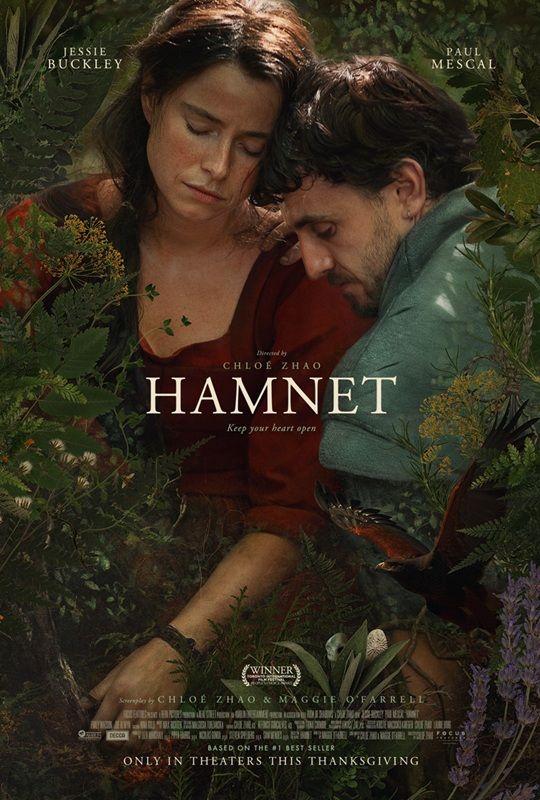
It is incredible on how the parallels can be drawn between the English film Hamnet and the Norwegian film Sentimental Value. The common thread linking both films remains using the creative space to cope with grief. In a scene, wherein you see William Shakespeare (Paul Mescal) narrating the story of Orpheus and Eurydice to Agnes (Jessie Buckley), you almost sense a subtext of a tragedy about to unfold at a certain juncture in the narrative. It is ironic also on how the tale here wishes to be perceived as a real-life Shakespearean tragedy that would go onto inspire one of the most famous works of William Shakespeare – Hamlet. The prologue at the start is again indicative of how the words Hamnet and Hamlet were considered to be the same name. It is at this point also that you are prepared on how the canvas of the drama here is personal, with shades that would eventually define and redefine the traits of an immortal protagonist of a timeless play, just as envisioned by Will and Agnes for their son. But life is never a bed of roses, is it?
Based on the novel Hamnet by Maggie O’Farrell, and adapted for the screen by Chloe Zhao and Maggie O’Farrell, the paradox in Hamlet is almost reflective of the two protagonists of the drama. Both Agnes and Will are like chalk and cheese – the former relies on intuitions to predict the future while earning the reputation of the ‘forest witch’s daughter’, whilst the latter wishes to make a name for himself in the world of literature against the wishes of his father who worked in the gloving industry. It is also interesting to note the frothy tone at the start of the film wherein the two potential love birds meet against the backdrop of the forest. The passage almost acts as a foreshadow of sorts for a later tragedy – with hints sprinkled in the narrative on how the characters of parents aren’t in favour. What may appear to be odd to the world, isn’t odd for the two lovers, but is life as rosy as the setting appears to be?
The drama in many ways acts as a foreshadow to Sentimental Value (2025), particularly equating the character of Will to Gustav Borg (Stellan Skarsgard) in his potential formative years with respect to his ambitions for art. In a scene, you see Will being increasingly frustrated with a sense of being trapped by the country-side while holding ambitions of writing plays in London. The situation calls for a sacrifice by Agnes who would sacrifice her life duties for her children, while Will is away. But the subtext also remains the distance – not only between the couple but also the children. Will would get a fleeting glimpse of his children, only when he is home – much like Gustav in a parallel world, which in turn also acts as a foreshadow for grief at a later point.
One of the important themes of empathy and care is linked to the character of Hamnet (Jacobi Jupe), the youngest son of Will and Agnes. It must be noted on how he shares a distinct connection with his twin sister Judith (Olivia Lynes), the latter who nearly survived after child-birth while later on suffering from a plague. Hamnet is brought up to be brave, building on the mock sword fights with his father. And yet, he has a strong affinity for his now-infested sister, almost trading death in exchange for her life. The scene involving him laying in a bed with her will go down as one of the most gut-wrenching scenes in the life.
The subtext of grief remains an integral trait connecting the characters of Agnes and Will. And it remains interesting on how both characters cope with the loss of their child differently – Agnes remains more emotionally vulnerable, while Will decides to immerse his grief in his work. The writing doesn’t wish you to judge either character, while willingly demanding you to empathize with the situation – given how loss of a child is the worst thing that could ever happen to a parent. In a crucial scene, you see a visibly vulnerable Will sitting by the river mouth the famous lines – ‘To Be Or Not To Be…That Is The Question’, a heart-breaking rendition of a tragedy that would later be known through his name (read : Shakespearean Tragedy).
It is interesting on how the play Hamlet acts as a medium to reduce the gap between Agnes and Will. For Agnes, it remains about a specific perspective of disassociation of her husband at the time of the passing of her son, wherein Hamlet does its bit in letting go of this perspective. In a moving scene, you see Agnes attending the play – visibly frustrated at the beginning for using her son’s name, only to later witness Will enacting the role of the ghost of Hamlet’s father. It remained a role swap of sorts representing the soul of Will which had died, while immortalizing his son through his play.
The play itself allowed Will to come to terms with his grief, through the artform that he dearly thrived on. The final shot of the emotions “extending’ to a larger audience was also representative of Agnes’ grief that felt as if it was shared by everyone around her. It remained a timely reminder on using an artform as a tool of expression – specifically in such play(s) that continues to inspire generations. And that itself felt like a bittersweet ending for Agnes and Will in a narrative that is a niche with its pacing but supremely immersive, meditative and lyrical in nature.
The dialogues have a specific stagey tone to them, often extending to the emotions that they wish to convey – a very specific trait that makes this drama a niche. And your perception of the drama will depend on how well you absorb the lines and decipher the emotions that add a subtext to the drama. The BGM is subtly melancholic while deftly allowing the emotions to seep through. Yes, there are moments of melodrama too which are represented throughly mildly louder notes, something that briefly disconnects you from the drama at times, but largely the score does work.
The cinematography comprises of frames that encapsulate the emotions of the characters beautifully. In a scene, you see Hamnet in his after-life with a hawk that was once a pet to his mother, drawing a parallel with the final scene involving Hamlet extending his emotions to a larger section of the audience – something that is taking from a top angle. Even in moments of stillness, you are witness to raw emotions erupting through some vulnerable closeups of characters that further reflect on their mental space.
The editing pattern is leisurely while seamlessly accounting for significant tonal shifts at regular instances in the drama. Director Chloe Zhao is meticulous in crafting this real-life Shakespearean tragedy through her characters and the setting. She ably uses emotions in the subtext of various scenes to convey the larger sentiment of grief, while maintaining a lyrical undertone to keep the drama measured in many ways. The delicate touches of silence and angst culminating into a tale of redemption and acceptance works wonderful under the context of the play that has been immortalized over the years. And she is quick to draw a parallel on how one of the characters in this tragedy also lives on with the play over the years. The direction is crafty and brilliant.
The performances are wonderful by the members of the cast. Bodhi Rae Breathnach as Susanna, Olivia Lynes as Judith, Joe Alwyn as Bartholomew and Emily Watson as Mary have their moments to shine. Jacobi Jupe as Hamnet brings such sensitivity and empathy to his character that his performance will leave you heartbroken. In the same breath, the casting choice of Noah Jupe as Hamlet (in the play at the end) much be applauded too – given how he is the real life brother of Jacobi, while almost essaying ‘Hamnet’ whom Agnes and Will would imagine as the grown up version of their son.
Paul Mescal as William Shakespeare does bring a sense of charm transitioning into grief and regret later on, in a performance that is subtly heartbreaking to witness. He brings a range of emotions to the table from the quieter pondering ones to the ones involving frustration, and he masters every beat wonderfully well. Jessie Buckley as Agnes has such expressive eyes and expressions to die for, that she invariably brings a sense of vulnerability and trauma to her character. She remains the other half of the emotional core of the film, almost being a silent warrior whilst her husband is away, while also being resilient in times of a crisis. The complexity of her character lay in her journey of acceptance, something beautifully handled towards the end in a palpable act that is achingly beautiful.
A nominee under the category of ‘Best Picture’ at the Oscars of 2026, Hamnet is a lyrical and meditative reimagining of grief wrapped in a real-life Shakespearean tragedy that gently tugs the strings of your heart while making for a heartbreaking watch. Highly Recommended.


