

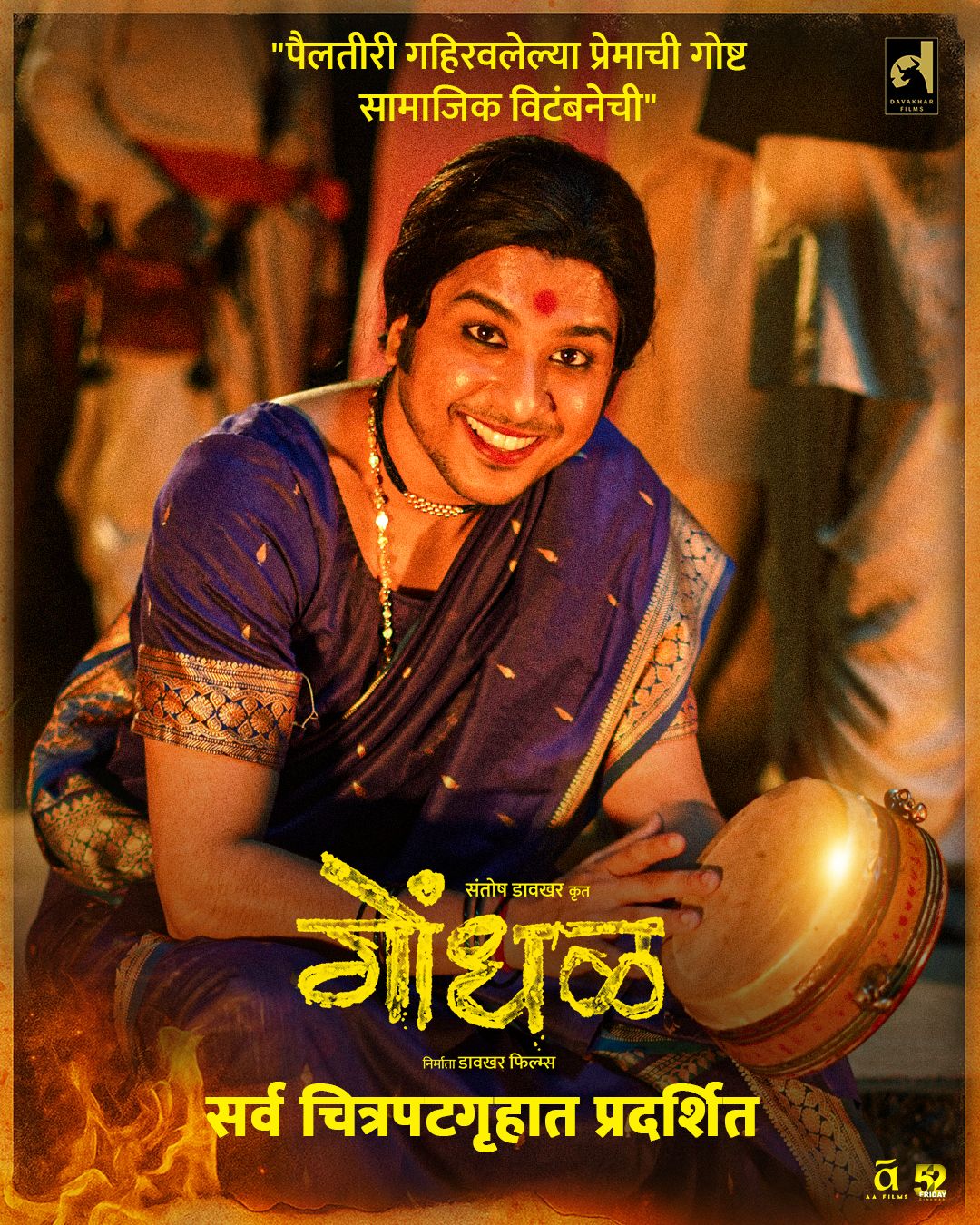
There is something Shakespearean about the world of Gondhal, India’s Official Submission To The Oscars Of 2027, a trait that is evident from its first frame. And the same is christened with a spectacular 25 minute opening sequence that remains a single-shot with switching POVs between the characters. Interestingly, one of the early POVs of a little child forms the unassuming arc of the drama – even as you are introduced to a young boy Vishnu (Dhruv Thoke) who is shown to be absorbing the traits of the world by asking questions to his grandpa Bhivaba (Kishore Kadam). The underlying subtext remains that of innocence, an important virtue that would soon be stripped off from the child’s psyche over the unfolding night. And whilst we get to know of some fleeting yet startling facts about the sudden disappearance of his father; something for which he is bullied in his school, the writing importantly juxtaposes this Shakespearean tragedy (if you could call it one) against the age-old custom of ‘Gondhal’ – a ritual of devotional singing and dancing that transpires over the night, to ward off evils from newly weds and new borns of the village.
Written by Santosh Davakhar, one of the important aspects of Gondhal remains its characterization. As the night unfolds (and we are still in the middle of 25 minute single-take shot), there is a hint of patriarchy and caste discrimination that christens the members of the village. The common meeting point remains the character of Suman (Ishita Deshmukh); a young woman who is forced to marry Anand (Yogesh Sohoni), despite harbouring feelings for another character. In a fleeting moment, you notice a character explaining her on how her relationship with Anand was finalized, because the ‘other’ Patil family demanded a much higher dowry – causing her alleged relationship with Sarjerao (Nishad Bhoir) to slip through the cracks. All of it, except that her heart longs for Sahebrao aka Murali (Anuj Prabhu), a simpleton who remains a mere performer at the Gondhal ceremonies – thereby reflecting a significant caste divide amongst the villagers.
The writing further warrants a drill down with respect to some of the other characters involved. For instance, Sarjerao reeks of privilege; having donned a moustache of prestige while also harbouring stronger feelings for Suman. In a scene, you see him being coaxed to kiss the ‘bride’, a challenge that he willingly accepts – even while harbouring an ambition of being the ‘Chief’ of the village, a position currently occupied by his father Patil (Suresh Vishwakarma) who is seemingly responsible for the mysterious disappearance of Bhivaba’s son. In a moment, you are also briefly acquainted to the erstwhile power struggles of the two families, in their quest to eventually land up with the title of the ‘Chief’ of the village.
On the other hand, the protagonist Anand remains a meek pawn in the midst of the complexities of the world on offer. In an early scene, you witness how he is subtly bullied by his cousin Sarjerao, which is quite evident in offering flirtatious exchanges with Anand’s wife, Suman. In fact, this ‘meekness’ also becomes the start of his character arc that remains unassuming for most parts of the narrative. In the same breath, even a character like Murali remains a mere pawn in the power tussle unfolding through the night – a seemingly powerless character who is just immensely in love with Suman, without the knowledge of anyone else involved.
The juxtaposition of the Gondhal ceremony is evident through the events of the night, wherein the cultural references of the Gods and Demons coincide with the characters of the world. The Shakespearean trait is ironically initiated by a character who herself remains marginalized with her voice, even as the events of the night unfold like a game of chess. It is interesting on how the protagonist Suman doubles up as Lady Macbeth, instigating a series of events that would end in a sea of bloodbath. It must be noted on how her victimization remains skewed in the moment, allowing her calculative side to rise to the occasion in a world that is essentially dominated by men who wouldn’t allow her to make decisions for her own. The subtext of patriarchy being subverted by an alternate streak of feminism is actively visible in the proceedings, even as Suman wishes to bump off her husband and her one-sided lover, by exploiting the traits of toxic masculinity that would often overpower the one highlighting patriarchy.
It is here also that the alternate relevance of the title of the film, comes to the forefront – creating an air of confusion and chaos amidst the fluctuating power dynamics between the characters. From a narrative standpoint, this remained a juggling final act as opposed to the bodies piling up consistently over the course of the proceedings. But having said that, the writing is so strong that it still makes an impact – a late order flourish after a subdued but atmospheric second act.
Spoilers (Skip This Sub-Segment If You Haven’t Watched The Film) :
One of the pivotal moments in the narrative occurs in a final face-off between two characters – Anand and Murali, the latter being tasked to kill off the former for his love, after Sarjerao goes missing; after being mistakenly killed off by Bhivaba amidst a history of a family feud. This, while a subtext of greed glitters in a moment for Sarjerao after he previously kills off his own father in order to secure the throne.
It is interesting on how the face-off between Anand and Murali is played out against a reference of a Deity and a Demon, even as Murali is shown to don a mask of a demon only to be hunted down by Anand, who is compared to a ‘God’ while overhearing and noticing the subtle ploys of his wife wanting to bump him off through the night. Murali is well aware that his move to kill off Anand would most definitely be realised as an act of treason, if he were to be caught killing a character from an upper caste.
But when that doesn’t happen, you witness the victorious Anand – a Godly figure appearing from the vicinity, even though the subtextual irony remains that of casteism and patriarchy triumphing over the less powerful and subdued characters. The writing beautifully paints a contrasting picture that is frightening in many ways, even when viewed through the POV of Suman; a character that you won’t always root for, but would eventually end up empathizing given how she continues to remain trapped in a wave of patriarchy as viewed through the last metaphorical shot of a chicken being covered with a basket lid.
In all of this, there is a searing POV that forms a connecting tissue throughout the film; the one involving the little boy Vishnu, whose mind is corrupted by the complexities of the world that he finds himself in. His skewing sense of morality is subverted by his loss of innocence, even as you witness a significant change of arc from his usual chirpy self at the start of the film. In a pivotal scene, you see him volunteering to seek revenge for his father’s death as opposed to pestering his grandpa with innocent questions – a significant inkling of corruption that has plagued his mind. In that moment, it also references on how hints of vengeance are passed down from generations, even as the ones equated to culture and mannerisms; thereby summing up a screenplay that is terrifyingly brilliant while being laden with dark Shakespearean undertones.
The dialogues are used as ‘significant’ filler conversations that contribute to the complex atmosphere of the drama. Much of the conversations reveal the brewing dynamics between the characters, something that offers an arc of its own – ranging from harmless and unassuming exchanges to something that is dark and complex in many ways. The music beautifully paints a contrasting picture of the world in question – lacing the offering a pious and unadulterated outlook to the devotional cultural references, while creating a contrasting subtextual outlook with the antics of the characters in question. And that is effective in communicating the tonal Shakespearean themes that christen the drama.
The cinematography comprises of frames that rely heavily on high-contrast, low-light framing, utilizing fire lamps and deep shadows to transform a sacred village ritual into a claustrophobic, sinister stage. The visual centerpiece is a spectacular, uninterrupted 25-minute single-take shot that had me immersed straight into the crowded chaos of the midnight ritual. The frames also play a part in creating unhinged perceptions about the characters, by drawing parallels with the ritual in question – something that offers a contrasting picture in the narrative, even while boldly playing around with metaphors (like the final shot of a chicken being captured; a dual interpretation of keeping the deep secrets of the village buried).
The editing pattern maintains a taut, steady pace throughout the rest of the film, striking a fine balance between the chaotic energy of the crowd and the intimate, building friction among the characters. Director Santosh Davakhar crafts a spectacular, deeply immersive experience in Gondhal by transforming a traditional Maharashtrian wedding ritual into a high-stakes psychological thriller. Instead of serving as a simple backdrop, the sacred folk performance acts as the narrative’s driving pulse, utilizing thundering drums and divine fervor to reflect the characters’ spiraling moral decay. His visionary execution is anchored by a breathtaking 24-minute continuous single-take opening sequence that winds from the dark rural woods, through a chaotic midnight crowd, and directly into the suffocating intimacy of a bride’s chamber.
The performances are wonderful to witness by the members of the cast. The likes of Aishwarya Shinde as Anand’s sister, Poonam Patil as Suman’s mother, and Madhavi Juvekar as Anand’s mother hint at traces of subdued and embedded alternatives of patriarchy through their respective performances. Pravin Dalimbkar as Vilas, Prashant Deshpande as Anand’s father, and Sharad Jadhav as Suman’s father have their moments to shine too. Kailash Waghmare as Mhorkya, Vitthal Kale as Mohan, and Prabhakar Mathapati as Anand’s brother-in-law remain impressive in depicting the contrasting personalities that contribute to the fractured fabric of the world in question..
Dhruv Thoke shines with pure, natural innocence as Vishnu, the inquisitive grandson of Bhivaba. He acts as the audience’s primary lens during the film’s famous, continuous tracking sequence, guiding viewers through the dark village paths. His earnest curiosity and simple questions provide a tragic, poignant contrast to the hidden adult resentments simmering around him.
Suresh Vishwakarma delivers a powerhouse performance as the vile patriarch Aabasaheb Patil, Sarjerao’s intimidating father. He projects a looming aura of patriarchal control, power, and ruthless entitlement that drives the film’s core societal conflict. He uses sharp, authoritative dialogue delivery to make his character an intensely formidable and unforgettable antagonist.
Kishor Kadam showcases veteran brilliance as Bhivaba, an enigmatic and respected traditional folk artist. He commands every scene he occupies, utilizing a masterclass in understated acting through subtle gestures and a piercing gaze. His authoritative presence grounds the film’s thematic depth, navigating the village’s complex social hierarchy and underlying moral hypocrisy with cold precision.
Anuj Prabhu stands out as Sahebrao, aka Murali. He brings a distinct, gripping energy to the narrative, weaving smoothly into the dark murder conspiracy that unfolds under the cover of night. He handles the script’s sharp tonal shifts with remarkable ease, adding layers of narrative unpredictability to the ensemble.
Nishad Bhoir turns in a chilling performance as Sarjerao, an obsessive lover fueled by dark, unpredictable desires. He perfectly captures the character’s volatile desperation, blending a deep fixation on cultural folklore with a dangerous streak. His raw intensity effectively matches the frantic energy of the midnight ritual, and his frictional chemistry with Deshmukh keeps the audience constantly on edge.
Yogesh Sohoni brings a vital grounding presence to the film as the gentle, unsuspecting husband, Anandrao. He portrays a sense of genuine, naive warmth that contrasts sharply with the sinister deceptions plotting silently all around him. He tracks the emotional erosion of his character beautifully, gradually transforming from a joyful groom into a deeply bewildered victim.
Ishita Deshmukh delivers a captivating performance as Suman, a young bride trapped within an oppressive rural marriage. She masterfully balances quiet vulnerability with a sharp, calculated resolve as she transforms her desperate situation into a deadly psychological chess match. Her highly expressive eyes anchor the film’s intense emotional weight, effortlessly shifting from silent compliance to dangerous intent.
India’s official submission to the Oscars of 2027, Gondhal stands as a searing Shakespearean tragedy that masterfully weaves profound cultural and devotional references with a stark, contrasting depiction of sinister societal forces. The film delivers a compelling, immersive commentary on patriarchy and casteism, building a world that remains supremely captivating from start to finish. Backed by stellar performances, it creates an atmosphere of frightening intrigue and psychological complexity like no other, making it a brilliant and unforgettable cinematic experience. Available in a theatre near you and Highly Recommended!


