

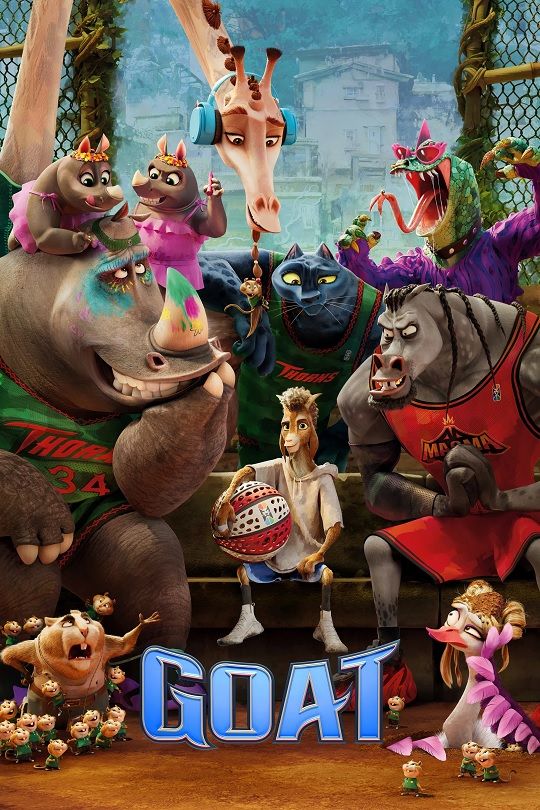
The title of the new English film Goat holds validity both as an acronym, and its physical sense. This is because the protagonist Will (Caleb McLaughlin) is actually a goat, in an arena where animals can speak. In many ways, the setting here remains an extension of last year’s Zootopia 2 wherein animals are like humans who can talk, communicate and have emotions to share and fulfill. This remains the starting point of Goat too wherein a young protagonist is pleasantly surprised by his mother who buys him tickets to the roarball tournament – a sport resembling basketball with a rendition of obstacles sprinkled in the sport. But the key sentiment remains that of the mother-son bond that would be shortlived in the narrative but fruitful in fuelling a sense of purpose for the protagonist during his journey of being a GOAT (Greatest Of All Time). It is an important ingredient that acts as a connective tissue in a space that hardly offers any novelty – both in the sports genre, or that of an underdog wherein you know what to expect, while wanting to immerse yourself in a sea of heartfelt emotions.
From Sony Pictures – the studio of last year’s global phenomena KPop Demon Hunters, and written by Aaron Buchsbaum and Teddy Riley, Goat offers a familiar journey of a familiar protagonist during his tryst with a familiar sport. And whilst ‘familiar’ remains a keyword, the underdog aspect of the drama offers a comparison between Will and Marty Supreme (2026) in a very different sense. Both the protagonists are underdogs dreaming of ruling the world in the sport that they are passionate about. And both of them are poor to begin with. In an early scene, you see Will unable to pay his rent while working as a delivery guy at a cafe that was was home to his mother. There is a tinge of bittersweet emotions tying the narrative together – almost forming a bridge of sorts between Will’s dream of playing roarball after being inspired by the presence of the GOAT player Jett (Gabrielle Union) while persevering through his current situation of poverty. This, until a bout of magic transforms his life forever.
The characterization drives the narrative here, despite the writing treading on a rather familiar path. For instance, the character of Jett reminded me of a fading superstar who isn’t willing to pass on the baton. In another world, Jett would have been a politician continuing to warm her chair despite being inefficient with the outcome. But given that this is a kids film, you see her character being driven by ego and arrogance while having very little to show in the form of results.
The other folks of the Vineland Thorns – an underdog team that Jett is a part of – form a motley group that aren’t equipped to work together. Be it the shady team owner Flo (Jenifer Lewis) who is nothing short of an opportunist, shifting sides at the drop of a hat, caring only about the money and not about the team. Or the group of misfits – a flightless bird Olivia (Nicola Coughlan) suffering from a flying syndrome, or a giraffe Lenny (Stephen Curry) who loves to rap as opposed to focusing on the sport, or a fiery Komodo dragon named Modo (Nick Kroll) who loves to laze around, or even an Indian rhino named Archie (David Harbour) who sums up the group of misfits here. And then there is an aging coach Dennis (Patton Oswalt) who is tasked with coordinating the chaos and motivating his players to play together.
Whilst the initial dynamic between Jett and Will is that of insecurity and a superiority complex, making Will warm the benches initially – the conflict within Will definitely strikes a chord while further making him an underdog. The conflict of being ‘short’ is something that I have dealt with all my life (I am 5 ft 7 inches on a generous side), and that made the drama relatable for me. From Will’s perspective, he finds himself in a sport that is designed for tall people wherein the only motivation that he has is of ‘Dreaming Big’, courtsey his mother who in his words was the only one who believed in him (so typical of mothers, my mom does too). And hence his driving force is greater than his vertical demerit, something that elevates the drama here. It is interesting on how the protagonist in the latest Spongebob SquarePants also had the same conflict, something that was progressively squandered unlike the case here.
One of the criticisms of the drama remained the characterization of the antagonist – a stereotypical horse called Mane (Aaron Pierre) who felt like a one-dimensional character driven by bravado, whilst having nothing else to offer. The layers were missing in a character that felt binary and caricaturish in every sense. Another little drawback remains the clutch moments in the narrative that could have elevated the drama a little more – be it a late conflict within the group that felt half-baked. Or even the contrived finale that didn’t exactly raise the levels of tension whilst being pretty straight-forward.
These moments needed a boost, given how the drama did peak during scenes of unity that engulf the narrative wherein the oddballs not only begin to gel well but also play as a team. In a sharp contrast, the dynamic exploring the arcs of Jett and Will felt slightly simplistic although the emotions were definitely in play. And interestingly, these emotions in play are something that paper over the cracks in the writing while presenting a drama that is heartfelt and feel-good in many ways.
The dialogues have emotions on check in the narrative with quotes like ‘Dream Big’ almost forming a fabric of the storytelling here. The BGM is decent here, doing just enough to aide the narrative but never fully investing in the emotions of the drama. The animation though is top-class, being flashy in many ways whilst bursting of vibrant colours that compliment the colourful characters on display. It isn’t as groundbreaking as KPop Demon Hunters, but in its own capacity, the animation is top notch here.
The editing pattern is crisp, at times a little too crisp for my liking given how the drama didn’t wish to stay in the moment with the emotions before quickly wanting to move forward. That did make the drama slightly uneven wherein the trade-off was between a quicker and sharper edit and an even more powerful emotional core. Director Tyree Dillihay does manage to impress with most of his characterization, and his ability of making emotions land. Yes, he does mildly struggle during some clutch moments towards the end, but still the direction is fairly good for most parts of the runtime.
The voiceovers are pretty good by the members of the cast. Jennifer Hudson as Will’s mother strongly contributes to the emotional core of the film, so much so that I wanted more of her in the narrative. Patton Oswalt as Dennis, Jenifer Lewis as Flo, Stephen Curry as Lenny, Nick Kroll as Modo, David Harbour as Archie, and Nicola Coughlan as Olivia – all of them manage to impress with their variations while also contributing to the fun elements in the drama. Gabrielle Union as Jett has a nice little character arc to play with, and she uses her voice to breath life into a character suffering from bouts of insecurity and vulnerability. Caleb McLaughlin as Will is an epitome of a perfect underdog – you see his understated tone that is reflective of his resentment, early on in the narrative. But the vibrancy of the character is steadily amped up wherein Caleb really makes you root for the character who is really affable whilst being driven by a strong emotional core. The voiceover is really good here.
Goat boasts of heartfelt emotions and flashy animation that elevate a familiar ‘feel-good’ underdog story. The drama is predictable and nothing new that you haven’t already witnessed earlier, but the bouts of emotions are heartwarming while accounting for a worthy watch here. Available in a theatre near you (from 20th Feb’26 onwards in India).


