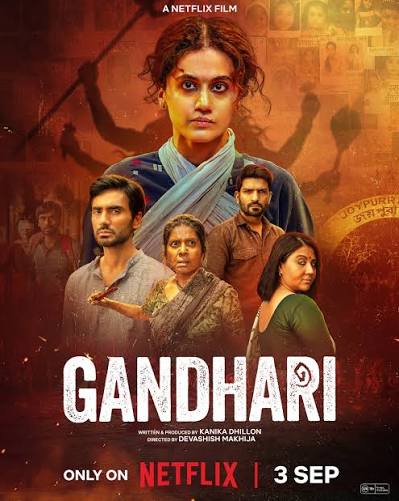

At a point just before the end credits roll of the Hindi film Gandhari, there is a quote that had me puzzled – ‘Behind Every Mother Is A Child….Taken From The Mother’. In hindsight, this confusing and twisted quote summarised the film here – given that the drama in question also did not make any sense here. And much of its silliness had to do with its inconsistent tone that was nothing short of a writing brain-fade. If in a scene, you see the protagonist Bani (Taapsee Pannu), now ‘temporarily’ blinded after an accident talking to an inanimate stroke of thin air – then you just know that the film is in trouble. If in another scene, you see this ‘blinded’ protagonist hang face-down from a structure out of nowhere like Spider-Man, making her a perfect match for Peter Parker – then you just know that the moment itself will go down as one of the facepalming moments of the year. Even from its concept POV, the title of the film inferenced from Gandhari from the Mahabharata made no sense to me; you cannot simply have a character drawing comparisons from the mythological literature because she ‘pretends’ to be blind. In the Mahabharata, the motive of Gandhari was to support her blind husband, but the same symbolism is skewed and a bit random – more on the lines of wanting to inherit the spirit of Andhadhun (2018) along the way.
Written by Kanika Dhillon, Gandhari begins on a fairly engaging note involving a train sequence that ends up with a kidnapping, leaving the protagonist and her husband Gokul (Ishwak Singh) without a daughter, and the former ‘temporarily’ blinded. The fictional town of the crime remains ‘Joypurra’ – a setting that is synonymous with the crimes of kidnapping, and of s*x trading of children as told by a cop character who is determined to nail the culprits. But even in these slightly engaging moments at the start (something that still only remained a pale shadow of Devashish Makhija’s train sequence in Joram), I could smell bouts of convenience thrown in the mix – what is the motivation of the gang named ‘Black Hole’? How has the cop character deduced information about them? Why are the other cops coming across as far too relaxed? And why is the month long timejump presented in fragments?
One of the prime issues with the writing remained its characterization. For instance when you are introduced to the top cop Kabir (Jatin Sarna), he comes across as a messaiah for the people of Joypurra, particularly given that he has some potent information about the gang ‘Black Hole’ and the ‘Behrupiyas’ who are prime suspects – the latter trying to imitate a lame commentary on socialism. But this same character is suddenly sidelined in a bid to make the Andhadhun-coded character of the protagonist into an unsaid superhero. It is the same issue that I had with a film like Toxic (2026) too – wherein the writing was centered around the heroic act of the protagonist, when the soul of the subject matter just wasn’t that!
The writing gets convenient by the minute, even through its characters with broad-strokes. The town is essentially filled with criminals, a conspiracy is hatched and carried out, a game of cat-and-mouse ensues, pitting some redundant cops with their criminal counterparts. In the midst is the metamorphosis of the protagonist – going from a ‘temporarily’ blind and helpless mother to a supermom vigilante, tracking every little move of a handful of folks from the town, with little help from her husband and a couple of random characters.
It almost felt like the writing reverse-engineered plot points for them to double-up as antics for the protagonist. For instance, a random flashback montage gives the viewers a glimpse of how the younger version of the protagonist was trained to be a street-side vigilante – only for her to rediscover her trait in the current timeline. Bobby Deol from Alpha (2026) would have been proud of Bani, much like her mentor Jhunu Amba (Mita Vashisht) here – because ‘wolf’s daughter will also be a wolf’, except that this wolf’s daughter is taken away. Is that what the quote at the end meant? The silliness also extends to the other flashback montage wherein Gokul randomly saves an already escaping protagonist, only for them to fall in love. This, even as random Chekov’s Guns are introduced in the writing – including an NGO, an ambulance, a lid of a ditch leading to the onshores, some more shady-looking Behrupiyas, and a faceless villain who only appears through fragmented shots.
The metamorphosis of the writing from an investigative drama to a vigilante mom film to a symbolism of war straight from the chapters of mythology felt just so messy with its outlook. It almost felt like an Andhadhun film transitioning into a star-led massy commercial vehicle at the end – even as I was witness to the protagonist taking down a handful of characters, including a couple of her loved ones – each presented against a romantic ballad being played out in the most bizarre manner possible. At this point, the convenience of the writing was superceded by the outrageous moments of the writing – even as the faceless villain is so easily neutralized by the protagonist, even as the star cop plays a distant secondary character who arrives after everything is done and dusted. Talk about an unintended tribute to the 80s! The screenplay remained a tale of two what-ifs here – what if the route opted was a gritty investigative drama with a mother-daughter emotional core? And what-if the real story behind the film….was taken from a real film? If the latter didn’t make any sense, neither did the messy writing here!
The dialogues could not have been a bigger advertisement of spoonfeeding the audience with bouts of exposition. For instance when a character finds herself at the center of a major conspiracy, her immediate words equate her to a mythological reference of Chaumata in the stomach of Magrasur, something that was setup three scenes prior. Why not allow the viewers to decipher things themselves? Why go in full Singham Again mode, and lay out every small detail? The music and BGM remain a mixed bag here. While a couple of songs do enough to raise the intensity of the drama, atleast in the moment, the choice of playing a romantic Ballad at a crucial juncture towards the end, felt like a laughable choice given how the writing itself aspired to be a distant cousin of Abbas Mustan in that moment. The worlds just did not blend here!
The cinematography comprises of frames that definitely shine in a couple of moments – be it the red hues gracing the occasion of a local festival that is deeply rooted in mythology, while drawing a parallel to the investigating protagonist in the very moment. But one key ingredient missing is the emotional core of the characters that felt lost in translation, so much so that some wild swings at the end did not quite feel earned too. The editing pattern felt more confusing that assured here – in a moment taking a month long timeleap, only to circle back to the transition period as a flashback homage. Why the jugglery again? Also, specific tonal patterns felt inconsistent given how abrupt the transitions were, never quite allowing me to fully settle in the narrative.
Director Devashish Makhija does try his best to elevate a messy script, at times scoring fairly well in some moments – like the train sequence at the start. But I had a sneaky feeling that he was always playing catch up with a script that just wouldn’t settle on a single route – often laced with the amplification of the protagonist in the wake of a conspiracy that just wasn’t the soul of the drama. The swings remain wild but ironically convenient, even through its maze of sketchy characters and an inconsistent world – both of which aren’t controlled well enough to leave a lasting impact. I have seen better works of Devashish (way better, in fact) – this just wasn’t one of them! And probably, a director can only do this much when the film is a mess at the writing stage itself!
The performances are a mixed bag by the members of the cast, particularly given how sketchy the writing is here in terms of the characterization. Talented actors like Chhaya Kadam as Uma and Chandan Roy as Somesh feel woefully wasted in the mix. Even a supremely gifted actor like Prashant Narayanan has nothing really to play with, in probably the worst written antagonists of recent times. Seasoned performers like Mita Vashisht as Jhunu, and Swastika Mukherjee as Miss Churni have such half-bakes characters that even desperate attempts at salvaging the drama remain a distant reality. Vishwanath Chatterjee as Inspector Saha, Priti Shroff as ASI Sanjukta, and Jatin Sarna as Kabir try their best, but the tepid characterization has its final say here, reducing them to secondary characters.
Ishwak Singh as Gokul is the lone shining light in a grim film, with grimmer doses of characterization. His expressions and body language definitely contribute in elevating a character that is written in a confused manner – having his moments to shine at pivotal instances. This brings me to the curious case of Taapsee Pannu who doesn’t quite leave a mark as Bani. There are moments wherein you see her hamming through her emotions, not always being in control of her pretense of being ‘blind’, something that immediately made me conclude that the range of a prolific performer was missing. Don’t get me wrong – she is a pretty safe performer. But the one thing missing in her armoury is range – something that doesn’t allow me to differentiate between any of her recent characters (in terms of specific traits). This is a limitation that needs improvement going forward, and hope Taapsee manages to impress in her future outings.
Gandhari is a messy and tonally inconsistent thriller that stumbles under surface-level writing and lazy plot conveniences. By abandoning storytelling basics, the drama unravels into a chaotic mess that becomes impossible to salvage by its conclusion. This structural failure extends to its sketchy, half-baked characters, providing so little depth that even the cast’s most seasoned performers are dragged down by the material. Ultimately, without a solid emotional or logical anchor, the film collapses under its own poorly executed ambition, resulting in a frustrating experience that is nothing short of a blinding swing and a miss. Available on Netflix.