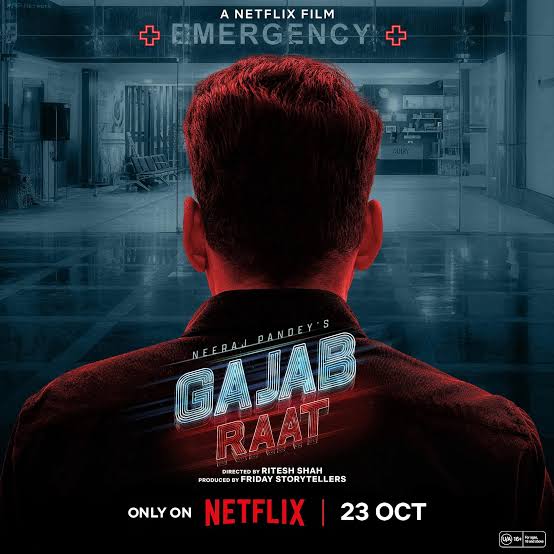

It is ironic on how the new Hindi film Gajab Raat could have just been an email, without changing a word in the script. And I can say that confidently given how the filmmaking here involves multiple tracking shots of people walking….and walking….some walking inside the rooms….some walking outside the rooms, all in order to create a sense of tension. This tension itself doesn’t feel earned because the needle of storytelling is stuck without moving an inch. These are the antics that invariably make a film gimmicky, and I totally get as to why the makers resort to this here – simply because the script itself is wafer thin, and the suspense is hardly surprising if one is well aware of the ongoing antics transpiring in the capital this year.
When you are first introduced to the protagonist SI Ajay Nirvit (Manoj Bajpayee), the setting remains that of a shady hotel, with folks being handpicked by the Delhi police – no, not the journalists from hotels about to cover the protests (because then the police would be called D*lli .. no?). You get a glimpse of his supposed honesty that immediately makes way for his trait of corruption – even as the protagonist comes across as a ‘Ghooskhor’ individual (he was supposedly a ‘Pandat’ before the online trolling forced the makers to change his caste and the title of the film), and a womaniser, both in the same breath; striking a deal with a ‘guilty’ woman in order to ‘engage’ with her at some point in the night.
Written by Neeraj Pandey and Ritesh Shah, it is evident from the title Gajab Raat that the events of the film transpire over a single night. So whilst you are introduced to the shady antics of the protagonist at one end, another stray incident occurs elsewhere – wherein an injured and assumed dead girl (Aditi Sharma) crawls her way out of a moving car, and supposedly ends up been pictured on the roads of Delhi. Given the issue of women safety, the top officials do not want another black mark on their already pitch black report card – thereby assigning a bunch of folks to look into the matter. In the process, you are also witness to the corrupt protagonist being dragged in this mess – only for him to wonder on who is this girl, and why has she ruffled these many feathers?
The issue with the writing instantly remains its characterization, particularly with regards to the characters around the protagonist. So you have the likes of a social activist Neha (Shraddha Das) who is feared by the protagonist, even while having no background of her personal life, except the fact that she transforms into a seductive manipulator in one scene, unsuccessfully so. You also have the likes of a shady CBI officer Navin Madhok (Akshay Oberoi), who is the first point of contact for bumping off the girl; also trying to bribe the protagonist at some point without much luck. And another NIA officer Karan Gill (Saqib Saleem) who is also after the same girl, while competing with folks around him. The issue stays with each of the characters here, they remain cardboard cutout variants of their respective personalities – without having any individual arcs of their own.
The only arc worth acknowledging remains that of the protagonist, whose corrupt streak is steadily transformed through the night – not because he wishes to turn a new leaf, but more so out of a burning question around the identity of the girl. It has clearly been a busy night (with all the unsolicited cardio implied), but you do witness a streak of idealism in the protagonist that is increasingly a case of the writers wanting the viewers to indulge in a suspension of disbelief, particularly given how the ‘reality’ is far stranger than fiction.
There is a glimmer of hope with the ensuing investigation in play, even as we witness the protagonist pulling his strings to get to the truth behind the chaos that has transpired over the night; including multiple attempts to bump off the girl. But when the truth is revealed, it isn’t as impactful given its specific attempt to water down the political side of things. It did feel rather superficial rather than layered, particularly with respect to someone who has constantly been in touch with all the news pouring in. Hardly anything surprises me now; and in that sense, there was a layer of staleness to the revelation, although pretty topical I must say!
The major issue that I had though was with respect to the final act that couldn’t be analyzed for what it stood for. It felt like a weird case of an unexpected cop out (much like changing the title of the film) – wherein the suspension of disbelief itself felt like a wild swing, particularly in times that we live in. No one from the higher up forces are gonna resign over these ‘petty issues’, and no one lower than them is gonna arm-twist them with their trivial moves. Without revealing much, it was a straight up cop out in the most convenient way possible. The girl is saved, no collateral done – everyone goes home happy with minimal damages, and democracy can literally continue breathing the polluted air or drink polluted water like it has been doing lately. And the corruption can kickstart for the protagonist, after a night of consciousness! Right? The screenplay needed better developed character arcs along with a bolder conclusion to have any sort of impact.
The dialogues are conversational, and try their best to hold onto to the mystery around its characters. But the lines are also pretty direct, and less impactful with the exposition towards the end; the layers are missing. The BGM tries to do a bit of the heavy lifting with a ticking score, specifically designed to maintain the urgency of the drama; typically complimenting multiple montage sequences of people just aimlessly walking around. The cinematography also does more of the same that is now a fatigued staple of most Neeraj Pandey ventures, employing tracking shots and following characters around the room – all in a bid to create bouts of tension; a alternate way of flogging a dead horse (read : script).
The editing pattern is assured in the first half, but woefully falters later on – employing choppy edits to significantly lower the impact of the drama (either this or someone was forced to do so, in order to have a quiet non-controversial release). Director Ritesh Shah frequently resorts to the gimmick of long tracking shots following characters walking around, a technique intended to manufacture tension but one that ultimately feels empty. His direction struggles to land the film’s core emotional beats, leaving the overarching conspiracies and individual character arcs feeling underdeveloped and flat. Consequently, when the final mystery is revealed, the lack of foundational narrative depth robs the climax of any genuine impact or resonance.
The performances are pretty good by the members of the cast – one reason while the drama appears to be watchable. Priyanka Bajaj Sibal as Dr Ajayta is understated with her act, and she comes across as pretty sincere and earnest. Kiku Sharda as Lovely scores with his funny one-liners, despite his character not having a significant contribution to the main plot. Nushrratt Bharuccha as Rosie is good but I still couldn’t come to terms with the real purpose of her character, particularly given the fact that a prominent name like her was cast in a rather insignificant role that had no real bearing on the screenplay. Shreya Rukmini as the nurse, Sunit Tandon as Sabharwal, and Sachin Kathuria as Sushil have their moments to shine.
Rajiv Gupta as SHO Praveen is terrific as ever, deftly allowing streaks of humour to christen his character, thereby cutting through the seriousness of the situation, effectively so. Saqib Saleem as Karan is decent but the writing never fully allows his character to blossom. In comparison, Akshay Oberoi as Madhok is quote effective in maintaining a cold, intimidating outlook to his character.
Divya Dutta as Suneeta delivers a dignified act while ably maintaining her posture through and through. Shraddha Das as Neha has a good screen presence, while having her moments to shine – despite the fact that the writing did not fully tap into her character’s potential. Aditi Sharma as Arya (the injured girl) is wonderful to witness here, coming across as quite sincere and earnest with her body language and expressions.
Manoj Bajpayee as SI Ajay elevates the lackluster drama here with a stellar performance that makes the entire film watchable. He commands the screen with a calculated gait that perfectly captures his character’s motivations, channeling decades of nuance into every step. His micro-expressions speak volumes even when the script falters, holding the audience captive through sheer emotional precision. Most riveting of all is his shifting smile – a fleeting, ambiguous flash that instantly adds layers of mystery to an otherwise predictable narrative. He was brilliant as ever in a performance that nearly rescued an insipid drama.
Despite solid performances, Gajab Raat is a lacklustre political thriller that feels like an instant cop-out. It is crippled by a wafer-thin plot, non-existent character arcs, and a watered-down resolution that makes for an insipid watch. If only tracking shots of people walking around aimlessly could maintain the levels of tension and intrigue in the narrative….Available on Netflix.