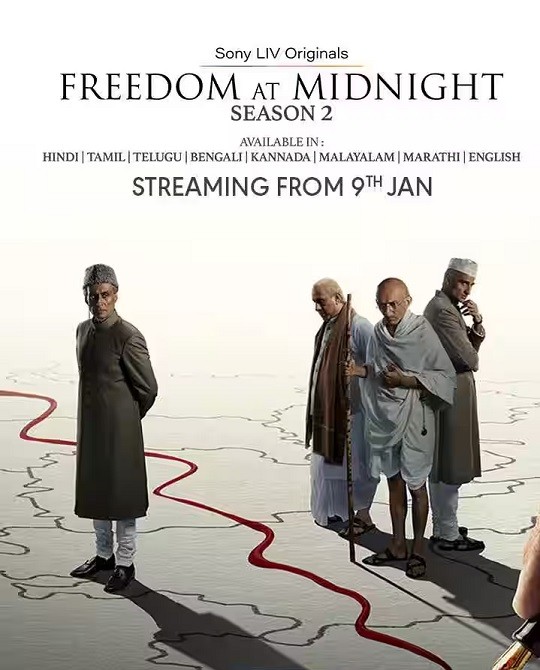

Given that the second season of Freedom At Midnight is a direct continuation of the first season, the contrasting styles of the narrative are clear as light and day. So while the first season was all about the character buildup of some of the most important historical figures of Indian history, you immediately are witness to faster cuts in the first act of the second season. As things stand, Pre-Independent India is on the verge of a partition, but the question is no longer ‘When’ but more in the ‘How’ space. It is important to recalibrate the dynamic between the characters too – something that we immediately witness at a conference table to decide the new territories of India, and the then new countries in the making – West Pakistan and East Pakistan. You see a palpable streak of tension cutting through the room even as British lawyer Cyril Radcliffe being freshly appointed to ‘draw the line’ enters the arena. The magnanimity of that one incident would go onto change the history of the two nations – even as you witness a wave of disagreement amongst the key members – Pt. Jawaharlal Nehru (Sidhant Gupta), Sardar Vallabhbhai Patel (Rajendra Chawla), Mohammed Ali Jinnah (Arif Zakaria) and Liaquat Ali Khan (Rajesh Kumar).
Based on the book ‘Freedom At Midnight’ by Dominique Lapierre and Larry Collins and written by Abhinandan Gupta, Adwitiya Kareng Das, Gundeep Kaur, Divya Nidhi Sharma, Revanta Sarabhai and Ethan Taylor, the urgency in the second season of the show is a reflection of an increasingly communal sentiment that is reflected in the minds of the people. In a crucial scene, you see Louis Mountbatten (Luke McGibney) – the last Viceroy of India claiming on how ‘everyone cannot be made happy’ while pressing for an early independence given the governance difficulties in the country. Just before he utters his words, you witness a character quietly inquiring on whether his home village would be a part of India or Pakistan. In the same breath, the camera pans onto three ‘Indian’ characters from the British army who are best friends in their own capacity, while having to make a choice of either migrating to a new country, or staying back to serve the army. Not only is their friendship at stake, but their decision coincides with one of the most ugly enmities between countries which can only be analyzed in hindsight.
I liked how the contrasting styles of the narrative coincided with the contrasting personalities of the characters. So when the camera is on Dr Nehru or Sardar Wallabhbhai Patel or even Jinnah, there is a streak of chaos that acts as a subtext to the proceedings. On the other hand, the calmness and stillness exhibited through the proceedings while tracking the parallel life of Mahatma Gandhi (Chirag Vohra) cannot be ignored too. This isn’t because chaos isn’t a subtext around the Mahatma – it is more to do with how he perceives the world in an idealist manner, where peace and compassion remain important byproducts of the partition. Clearly, his idealism has lead to a sense of disagreement with the members of the Indian National Congress, but the mutual respect is still in play – even as you witness both Jawaharlal Nehru and Sardar Vallabhbhai Patel visiting him at a later stage. This is contrary to the multiple agendas in play today that you may read over a cup of tea over whatsapp.
The communal sentiment resulting in the ultimate riots of 1947 is immediately reflective in a fleeting scene wherein the Godmen greet all their leaders except Maulana Azad (Pawan Chopra) on the night of the partition. It is also important to note on the kind of compassion that Pandit Nehru holds – always being an idealist in his own capacity, and wanting to opt for a middle ground whike treading on the path of secularism. In a scene, you see him settling a debate on the date of the independence wherein the relevance of opting for a midnight slot comes on the back of the faith of the other party. In the same breath, you see Mohammed Ali Jinnah being a dictator of sorts, almost single-handedly wanting the betterment of his country – also overruling Lord Mountbatten in a couple of instances. In hindsight, it would be safe to assume that the fate of the two countries in current times is a direct extention of the personalities of the two leaders, both in terms of progress and prosperity.
The writing wishes to dwell on a lot of aspects here, almost focusing on the events that transpired immediately post the partition. So whilst you are witness to families being displaced or killed on both sides of the border, you also are hinted upon the rise of a nationalistic sentiment through the character of Madanlal Pahwa (Anurag Thakur), who correlates his personal tragedy to a form of hatred for the Mahatma. It is essentially a game of ideologies that acts as an undercurrent for a rising sentiment and a narrative against a world leader that the world adores but is instead criticized in his own country today.
The depth in the drama could be gauged while touching upon the Kashmir issue – an extention of the princely states that were given a choice to opt for either country, even while significantly dwelling upon the politics and the situations of the time. It again wasn’t as binary as things are perceived today but at the end of the day – the heaven on earth was subjected to frequent skirmishes, something that is evidently showcased on the show too. For Pandit Nehru, it was a personal battle of safeguarding his origin (he was a Kashmiri Pandit). For Jinnah, it was about opting for the land with the religious majority. And for the Maharaja of Kashmir, it was about safeguarding his land – a thing that lead to an assurance of protection under Article 370 by the Indian government, much against the liking of Pakistan. This, even as the teachings of the Mahatma were miscontrued for favouring one community over the other.
The drama doesn’t get too controversial in the events leading to the assassination of the Mahatma. The focus remains on the human emotions in a battle of ideologies – something that allowed the idealism to step in for the Mahatma. Be it him convincing a rioter to start afresh, or taking a stand on the pending debt of the Indian Government towards Pakistan, or even going on a fast until death on not one but two occasions. In this passage, you see two different personalities of leaders on display – whilst Pandit Nehru and Sardar Patel visit the Mahatma despite differences between them, the same is only acknowledged by Jinnah with the words – ‘Leader of the Hindus’, even turning down a request of his visit. On the other hand, the growing sentiments of insecurity also lead up to the ultimate tragedy – but in the words of the Mahatma – he would eventually die, but his teachings would live on forever!
In that sense, the drama is a pondering watch – even as the partition briefs takes its toll on the leaders on both sides wherein they are shown to have multiple disagreements between themselves too. But the narrative of a feud between someone like Pandit Nehru and Sardar Patel isn’t completely true. There were disagreements, yes – but it never transitioned into a power tussle. Both were aligned towards the betterment of the country – something that is reflective in the ending caption of the show wherein multiple IITs and IIMs were built in THEIR tenure! And the screenplay packs in a lot of information that is dense but crucial in understanding the perspectives and the situations in play then – something that is most important in divisive times today.
The dialogues are conversational but laced with ideologies that add depth to the lines, even while showcasing the perspective of every character quite efficiently. Also, I liked how the characters speak in their own language, particularly the British characters who aren’t diluted while having to mouth their lines in Hindi. The BGM is tactful in allowing the conversations to brew even while offering just enough aide to enhance the impact, particularly during the revelation of something important. The cinematography is excellent coupled with an incredible production design that recreates a grim but accurate image of the yesteryear’s era in the pre-partition setup. The colour grading is progressively dull, something that is done deliberately to represent a dark chapter in Indian History. This contributes wonderfully to the depth in the drama. The prosthetics department deserves a raise for some wonderful makeovers for the actors which end up having an uncanny resemblance to the characters that they essay. The editing is crisp and sharp while having a trajectory of its own – urgent in parts but also willing to pause and reflect on the emotional core of the characters on show. Also, credit to the editor for interjecting some wonderful transition cuts that don’t ultimately make the drama episodic in nature.
Director Nikkhil Advani does a brilliant job in tactfully reconstructing the events leading up to the partition. He isn’t interested in offering his own perspective through his characters. Instead, he treats his characters with utmost sensitivity such that all of them are dignified in their own manner while never quite resorting to stereotypes. The direction is wonderful here with the world building around significant events while offering a leisurely but slightly more urgent perspective that eventually acts as a driving force in the narrative as well.
The performances are really good by the ensemble cast and kudos to the casting director Kavish Sinha for hand-picking a plethora of talent in this casting coup of sorts! Richa Meena as Mani, Priti Manyal as Vaishali, Lisa Marie Spiegel as Mrs George Abell, Aparajita Dey as Sushila, Urvashi Dubey as Abha, Shreya Nair as Manu, Ahalya Shetty as Indira Gandhi, and Khurshed Lawyer as Pyarelal have their moments to shine while being really good with their performances. Sidharth Bhardwaj as DW Mehra, Brij Bhushan Shukla as Dr. BR Ambedkar, Sanjiv Jotangia as Nawab of Junagadh and Kaizad Kotwal as Maharaja Hari Singh Of Kashmir are first rate. Abhishek Banerjee has a significant screen presence, and he does a phenomenam job despite a limited screen time. Manish Gulati as Subedar Ahmed Qureshi, Jashn Singh Kohli as Subedar Harpal Singh, Anupam Tiwari as Subedar Faiz Hashmi and Shubham Pareek as Subedar Major Pratap Singh Rathod contribute to the emotional gravitas and conflict of the drama really well.
Anurag Thakur is such a talented performer, and he brings vulnerability to his character of Madanlal Pahwa who is a victim of the partition but also brainwashed to a path of hatred. He was brilliant to the core while putting forth a commendable act. KC Shankar as VP Menon delivers a wonderfully understated performance laced with dignity. Pawan Chopra as Maulana Azad is terrific while being well within his character that often stands in solidarity with the Congress. Malishka Mendonsa as Sarojini Naidu oozes of balanced effervescence and does a remarkable job here despite a limited screen time. Rajesh Kumar as Liaquat Ali Khan is superb to witness and the kind of measured vile but subtle bouts of compassion that he brings to his character is terrific to witness. There are moments of trigger and outburst with respect to his character, and he delivers a rather measured performance while effortlessly standing out amidst the crowd. Ira Dubey as Fatima is a character which is a silent supporter and a fuel to the character of Jinnah, and she pulls it off with utmost grace and dignity.
Cordelia Bugeja as Edwina Mountbatten is natural to the core, a character that is known to voice her opinions while also possessing a layer of empathy towards others. And she has all her bases covered in a supremely organic performance. Luke Mcgibney as Lord Mountbatten isn’t shown to be ruthless or outwardly vile. This was a cerebral character with his own vested interests alright, but written with sensitivity to make him more grounded and humane. And he does a phenomenal job here. Arif Zakaria as Mohammed Ali Jinnah delivers a towering performance which is also extremely grounded at the same time. There is a measured flair in his performance while always maintaining a calm demeanor that absolutely hits home. This is a performance that needs to be studied by budding actors on how to underplay a character with utmost dignity.
Rajendra Chawla as Sardar Vallabhbhai Patel is outstanding to the core. This was a complex character to perform given that his body language is directly proportional to the events transpiring around him, something that also adds up as a wonderful character arc. And Rajendra does a phenomenal job while also intricately placing traces of humour in his performance. Sidhant Gupta as Pandit Jawaharlal Nehru is phenomenal here. The kind of range that he possesses as an actor cannot be denied, and I am so glad that he is willing to portray characters outside his comfort zone. He is quietly charming while dealing with his own conflict of following Bapu’s footsteps or having to take an important decision for his country. And he wonderfully captures the range of emotions through his body language and expressions while delivering a wonderful performance to savour and cherish.
Chirag Vohra as Mahatma Gandhi is such a revelation himself. There is a softness in his demeanor combined with an assertiveness that he beautifully captures through the lens of his character. His sincerity, sensitivity and earnestness is for everyone to see in what was a superb and probably one of the finest portrayals of the Mahatma on celluloid.
The second season of Freedom At Midnight is a brilliant deep dive into the darkest unspoken chapters of our country that is filled with compassion and sensitivity while being focused on exploring the humane outlook of various historical figures. And this is a huge win in divisive times wherein multiple narratives are been floated around. This may well be an early contender for the best show of 2026! Available on Sonyliv and Highly Recommended!