

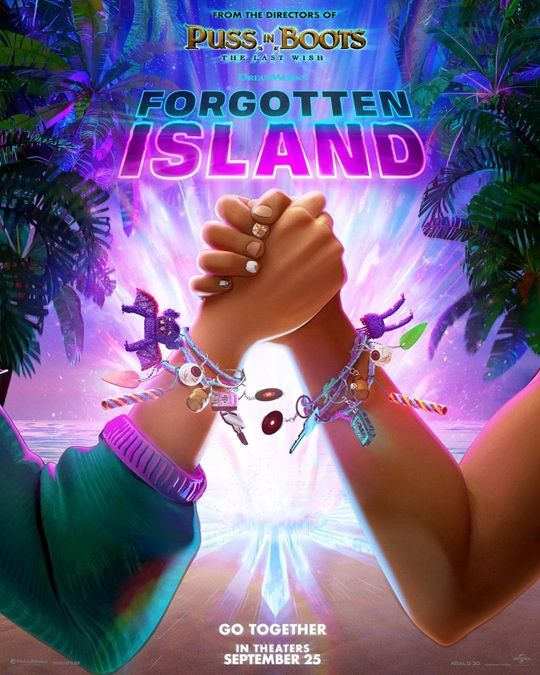
The cold open of the new English film Forgotten Island pushes you into a glittering and vivid imagination of the protagonist Josephine aka Jo (H.E.R.), even as she ably narrates a story about the forgotten island of Nakali to her class. This fleeting event remains a searing metaphor centered around her childhood – the one that features monsters in a mythological world, all wrapped in a powerful memory. It also tells the viewers a thing or two about the psyche of children like Jo, wherein their brain features like a sponge – imbibing on her surroundings with a flair of imagination to create alternate versions of herself in her head. The drama does allow for a context to the timeline with the year being 1990, and derivatives of the imaginary world of Jo stemming from the mythological stories told by her grandma – with all of them being derived from the land of Philippines, a clear cultural influence on her thoughts that would soon run wild.
Written by Joel Crawford and Januel Mercado, the basis of the movie Forgotten Island remains the bond that Jo shares with her friend Raissa (Liza Soberano). In fact, their friendship could be linked to their common love for the stories of Nakali – an immediate metaphor for shared memories during their childhood. But despite possessing similar thoughts, both these protagonists have different character traits – Jo being more attached as a person, and valuing connections over Raissa, who aspires to be a scientist at NASA. In that regard, the latter is driven by a practical mind who would always think rationally – as opposed to the care-free mind of Jo who would allow her imagination to run wild.
Much of Jo’s traits have got to do with her upbringing, of having spent most of her childhood with her grandma – and thriving on the memories of her parents who have now passed away. Hence, the dimension of memories – Jo remains an attached individual, clinging onto people around her despite knowing in heart of hearts that all would leave one day. So, the main seed of conflict for Jo remains the fear of separation (particularly after her grandma’s death) – a trait that comes back to haunt her when Raissa is scheduled to move out of the country for further studies. Hence, the magical element of the drama that follows immediately, wherein both the protagonists enter the ‘Forgotten Island’ of Nakali through a portal – actually marks a metaphor of the transition phase for the characters from childhood to adulthood; a place that would account for and evaporate the last standing memories of growing up! Eternal Sunshine Of The Spotless Mind (2004) says Hii!
There is a hint of The Hangover (2009) in the magical setting that the protagonists find themselves in – waking up with no memories from the past 12 hours, and being physically changed; each with new tattoos and a new pair of wings for Raissa along with half her hair shaved off. The inculcated elements of humour are an instant reminder of the care-free nature of growing up, without having to ponder over looks. And the fact that both the protagonists are bothered, also marks a pivotal reminder on how they are on the cusp of transitioning to adulthood – with the exception of having to hold onto their last standing memories of friendship.
The proceedings also infuse vibrancy in the form of mythical creatures that remain a nod to The Wizard Of Oz, wherein the landscape of the yellow brick road is replaced by a vivid filter of shocking pink that alternate and pursues the fabric of the world here. Some of the creatures include Raww (Dave Franco), an utterly friendly were-dog who can’t control his transformations, and a character who offers to be their guide; Batiba (Jenny Slate), a demon who is known to eat away the memories; Prince Mermahn (Kevin McCann), a narcissistic and alternate objectification on alpha-males with a refreshing demeanor of a mermaid; King Truffle Wuffle (Ronny Chieng), a cutsie king of the land with a sinister presence; Bungi (Manny Jacinto), a giant baby demon known to throw tantrums; and Datu (Jo Koy), who is the leader of the trees. And to cap this world is a ferocious demon named Manang (Lea Salonga) who must be overcome for the protagonists to return home.
It is interesting on how each of the mythical creatures are extensions of the psyche of the protagonists, almost representing their fears and internal struggles – both of which draw parallels to mythology. It is almost like their perception of the mythical creatures in the wake of the crisis faced by each of the two protagonists – a direct reflection of their insecurities. For instance, the character of Batiba is a direct metaphor for the insecurity of Jo who is faced with the challenge of having to hold on to her memories – something that includes her friendship with Raissa. Prince Mermahn is an extension of the concept of looks that would soon feature in the adulthood of the protagonists, even as Bungi, King Truffle Wuffle, and Raww would remain pertinent ‘ingredients’ of childhood being kept alive. And Manang would signify a barrier that would need to be overcome for acceptance to set in.
The searing commentary on offer also remains that of identity for the two protagonists – equating it with the idea of memory that have defined their personalities up until this point. The writing doesn’t wish to necessarily take a stand on keeping the memories alive, instead introducing the idea of acceptance in order to move forward, and invariably also form new memories with new people. But even then, there is a hint of attachment that the writing offers – creating a parallel between identity and the cultural roots of the two protagonists as vital memory pockets for the path ahead.
So subverting through the chaos and laughter ensued on the land with subtle bouts of betrayal and attachment, the emotional core of the narrative is kept alive through the impending memories of the two protagonists – leading to a bittersweet ending that had my heart melt. The screenplay is heartfelt and wonderfully well written, whilst providing a flashback of childhood and the memories tagged through it, with a clever use of Filipino mythology that hits home with all the right emotions in play.
The dialogues have a sense of playfulness tagged to them, often subverting the heavier themes on offer to create a frothy ride. But the lines do contribute towards a strong emotional core, something that forms a thread throughout the narrative. The BGM is chaotic, complimenting the vividly imaginative streaks in the narrative – in turn creating several bouts of humour, and palatable emotions along the way. The animation feels like a cross-breed between a chaotic Studio Ghibli anime, a seamlessly poetic influence of the Spiderverse, and a frothy tone of KPop Demon Hunters. It is vibrant, effervescent and utterly delectable to witness.
The editing pattern is sharp, infusing fast cuts that offer no respite – keeping the proceedings flowing like water. In fact, there is a rhythm to the chaos on offer – wherein the editing style includes match cuts that seamlessly blends variety moods of a scene inside a single frame.
Directors Januel Mercado and Joel Crawford brings a set of vibrancy, while maintaining a strong cultural hold on the proceedings – something that you immensely get to witness through some incredible and flashy world building. I liked how there was an attempt to tap into a conflict that remained real and relevant, even in a world full of monsters and mythical creatures – a rare indication that the emotional core of the drama isn’t compromised. This in many ways felt like a nod to the films from Walt Disney, that were immensely fun and entertaining to witness while tapping into a concept that is laced with humane emotions. The vivid imagination often gives way to some insightful concepts here – backed thoroughly by great direction that just hits home through some commendable characterization. The direction remains excellent here.
The voiceovers by the talented cast add several bouts of synergy to the proceedings. Jo Kay as Datu adds some quick-witted lines that had me smiling. Ronny Chieng as King Truffle Wuffle infuses a layer of sinister cuteness to his personality, while delivering a hilarious act. Manny Jacinto as Bungi and Kevin McCann as Mermahn offer distinctly different personas while ably contributing to the humour quotient of the narrative, each of them shining through their respective sequences. Dolly de Leon as Lola lends a warm and grounding presence in the narrative, and delivering a heartwarming voiceover despite a limited screentime.
Lea Salonga as Manang is intimidating and terrifying while grounding her voiceover in a chilling atmosphere of fear. Jenny Slate as Batibat adds her signature eccentric flair and comedic texture to the mythical tree-dwelling spirit. Dave Franco as Raww infuses the story with a charming vibe as the hapless weredog who guides the protagonists through the mystical island.
Liza Soberano as Raissa offers a contrasting outlook to the chaotic vibrancy of her co-star. She is earnest and sincere, while delivering a grounded voiceover without compromising on the levels of intensity around her. H.E.R. as Jo voices the violently imaginative, fiercely loyal, and somewhat chaotic high school graduate who anchors the emotional heart of the film. Both of them are terrific to witness here.
Forgotten Island is a brilliant, emotionally resonant drama that beautifully captures the bittersweet metamorphosis of childhood through the lens of memory, identity, and the painful art of letting go. Powered by vivid animation and a stellar voice cast, the film masterfully balances a chaotic, imaginative narrative with deeply heartfelt emotions. It weaves complex themes of emotional attachment and personal growth into a visually stunning experience, ultimately delivering a profound, vibrant, and heartfelt watch that lingers long after the credits roll. Available in a theatre near you, and Highly Recommended!


